Interview
Rektal Tuşe: Chaos, Rage and Grindcore Truth Born from Dark Humor
Hey guys, greetings first of all, and thanks for taking the time for us. Without dragging it out, let’s jump straight into full chaos talk.
PitStop: Looking at your recent output, we see that the earlier “humorous and extroverted” approach of your early period has been replaced by a darker, more chaotic and introspective tone. Was this transformation a conscious aesthetic rupture, or a natural reflection of the spirit of the times?
Erkin: Greetings, and thanks to the PitStop family for their interest. We also wish the new platform good luck.
We could say it’s both, actually. When we formed the band in 2009, we were 22–23-year-old young guys. Not an extremely early age, but as you said, both the spirit of the times was more open and cheerful, and we were in a position with few responsibilities, a strong sense of joy for life, and like any young people, we just wanted to have fun. As the years passed, both our approach to the band matured and we “grew up.” So, both.
PitStop: In your music there is both grotesque humor and genuine anger. Which one should the listener take seriously, or is trying to separate them already a mistake in itself?
Erkin: Trying to separate them would be a mistake. Because from the very beginning, even within humorous material, there have always been political references. This has been the case since day one, even from our first demo. The name of the demo—and the track that gives the demo its name—“Gayet Ciddiyiz!” (“We’re Quite Serious!”) is already a clear example; it’s a heavy mid-tempo track placed at the end of a humorous process, carrying a “serious” message. It was a scream against society’s indifference toward stripped rights, the transformation of the media, the hedonism and shamelessness of those siphoning off the people and the country, and all forms of social decay. On the same year’s “Sick Alliance” split, “Kara İncirin Laneti” talked about crude jokes from the ass, while actually referring to what had latched onto us; “Ölücülük Dizboyu” described opportunistic free-loaders while actually meaning greedy politicians; “Havada Bir Top Bulut Olsam” was not just “let’s make an extreme version of a childhood song, it’ll be funny!”—it was pointing at massacres by saying “what a beautiful homeland this is, with Sivas, Çorum and Maraş”; “Yirmidokuz” was there not just to reflect a funny TV sequence, but to criticize patriarchal violence against women. In “a-politik-a” we already started delivering direct messages; it was a kind of transition point. What came after is known.
PitStop: In your newer material (especially recent singles and the upcoming album process), your sound feels denser, more layered and at times even more “European” in character. What has changed in your production and composition approach?
Erkin: The reason for that is that the tracks on the new album are based on improvisation. Almost all of the songs were written during two separate long, improvised rehearsals. Selecting, separating and shaping those recordings into their final form took us years, honestly—it wouldn’t be an exaggeration. The reason for the silence after the pandemic-era mini album “Aklen Muaf” was partly that. The only exception in our DIY production approach is that our latest single “DxKxBxDxDxNxDx” was recorded by us, while mixing and mastering were done abroad. We will follow a similar path on the album.
PitStop: Grindcore is still quite a niche field in Turkey. Do you see Rektal Tuşe today as a product of the local scene, or as a project that now speaks the international grindcore language?
Erkin: First of all, Rektal Tuşe is not a project, it’s a band. And no matter how international a band becomes, it cannot detach itself from its local scene, so we are of course always a product of the Ankara and Turkey scene. In terms of vision and goals, we believe we do speak that international language you mentioned, but it is no secret that this has not yet fully materialized. We are well aware that we are insufficient when it comes to going abroad, and our goals—especially after the album—are to play shows internationally and bring our sound to listeners outside Turkey.
If we open a parenthesis on “grindcore in Turkey,” its golden age was probably the ‘90s. When we formed the band, one of our motivations was “why is there no grindcore in Turkey, let’s do it ourselves,” and in 2026 we sadly still don’t see much of a difference. We believe we have been waving the flag of this genre in Turkey for 17 years without interruption, and we won’t be modest about that.
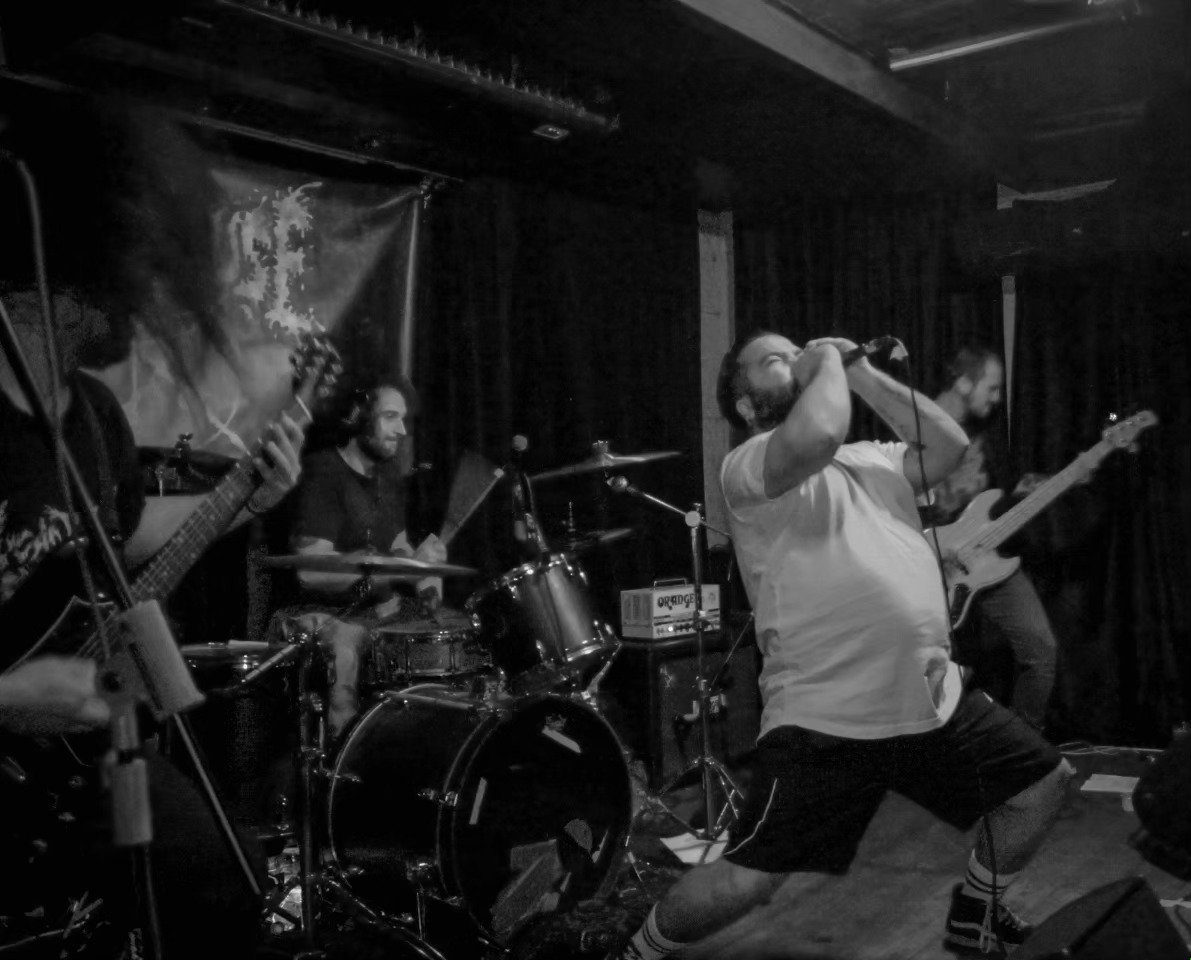
PitStop: Your live performances are known for being highly energetic and chaotic. How has your approach to live shows evolved in recent years?
Erkin: Personally, our moods may change with what the world brings us, but as a band our motto and mindset on stage is to live the moment together with the audience and deliver a constantly high-energy, aggressive show. That has been the case from the very beginning. Nothing has changed in that regard. We also want to thank everyone who never leaves us alone at shows, who goes crazy with us, stirs up the pit, sings along when the mic is handed over, and sometimes even jumps on stage to scream into the microphone. These shows are made with them—the audience is what turns a set into something more than a rehearsal.
PitStop: Lyrics play a major role in your work, with references to daily life, society and politics. In today’s Turkey, does producing music push you toward more direct writing, or is a more metaphorical language the safer option?
Erkin: Let’s say the conclusion first: after 17 years, it is clear that Rektal Tuşe’s music and concept have naturally evolved into a more mature direction in line with both our mindset and the natural flow of life.
But honestly, “today’s Turkey” pushes you toward metaphorical language and moderation. In a society where a handful of social media trolls can get concerts postponed through perception manipulation, where band members can be arrested over concepts and lyrics, where justice and the legal system are turned into tools of political power, where a nepotistic and mafioso system reaches into every capillary, and as a result people gradually become more corrupt and more bigoted—losing intellectual flexibility, empathy, and becoming trapped in dogmas, echo chambers, and an increasingly frustrated and angry mass—yes, in short, it is safer to express yourself indirectly and metaphorically rather than directly. We can say this has had a direct, or at least indirect, effect on our lyrical development. BUT as we said, we already felt that both mentally and musically the band had reached a point where it might not be able to carry an extremely direct and aggressive language.
PitStop: Looking at your discography, the DIY spirit has always been strong. Do you still operate with the same independent reflexes today, or has your production process evolved into a more professional structure?
Erkin: From recordings to physical releases, we have always been as DIY as possible, and we still are. But of course we can’t always handle everything ourselves in terms of time and capacity, so we naturally get help. That could be merch production, studio recording, or other promotional materials…
With the new album, we are also hoping to sign with a label to ease this load and possibly secure a record deal that could help us gain international visibility. If not, DIY will always remain with us. :)
PitStop: Grindcore sits somewhere between punk and extreme metal in its origins. Where do you position your music in this spectrum: more of a punk manifesto, or a radical extension of extreme metal?
Erkin: Calling grindcore a punk manifesto might be a bit too bold. We always define it like this: for us, grindcore is the illegitimate child of extreme metal and punk, feeding equally from both. From extreme metal it takes its noise, speed, explosion, blast beats; from punk it takes its anger, rebellious, libertarian, insurgent attitude—and melts them perfectly into one. That’s why we love grindcore so much.
PitStop: Expectations for your upcoming debut full-length album are quite high. Will this album be a summary of Rektal Tuşe so far, or a completely new chapter?
Erkin: It will open a new chapter—short and clear answer.
The two singles released in 2024 and 2025, “EI8HT26IX” and “DxKxBxDxDxNxDx”, which are independent from the album production, do reflect the general structure of the album tracks, yes—but that’s not all. It will be more layered, more variable, in short more progressive and darker in structure, while still not compromising the signature Rektal Tuşe sound. We are honestly very excited to share the new songs with listeners.
PitStop: When you listen to your own music, can you approach it like an outsider? Or has Rektal Tuşe become an inescapable internal reflex?
E: As the founder and guitarist/vocalist, I can say it’s more of a reflex for me. But I do listen to the output a lot; I like discovering how it sounds in different environments. Even years later, there are periods when I return to the songs frequently. Sometimes there is a comparative reflex with other bands I like or new discoveries, thinking about what we can do better, how we can present things more effectively.
A: The humorous early period before I joined the band feels foreign to me. Since “Aklen Muaf” was my first studio recording, it has become a reflex. The new album songs are not yet a reflex, so I can still approach them like an outsider.
B: For me it has been a transition from one to the other. At first it was a band whose shows made me lose control completely; now I am part of it. Despite being a reflex, it never loses its neck-breaking energy, and I still completely dissolve into the audience while playing.
PitStop: Finally, if you have a message for your listeners, here is your space.
Erkin: Support underground bands that you truly believe make good music, not groups trying to get somewhere through connections and who will disappear after a while. Always give feedback to bands—positive or negative; even criticism is better than no interaction at all, don’t forget that.
Anyone who is not following us and has read this interview until the end should definitely follow us, our tracks are everywhere, listen to them, come to shows if you can, and buy merch. What more can we ask for—take care of yourselves.
And one last message to the youth: the wheel will turn eventually; despite everything negative, don’t give up, hold on to life, but keep your anger alive.
Rektal Tuşe:
rektaltuse.bandcamp.com
instagram.com/rektaltuse
https://www.facebook.com/rektaltuse
youtube.com/@rektaltuse |www.youtube.com/user/rxtxgrind
Email: rxtxgrind@gmail.com | rektaltuse@yahoo.com.tr | rektaltuse@hotmail.com
https://linktr.ee/rektaltuse”