Album Review
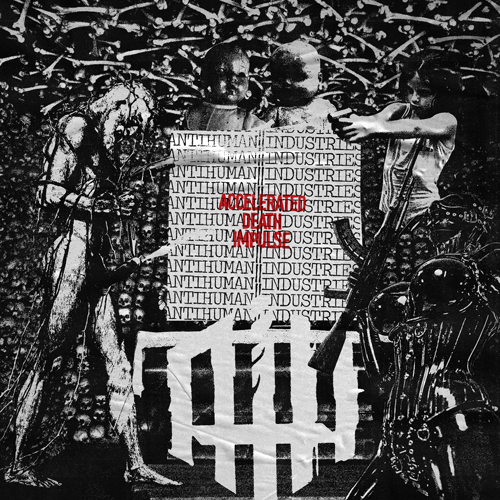
AntiHuman Industries - Accelerated Death Impulse
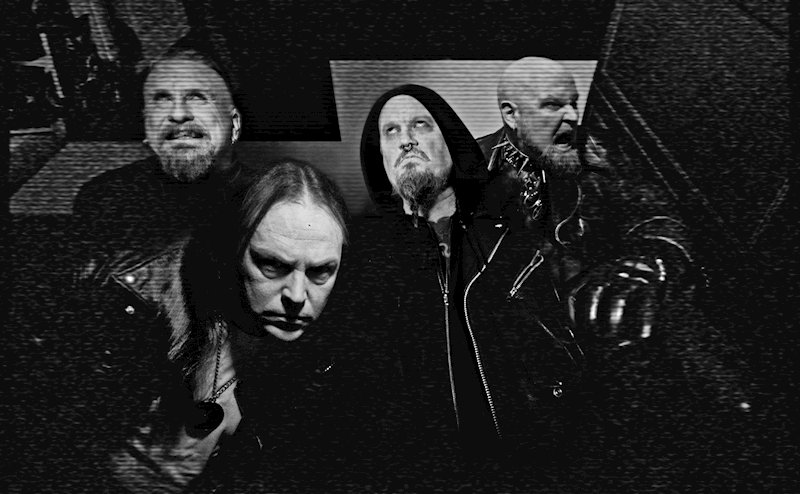
AntiHuman Industries, emerging from Finland’s underground extreme metal scene, operates as a project that brings the cold harmonic core of black metal into the same compositional field as the mechanical rhythmic aesthetics of industrial music, active within the black metal sphere since 2019. Featuring seasoned figures who previously played in formations such as Horna, …and Oceans, and True Black Dawn, the lineup places the band’s approach not merely as a genre exercise but within a continuous line of scene-internal evolution. Accelerated Death Impulse stands as the first full-length expression of this accumulated experience, attempting to reframe black metal’s organic aggression through a mechanised rhythmic discipline.
From the very outset, the album establishes a structure in which guitar riffs revolve within a sharp yet relatively narrow harmonic space, while the drums do not expand this confined area but instead continuously accelerate and compress it. The drumming approach, alternating between blast beats and industrial-style percussive programming, creates less a fixed rhythmic centre than a sense of constant alertness. This choice aligns black metal’s classic repetitive propulsion with the mechanical impact aesthetics of industrial music on the same plane; however, this fusion often operates through tempo and velocity rather than offering true diversification of riff organisation.
On the guitar-writing side, the primary motion language is built on tremolo-heavy, highly compressed cycles that mostly revolve around a single motif. These loops are occasionally reinforced by synth layers rising in the lower register; however, the use of keyboards is largely limited to adding atmospheric density rather than shifting harmonic direction. Particularly in passages reminiscent of 1990s Norwegian black metal, the synthetic touches function less as counter-harmonic expansion and more as a surface layer orbiting the existing riff structure.
The industrial dimension of the album is most clearly expressed in its rhythmic foundation. Programmed-feeling percussion layers and mechanical strikes occasionally generate a hardness that recalls Ministry; however, this reference functions less as a structural rupture within the compositions and more as a density strategy that keeps aggression levels consistently elevated. As a result, the industrial element often reads less as a compositional tool that transforms the structure and more as a constantly active filter applied to the sound.
One of the album’s strengths lies in its refusal to maintain absolute homogeneity across tracks. Some sections retreat almost entirely into raw, unadorned black metal, while others introduce more pronounced electronic interventions and rhythmic deviations. These shifts initially create a sense of variety; however, over longer listening, the issue becomes that these variations rarely alter the underlying riff logic. Even when surface layers change, the core compositional movement largely remains anchored to the same axis of “speed + repetition + intensity”.
The vocal approach is pushed back within the mix and positioned less as a narrative voice than as a form of signal distortion. The fragmented, distorted vocal line functions primarily as a rhythmic accent, especially in faster passages, while avoiding any melodic or dramatic steering. This reinforces the album’s post-human aesthetic, which deliberately suppresses the human factor, yet it simultaneously becomes a choice that limits compositional variability.
One of the most striking structural breaks appears in the closing track “Grief”. Here, the introduction of clean vocals opens a brief zone of release within the otherwise dense mechanical character of the mix. Compared to the album’s prevailing logic of constant acceleration and compression, this intervention proposes a different dynamic. However, rather than integrating into the broader compositional language of the record, it feels more like a late addition — less a transformative element than a delayed contrast effect.
The production generally maintains a deliberate tension between organic and mechanical qualities. Rather than an overly sterile digital surface, the album opts for a compressed but not fully synthetic tone. This choice situates Accelerated Death Impulse within a semi-organic zone of deformation rather than full mechanisation in the industrial black metal spectrum. However, this balance occasionally leads to overlapping layers and a reduction in perceived detail, particularly in the mid-section of the record.
Within the broader scene context, Accelerated Death Impulse positions itself in dialogue with more established industrial black metal reference points such as Mysticum and Thorns, though it approaches this lineage through sustained aggression rather than structural disruption. The experienced Finnish underground lineup — drawing on the industrial black metal backgrounds of figures such as Spellgoth, Corvus, Syphon, and VnoM — provides the album with a solid technical foundation, yet this accumulated expertise does not translate evenly into compositional diversity across all tracks.
Released via W.T.C. Productions, the album aims less to reinvent the “mechanised black metal” strain than to intensify it. However, because this intensification does not consistently expand into structural development, the record gradually shifts toward a linear sense of assault over time.
Ultimately, Accelerated Death Impulse constructs a framework that demands sustained, high-level attention from the listener, yet offers not so much new compositional directions in return as a repetition of its existing mechanical system at varying speeds. As such, rather than expanding the boundaries of industrial black metal, it proposes a compressed architecture of energy within those boundaries — a listening experience that, at points where this architecture tips into uniformity, requires considerable endurance.
OZAN