Album Review
Atronos - Gram
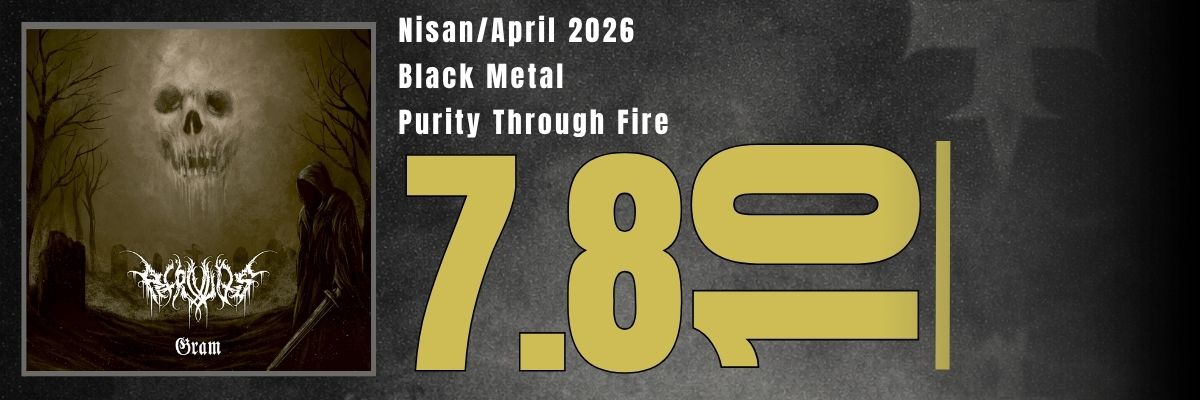
Atronos stands out as a band positioned within the Teutonic black metal tradition, built around a network of musicians whose paths intersect through projects such as Mavorim, Eisenkult, and Ad Mortem. Across their first two albums, the band developed a line that oscillated between melodic density and aggressive rhythmic structure, combining both pagan and classic black metal references within a single framework. “Gram” is positioned as their third full-length, reshaping this accumulated foundation through a more direct, compact, and riff-oriented approach to composition.
With its third full-length album “Gram,” Atronos may appear on the surface as a continuation firmly rooted in the melodic and Teutonic black metal tradition, yet its real impact is built on the tense balance between riff organization, vocal dramaturgy, and production choices. The album’s opening approach is remarkably clear: guitars enter from the very first second with an unrelenting logic of attack, but this is not a random burst of speed; instead, it generates a controlled sense of intensity structured through short motifs, rapidly repeating riff cells, and sharp transitions. In this sense, “Gram” neither fully returns to the extended atmospheric architecture of “Erwachen,” which leans toward epic expansion, nor does it drift into a purely raw black metal direction; it instead opts for a direct, uninterrupted, and compact narrative form.
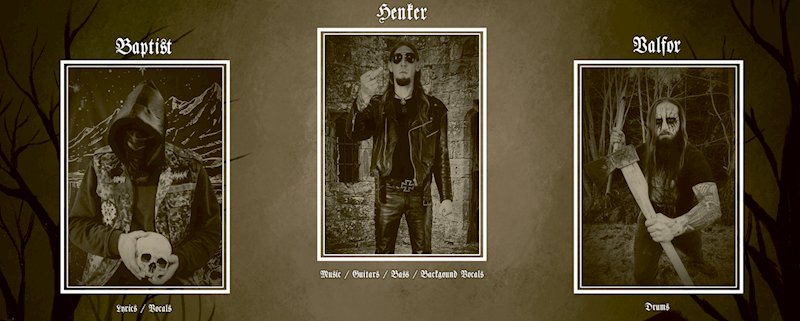
Henker’s guitar writing forms the backbone of the album. The riffs predominantly move through mid-to-high tempo tremolo lines, but the critical aspect here is less variety and more the economy of transitions between structural blocks. Rather than relying on a high number of riffs, the tracks reposition a limited set of core ideas across different rhythmic angles. This is especially evident in tracks such as “Kummertreiben” and “Titanisches Erbe”; the riffs themselves are not technically complex, yet they generate a constant sense of forward propulsion through the drum layer’s continuous micro-tempo shifts and accent placements. This defines the album’s overall character: a structure constantly pushed forward without expanding harmonically.
Within this framework, Valfor’s drumming is not merely a tempo-keeping element but a carrier of the riff architecture itself. The blast beat usage remains rooted in standard black metal references, yet especially in transition sections, ride- and tom-oriented breaks create a rhythmic fluctuation that interrupts the linear flow of the guitar riffs. This reduces the risk of certain passages becoming a single uniform block, while at other moments it leads to a sense of excessive homogeneity within the compositions; in other words, rhythmic variation does not always translate into structural variation.
One of the most defining elements of the album is Baptist’s vocal approach. The vocals are not simply an aggressive black metal layer but carry an almost theatrical narrative position. There is a wide range of expression, from high-pitched screams to deeper, more guttural tones and passages that occasionally take on a semi-declamatory quality. However, the mixing choices do not always foreground this variety; in certain sections, the vocals are pushed back into the guitar wall, reducing lyrical intelligibility and creating an ambiguous result as to whether this is a deliberate atmospheric decision or a structural balance issue. Nevertheless, the vocal layer remains the only explicitly “human” element of the album, while the rest of the structure is largely built on a mechanical aesthetic of attack.
Production is another layer that directly defines the aesthetic identity of “Gram.” A dense, tightly packed mix is employed, with a strong emphasis on low-mid frequencies and minimal spatial gaps. The guitars are sharp but not sterile; a slightly muddy sustain character softens their edges, producing a constant fog-like effect. This prioritizes momentum over clarity, especially in faster passages. The bass largely functions as a unified low-end mass beneath the guitars rather than forming an independent melodic layer, reinforcing overall frequency density.
The melodic dimension of the album is not purely decorative, but it also does not consistently reshape the structural logic. In tracks such as “Mit Hass im Aug’ und Stahl im Blut,” the anthemic character of the opening riffs establishes a recurring backbone that remains intact throughout the composition. Here, melodic ideas function less as transformative elements and more as fixed centers of gravity around which the riff structure stabilizes. Conversely, in the more intense and fast-paced “Titanisches Erbe,” brief interventions such as ambient closing sections serve less to expand the composition and more to create sharp contrasts; they deepen atmosphere only in a fragmentary sense rather than structurally extending the track.
Another notable aspect of the album is its minimal structural progression despite its “melodic black metal” framing. The songs neither approach verse-chorus structures nor develop explicitly progressive architectures. Instead, they rely on linear development driven by riff transformations. This approach makes some tracks immediately memorable (“Kummertreiben,” for instance), while in others it can create the impression that ideas exhaust themselves too early. This is not a matter of compositional weakness, but rather the boundaries of a deliberately “directness-oriented” aesthetic.
The visual and conceptual framework supports this musical direction. Teutonic and folk-oriented black metal references, alongside lyrical and titular imagery centered on war, collapse, and historical violence, establish a coherent context for the music’s fast and uninterrupted attack logic. However, this alignment is not entirely seamless: at certain moments, the transitions between melodic anthemic ideas and raw aggressive sections feel less like a conceptual expansion and more like a stylistic juxtaposition. In other words, there is aesthetic coherence, but not every element enters into a transformative relationship with the others.
Ultimately, “Gram” refines the trajectory established by Atronos’s previous albums without radically redefining it. The album demands a linear listening approach: following the flow of riffs, catching micro-transitions, and reading the internal dynamics of the compositions within a consistently compressed production environment. While structurally consistent on a technical level, this approach does not always open up a broader compositional horizon; instead, it remains a controlled structure that continuously pushes forward but only rarely expands. As such, “Gram” reads as a release that strengthens the band’s position within its scene, but does not fundamentally redraw its aesthetic boundaries.
OZAN