
Album Review
Autumnblaze - Glut
Since the late 1990s, Autumnblaze have carved out a distinct space within Germany’s melancholic dark metal lineage, gradually reshaping their black metal roots into something increasingly more fragile and inward-looking through gothic, dark rock, and atmospheric metal elements. Particularly across their later works, the band has managed to develop a deeply personal expressive language by pushing aggression into the background and constructing emotional weight through simpler songwriting and carefully controlled atmospheres, all without leaning on the genre’s familiar dramatic clichés. “Glut” stands as one of the most refined and self-aware manifestations of that approach — an album that tightens Autumnblaze’s music toward its essence rather than attempting to expand it.
Now fully settled into their second era of exclusively German-language lyrics, Autumnblaze shape “Glut” around the idea of conveying dramatic intensity in a more direct manner. The central shift here is not rooted in riff complexity or harmonic expansion, but in the way the songs breathe. The band pulls the dark rock, gothic metal, and melancholic post-metal language they developed after “Auf zerfetzten Schwingen” toward more accessible structures, yet without falling into the sterile “emotional polishing” so common across many contemporary German dark metal productions. The core identity of “Glut” emerges from the tension between controlled simplicity and fragile intensity.
The album’s songwriting is largely built around mid-tempo frameworks. Rather than constantly generating technical movement, the guitars operate through wide chord voicings, elongated sustains, and harmonic layers concentrated in the low-mid frequencies. This approach becomes especially apparent on tracks like “Licht Aus” and “Polarlichter.” More often than not, the riffs establish unresolved harmonic cycles instead of building toward dramatic peaks, leaving the material suspended in a constant state of limbo. In this regard, the riff construction occasionally recalls Katatonia. Autumnblaze never fully leans into the weight of doom metal here, yet simultaneously rejects the traditional melodrama of gothic metal. What emerges instead is a structure driven by a carefully controlled sense of internal withdrawal.
The function of the drums has also shifted noticeably on this album. Rather than generating aggression, the rhythmic foundation acts more as a stabilizing carrier for the songs’ emotional flow. While kick and snare usage is frequently pushed into the background, ride and crash transitions are used to emphasize atmospheric rises. Combined with the album’s mixing philosophy, this decision results in a record that consciously avoids becoming “explosive.” The overly triggered drum brightness common in modern extreme metal productions is absent here; in its place sits an organic yet carefully controlled sense of depth.
This is precisely where Markus Stock’s mix makes its presence felt. The album sounds warm, clear, and layered, yet that clarity never mutates into sterile sheen. While the guitar tones are given enough room to breathe, the vocals are placed firmly at the center of the mix. That decision makes the role of the German lyrics far more pronounced within the album’s overall structure. Autumnblaze’s continued commitment to writing entirely in German is not merely an aesthetic preference, but a compositional choice that directly shapes vocal rhythm and phrasing. The harder consonants and denser phonetic texture of the language make the melodic movement feel heavier and more physical compared to the band’s English-language era. Even during the quieter passages, the vocals approach the edge of spoken-word delivery without slipping into dramatic theatricality.
The crucial point here is this: “Glut” expresses fragility not through constantly escalating intensity, but through restrained tension. Much of the album’s emotional impact is built through reduction. The songs refuse expansion, keep their climactic moments brief, and continuously delay melodic resolution. For some listeners, this approach may render the album overly controlled, particularly because Autumnblaze deliberately pushes the cinematic crescendos so prevalent in contemporary atmospheric metal into the background. Yet it is precisely this sense of limitation that makes the album’s personal tone feel more convincing.
The inclusion of the alternative mix prepared by Charles Greywolf is more than a collector-oriented detail; it is a significant artistic decision that clarifies the album’s broader aesthetic philosophy. The emphasis on the second version sounding rawer, less processed, and more impulsive suggests that the band does not present the “final” production as some form of absolute reality. In that sense, the approach can also be read as an indirect critique of modern metal production culture. By preserving the songs’ initial instinctive forms, the alternative versions of “Glut” expose the distance between composition and production. If the primary mix represents emotional clarity, the alternative versions reveal the songs’ fragile structural skeleton.
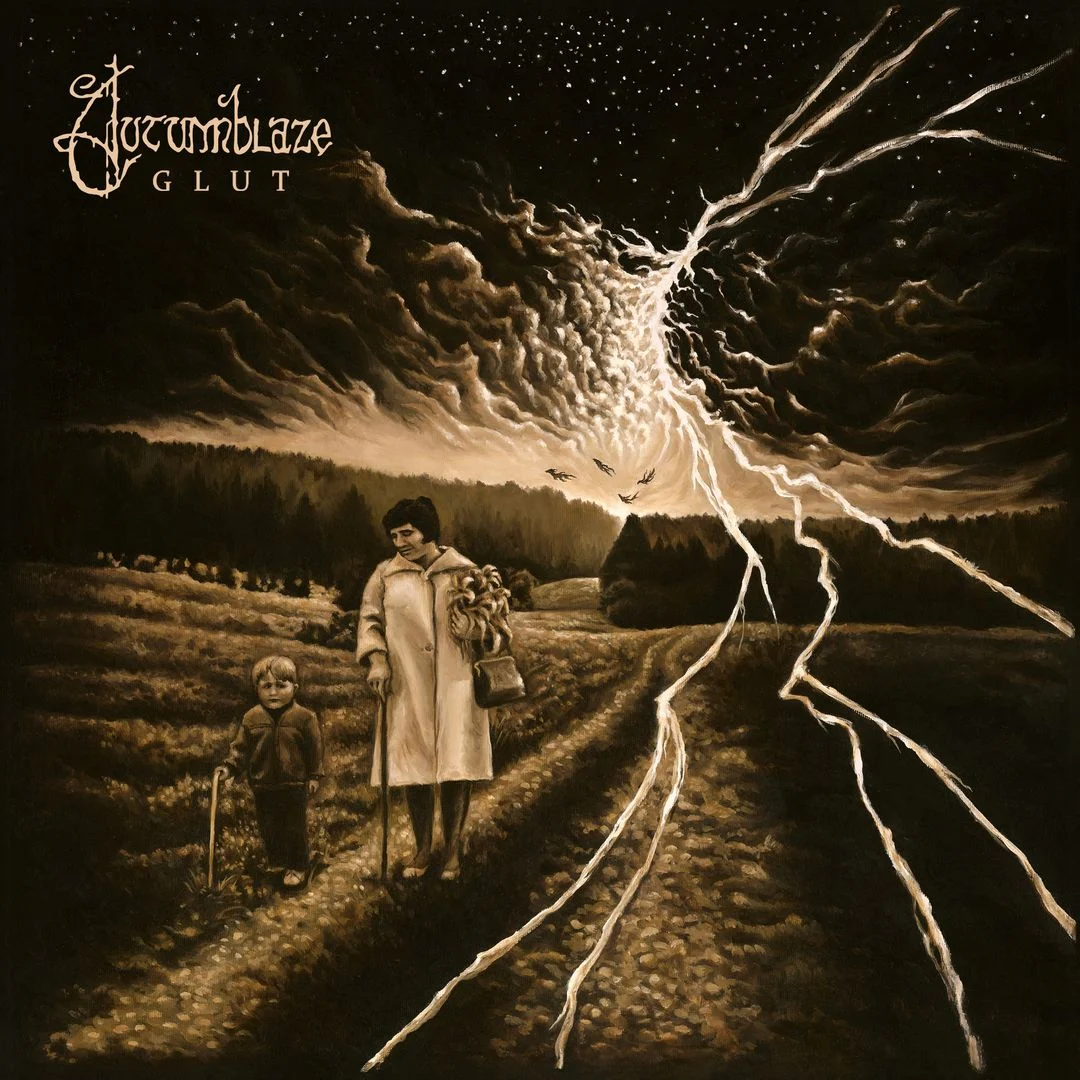
The album artwork functions as a visual extension of that same philosophy. Friederieke Myschik’s oil painting, based on an old family photograph, uses its handcrafted quality not to evoke nostalgic romanticism, but to reinforce the album’s personal and imperfect character. The fact that the visual identity and the music meet within the same restrained space of melancholy is important, because while many contemporary gothic/atmospheric metal albums use their artwork to compensate for dramatic weight the music itself cannot sustain, “Glut” instead mirrors its visual restraint through the controlled intensity of its sound design.
Autumnblaze are not attempting to radically reshape genre boundaries here. What “Glut” accomplishes is something subtler: stripping the band’s long-established melancholic dark metal language of unnecessary ornamentation and pulling it toward a barer, more direct, and more human form. For that reason, the album functions less through immediate impact and more through an internal tension that gradually reveals itself across repeated listens. It demands patience from the listener, because the songs are built not around dramatic detonations, but around continuously deferred resolutions. In contrast to the increasingly dominant “maximum intensity” reflex within contemporary extreme metal, “Glut” positions itself as an album that consciously pulls back, leaves space, and carries fragility without exaggerating it.
OZAN