Album Review
BEWITCHED - Diabolical Death Mass
Founded in Sweden in 1995, BEWITCHED became one of the defining names of the 90s underground black/thrash wave by merging the aggression of black metal with speed/thrash riffing. Their early identity, particularly shaped through “Diabolical Desecration” and “Pentagram Prayer,” was built around a harsh yet memorable approach that fused Bathory’s primitive darkness with classic heavy metal melodicism. The band’s music never leaned toward atmospheric or experimental black metal; instead, it operated through direct, riff-driven aggression loaded with street-level energy. Despite a long period of silence, the band maintained its visibility within the underground through live performances, and with “Diabolical Death Mass” they attempt a return that reaches beyond modern black/thrash nostalgia. The album ultimately opens a discussion around how BEWITCHED balance reproducing their own legacy with giving it renewed weight.
BEWITCHED’s black/thrash approach was never built around complex structures or any ambition to redefine the genre. “Diabolical Death Mass” continues along that exact trajectory; the album’s central driving force is still compact, immediately effective riff writing and relentless rhythmic aggression that constantly pushes forward. What matters here, however, is the band applying this formula not as nostalgic repetition, but with enough controlled confidence to demonstrate why the early black/thrash aesthetic of the 90s still functions today. Within its opening minutes, the album clearly establishes both its production philosophy and compositional logic: high-gain yet not overly sterilized guitar tones, pronounced mid frequencies, constantly moving dual-guitar arrangements, and a drum performance that carries the songs without loosening their grip.
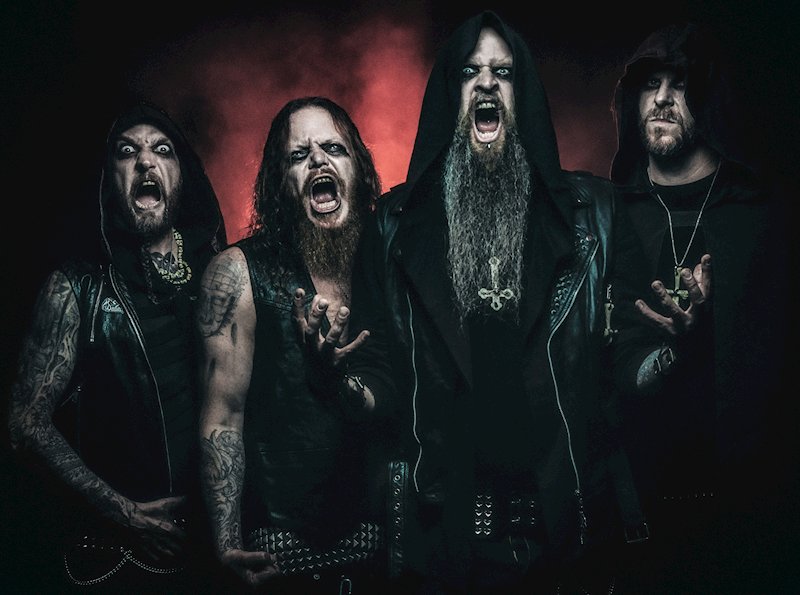
The opening intro functions as a brief atmospheric setup; the real character emerges immediately with the title track itself, “Diabolical Death Mass.” While the riff construction is largely rooted in a classic speed/thrash backbone, the darker tonal choices within the melodic transitions and Vargher’s half-snarl, half-shouted vocal delivery elevate the song beyond ordinary retro-thrash territory. The vocals initially stand out for sounding slightly thinned-out and pushed back within the production. At times, this choice recalls the filthy energy of older recordings, though it also softens the physical weight of certain choruses. Still, considering the band’s fundamental objective, the mixing decision feels deliberate; Bewitched seem intent on avoiding the trap of excessive fullness and artificial heaviness that modern productions often fall into.
The album’s greatest strength lies in the fact that the guitar writing never stops moving. Tracks like “Into The Fire” and “Crossing The Styx” advance through almost uninterrupted blocks of flowing riffs. What stands out here is the band’s ability to merge tremolo-driven black metal momentum with a hook sensibility rooted in classic heavy metal. Marcus E. Norman’s solo sections in particular function as more than technical showcases; they create structural fractures that prevent the songs from collapsing beneath the pressure of monotonous speed. While most of the solos draw heavily from bluesy heavy metal roots, the rhythm guitars never entirely abandon their sharp thrash emphasis, defining the album’s constant movement between old Bathory-style aggression and traditional heavy metal melodicism.
Throughout the album, the drums function less as a source of uncontrolled destruction and more as an engine stabilizing the momentum of the riffs. That distinction matters because “Diabolical Death Mass” operates less like a chaotic black metal record and more like a disciplined black/thrash album. Tempo shifts are used frequently, but these transitions are designed less to create progressive dynamism and more to keep the listener’s attention at a consistently elevated level. On tracks like “By Satan Enslaved,” the brief use of mid-paced sections prevents the album from exhausting itself entirely through speed. Even so, the band never pursues atmospheric expansion or dramatic depth at any point; the entire structure is built around generating direct physical impact.
One of the album’s most interesting aspects is the way it uses nostalgia. Bewitched have no interest in modernizing the old-school black/thrash aesthetic while reproducing it. “(Fear The) Revenge Of The Ripper,” in particular, works as a consciously self-referential piece tied to the band’s own past. In today’s extreme metal environment, this choice could have led to two different outcomes: either a sense of creative exhaustion or a reclamation of the band’s historical identity. Bewitched lean much closer to the latter because the album feels less like imitation and more like a continuation from exactly where they once left off. For that reason, the record avoids producing the museum-piece aesthetic that defines countless modern “retro” black/thrash acts.
At the same time, the album’s limitations are equally apparent. A significant portion of the material revolves around similar tempo structures and comparable harmonic tensions. Bewitched approach this not by concealing the lack of variation, but by sustaining the same attack formula through different riff variations. That approach gives the album cohesion, though it also makes it harder for certain tracks to develop individual identities. The absence of a generational anthem on the level of “Hellcult Attack” or “Hard As Steel, Hot As Hell” partly stems from this. The songs function less as standalone statements and more as components within a collective assault.
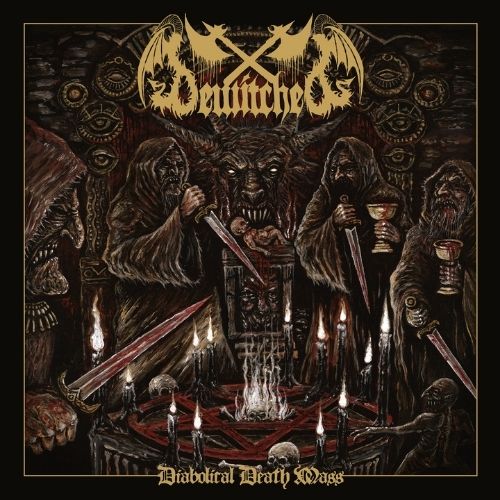
The dirty yet controlled nature of the production also aligns with the visual identity. The cover artwork leans entirely into traditional evil black/thrash iconography and avoids any modernization that would contradict the album’s musical direction. At this point, the visual aesthetic becomes more than decorative; it acts as a complementary element reinforcing the music’s nostalgic yet still aggressive character. Bewitched consciously distance themselves from the atmospheric, avant-garde, or post-industrial tendencies of contemporary extreme metal. The album’s entire aesthetic language functions like a modern echo of the filthy tape-trading culture of the late 80s and early 90s.
For that reason, “Diabolical Death Mass” is not an album concerned with transformation. It does not attempt to expand the genre’s boundaries, introduce experimental layers, or reinterpret black/thrash itself. Yet precisely because of this conservative approach, the album generates a more physical and instinctive energy than many increasingly sterile contemporary extreme metal productions. Bewitched reject modernization without surrendering to nostalgia; instead, they establish a balance capable of transmitting the riff-centered aggression of their original era through the possibilities of modern production with enough force intact.
The album demands neither theoretical analysis nor atmospheric patience from the listener. Its primary expectation is surrendering to riff density and the constant flow of forward-moving energy. In that sense, “Diabolical Death Mass” will resonate less with listeners searching for innovation within today’s black/thrash scene and more with those wanting to remember why the genre’s core mechanics remain effective in the first place. What Bewitched accomplish here is not simply repackaging an old formula, but demonstrating that the formula itself is still more than capable of killing.