Album Review
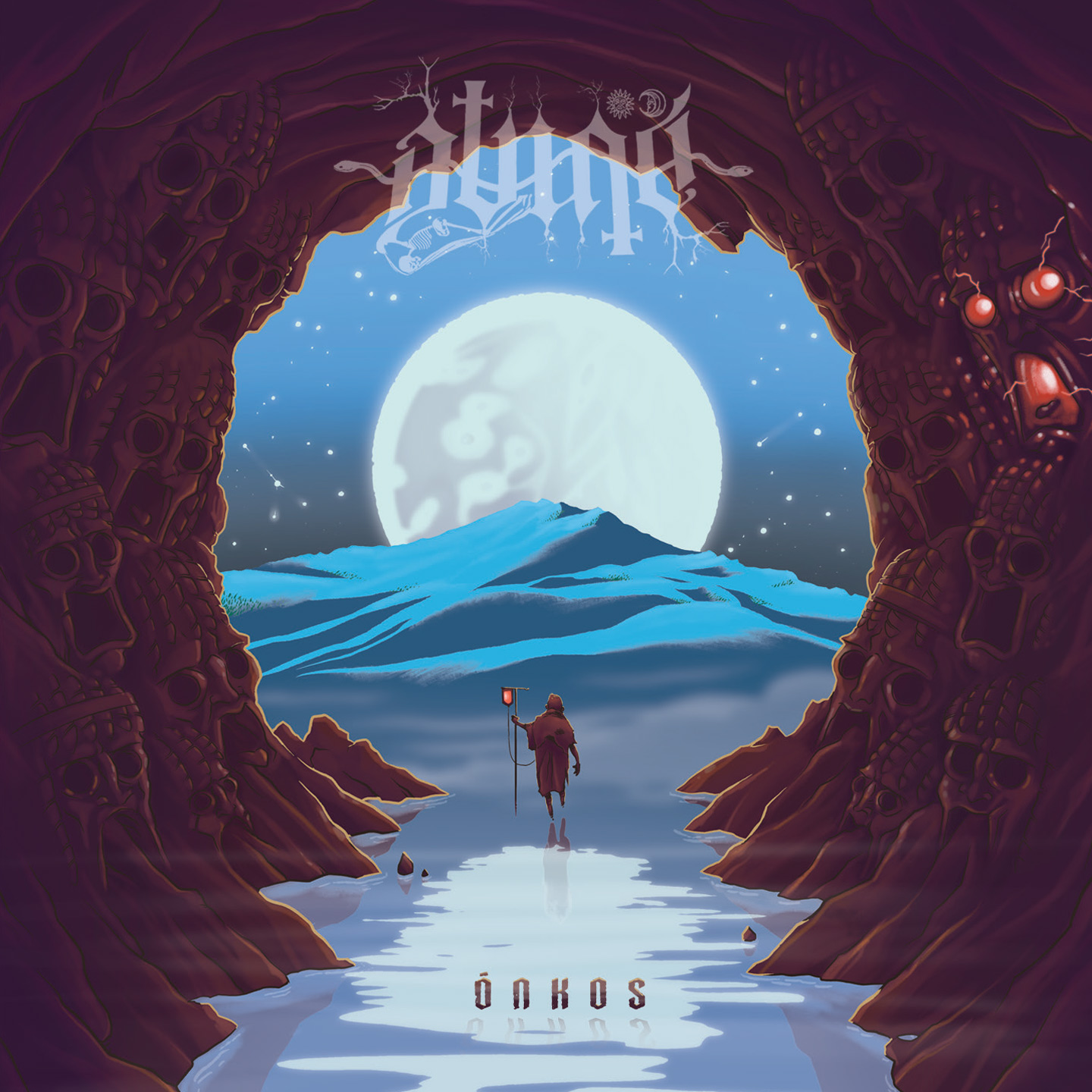
Binah - Ónkos
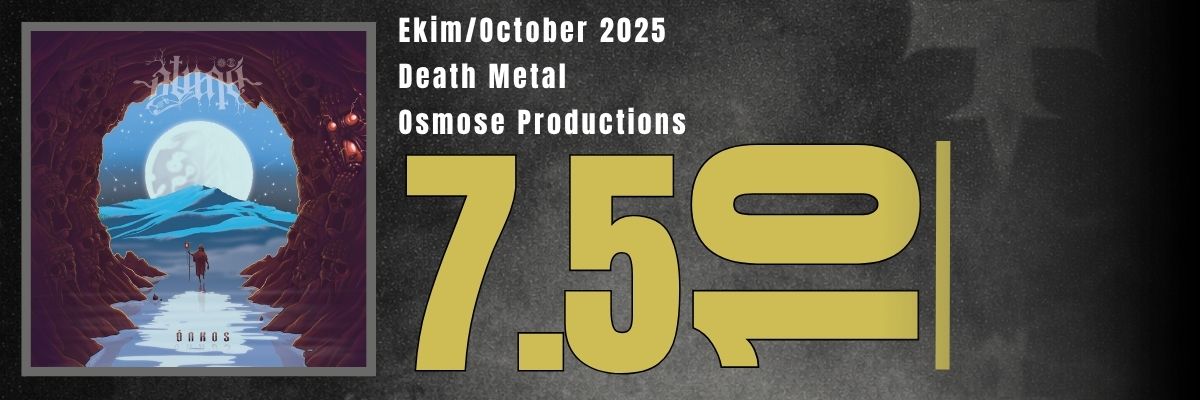
Binah’s “Ónkos” album, at first glance, is built around a compositional concept that deliberately stretches familiar death metal templates: two tracks exceeding twenty minutes each. Rather than functioning as a simple exercise in “long-form” writing, this choice opens up a space where riff-driven death metal composition breaks away from linear song structures. However, this space is not always filled with equal density; the album’s real tension is established precisely here, between the ambition of the form and the continuity of the musical motifs that are meant to sustain it.
The guitar tone carries an excessively saturated, low-end-drenched version of the HM-2 character, yet this dirty texture is not confined to a straightforward Swedish death metal reference. The riffs often establish a cyclical and layered structure, particularly in mid-tempo passages where the same motif is recirculated through different harmonic angles and accents. This approach extends the sense of weight associated with Bolt Thrower-esque dynamics into a doom-oriented expansion; however, doom here does not operate as a classical “slowing down,” but rather through the expansion of temporal perception via riff repetition.
In this sense, ‘Mount Morphine’ presents a more controlled structure. The track creates a threshold-like sensation by delaying the entrance of the riffs through initial synthetic atmospheric layers (a distant, almost non-industrial but amorphous synth surface). This delay enhances the impact of the detuned guitars that follow; when the guitars enter, the listening position is already one of being “drawn in” rather than “set in motion.” The first clearly articulated structural shifts emerge around the mid-section: a drum language that oscillates between blast beats and murky mid-tempo passages prevents the composition from progressing linearly, instead reorganizing it into blocks.
At this point, the role of the drums is critical, as they segment the riffs rather than merely following their transitions. Especially in the mid-tempo sections, ride and tom-driven patterns break the homogeneous wall-like effect of the guitars, dividing the piece into distinct segments. Despite this, some transitions feel less like compositional necessity and more like a reflex to “keep the flow going”; the structure advances, but not every progression produces a new dramatic justification.
‘The Ever Aftermath’ (despite variations in naming across texts for the second long-form piece) establishes a more abrupt entry structure and contains more frequent tempo shifts compared to the first track. Here, there is a clear contrast between short bursts leaning toward thrash and slower, doom-heavy drags. The guitars employ a greater use of leads, and these lead lines are sometimes layered over the main riff as a secondary texture, increasing harmonic density. However, this density is not always directive; in some passages, the leads function more as surface decoration than as a force pushing the composition forward.
The bass line, while often an element that can be buried in productions of this kind, becomes audible in certain sections—particularly in mid-tempo passages—creating a separate layer of motion that supports the guitar wall from beneath. Still, the overall mix approach remains guitar-centric, causing some rhythmic nuances to dissolve into the low-frequency mass.
The album’s atmospheric layers—synth and drone-like textures—constitute one of its most debated elements. At times, these layers genuinely expand the riff structures: especially in transition sections, they fill harmonic space and give the music a ritualistic density. Yet in other moments, they remain more of a backstage texture than a compositional driver; instead of influencing structural decisions, they simply occupy empty space. This, at points, reduces the album’s experimental intent to an aesthetic surface effect rather than reinforcing it.
The vocal approach remains within a classic death metal growl framework and is positioned low in the mix. This choice removes the vocals from the role of narrative carrier and instead integrates them as a rhythmic element embedded within the riff density. However, due to limited intelligibility, the vocal layer functions more as a textural contribution than as a vehicle of compositional meaning.
One of the most evident issues—or deliberate choices—on “Ónkos” is the distance between the sensation of constant forward motion in long-form composition and true dramatic articulation. The tracks flow continuously on a technical level; riff transitions are often seamless. Yet each transition opens not into a new compositional idea, but into a variation of the existing one. This produces formal density in places, but weakens the sense of motivic necessity across the 20-minute structures.
Despite this, the album cannot be described as entirely scattered. Especially the heavy doom passages, when combined with the muddy character of the HM-2 tone, generate a tangible physical weight, and in these moments the album engages with the Swedish death metal legacy not merely as reference, but as a reworked practice of rhythmic deceleration. These sections form the strongest structural backbone of the album.
In a broader sense, “Ónkos” is a work that compresses death metal form into two extended compositions, testing the songwriting reflexes of the genre. However, this test does not always produce new outcomes; in some sections the expanded structure functions as a genuine compositional necessity, while in others it dissolves into a prolonged atmospheric idea. As a result, the album settles into neither a fully experimental rupture nor a conventional continuation of death metal, but rather proposes a structure that is continuously reconstructed between these two poles without ever fully stabilizing.
From the listener’s perspective, “Ónkos” establishes a mode of listening that demands constant attention but does not always reward it with new compositional counterpoints. This places the album within long-form death metal practice as both ambitious and, at times, vulnerable to dissolving under the weight of its own intent.
OZY
https://osmoseproductions-label.com/binah-onkos/