Album Review
Nights Of Malice - Chaos Exordium
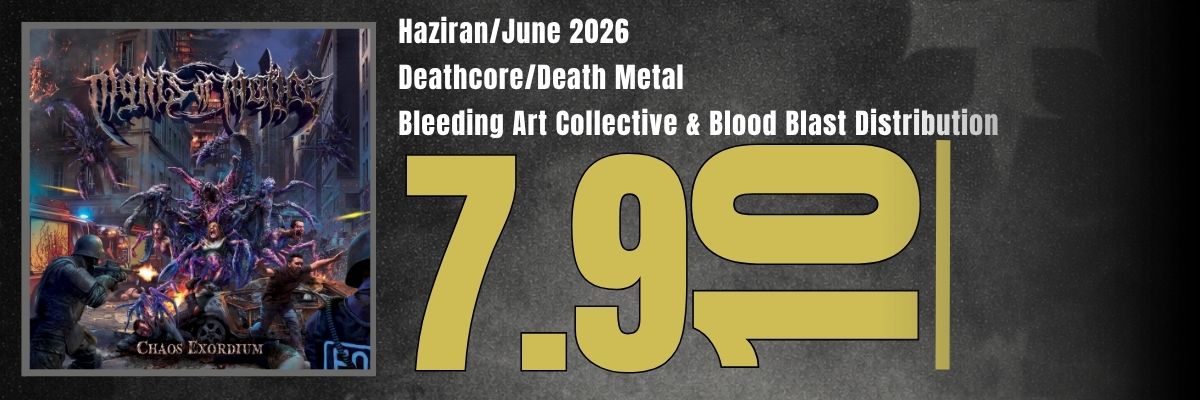
In recent years, the increasing visibility of technical death metal influences within the deathcore scene has led many bands to repackage formulas that have become confined to the “speed + breakdown + production intensity” triangle. Within this context, New Jersey-based Nights of Malice raises the question of whether it remains within that formula or actively reorganizes it with the forthcoming “Chaos Exordium”.
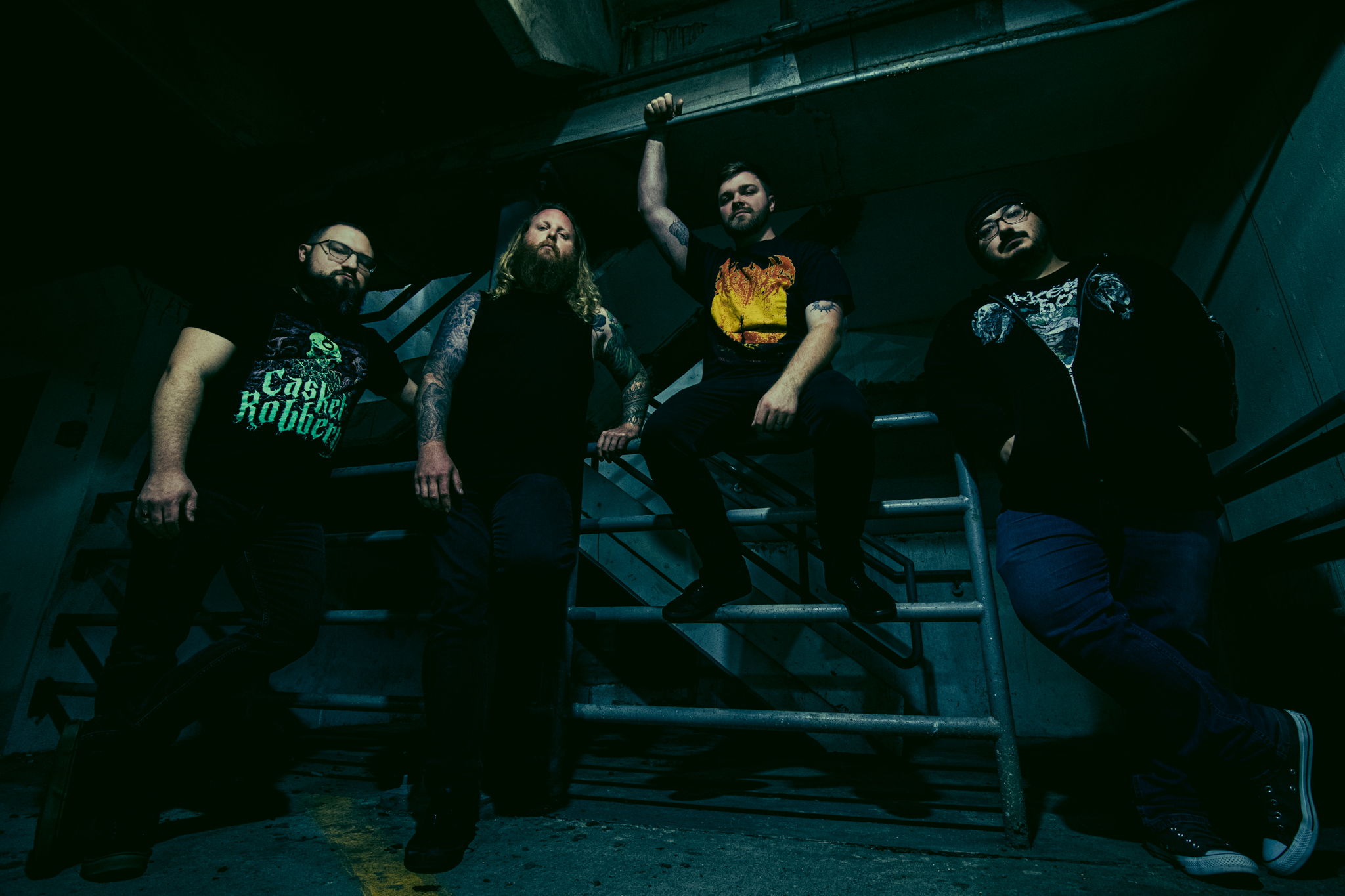
For Nights of Malice, “Chaos Exordium” is primarily a riff-driven album. In contrast to contemporary deathcore’s growing reliance on atmospheric layers, symphonic reinforcement, or artificial dramatic build-ups, the band instead anchors its compositional weight directly in guitar movement. The album’s core logic lies in placing fast, technical death metal–derived riff transitions within a constantly shifting structure built around groove-oriented ruptures. As a result, the tracks do not unfold like linear deathcore templates waiting for breakdowns; instead, new variations are continuously introduced, tempos are reshaped, and the drums function less as passive accompaniment to the guitars and more as a secondary engine defining the aggression of the arrangements.
This approach becomes particularly evident with “Ex-Mortis,” which effectively defines the backbone of the album. While the guitar writing clearly carries modern technical death metal influences, the band avoids slipping into a sterile display of virtuosity. The transitions between tremolo-driven rapid passages and palm-muted, groove-heavy sections create a sense of tension that constantly tightens and releases. What matters here is not simply the complexity of the riffs, but the constant relocation of rhythmic emphasis. This allows the album’s dynamics to be built not only on speed, but on rhythmic instability. Especially in the dual-guitar framework, one guitar maintains the rhythmic backbone while the other disrupts the surface with dissonant excursions and brief lead interventions, making the technical dimension of the record far more functional.
Joe Capasso’s drum performance carries this density not merely through blast beat intensity, but through control of transitions. Throughout the album, fills are frequent but never ornamental; they operate as structural markers indicating shifts in direction. While the mechanical trigger-like feel common in modern deathcore production is still present, the drum mix does not fully dominate the foreground due to the guitar-centric approach of the production. This is precisely the most defining choice of Atrium Audio’s production: keeping the midrange density of the guitars dominant and placing riff writing at the center of the record. At times, this pushes the bass guitar into the background, but given the band’s priorities, it reads less as a deficiency and more as a deliberate hierarchical decision.
Brendan McGrath’s vocal approach also contributes to the album’s constant sense of motion. Instead of relying on a single-layered harsh/scream intensity typical of traditional deathcore, he adopts a faster, more articulated delivery that often competes rhythmically with the guitars. Particularly in short-interval phrasing, the vocals are not merely carriers of aggression but are positioned as an integral part of the riff flow itself. This effectively prevents the album’s technical dimension from becoming a purely instrumental showcase. Guest contributions from Chaney Crabb and Bobby Yagodich do not radically alter the chemistry of the tracks; rather, they function as brief expansions of the vocal texture. In other words, their presence serves more to diversify the album’s intensity than to structurally transform it.
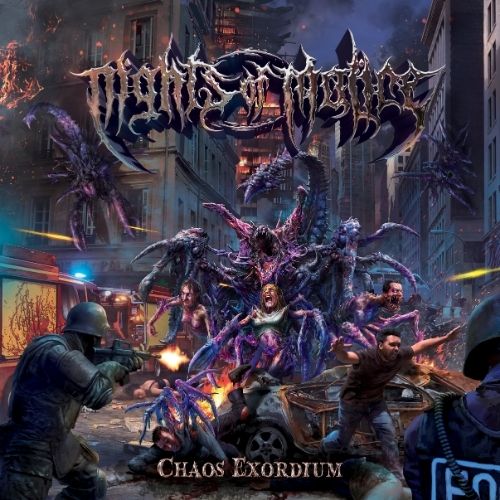
The album’s relationship with horror aesthetics is also notable, as the band does not rely on atmospheric interludes or cinematic effects to construct this dimension, but rather on sheer riff severity. The references to “The Evil Dead” in “Ex-Mortis” similarly avoid nostalgic horror romanticism; instead, they are reinforced through the track’s chaotic tempo structure and abrupt ruptures. In this sense, there is a clear alignment between the album’s visual identity and its musical language. The cover artwork by Andriy Tkalenko similarly opts for dense, aggressive visual chaos rather than the overly digital, sterile aesthetics frequently associated with modern deathcore. This approach mirrors the music itself, as “Chaos Exordium” operates as a record built from continuously overlapping ideas.
At the same time, the album’s greatest strength—its dense riff flow—also begins to define its limits. Due to the band’s constant drive for motion, certain ideas are not given enough space to fully settle. Mid-tempo groove sections, in particular, are often interrupted quickly by new technical transitions, deliberately pushing memorability into the background. However, this same decision is also what distances the band from more traditional, breakdown-centered deathcore frameworks. “Chaos Exordium” functions less as a structure built toward isolated impact moments and more as a compositional system that continuously opens new angles of attack.
Ultimately, the album proposes a riff-focused, technically sharp yet physically grounded approach in response to deathcore’s recent shift toward increasingly cinematic and heavily layered aesthetics. The innovation here does not stem from genre-defying experimentation, but from how the band organizes its technical death metal-rooted riff discipline within modern deathcore density. For this reason, “Chaos Exordium” does not operate as an easily consumable extreme metal record; it defines itself instead as a demanding, constantly shifting album whose intensity is constructed directly through compositional motion.
OZY
https://www.facebook.com/nightsofmalice
https://www.instagram.com/nightsofmalice
https://youtube.com/@nightsofmalicemusic
https://www.bleedingartcollective.com
https://www.instagram.com/bleedingartcollective
https://www.facebook.com/BleedingArtCollective