
Album Review
Coprolith - Putrescence
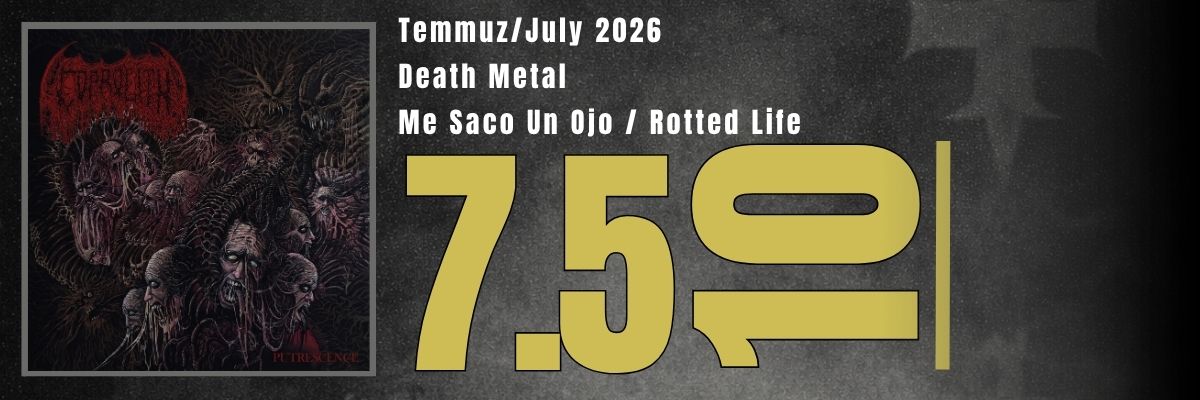
Coprolith position themselves as a Toronto-based act that reconfigures the early ’90s aesthetic of death/doom metal through contemporary production choices. Putrescence is not merely a reproduction of the genre’s canonical references, but a debut album that tests how these reference points can be re-compressed through density and form. From its earliest moments, the record focuses on a single objective via riff architecture, tempo transitions, and production language: a controlled, deliberately shaped classic death metal assault rather than an uncontrolled one.
The album is constructed less as “pure intensity situated within the death/doom tradition” and more as a system that re-compresses the internal mechanics of that tradition. The opening track “Sentenced to the Grave” clearly summarizes this approach: the atmospheric, almost abstract opening drones quickly collapse into a fully physical riff blockade. This transition is not built on the classic “intro → riff explosion” format, but rather on the rapid implosion of any sense of empty space. Guitars move with a low-tuned, mid-heavy density, while the riffs rarely generate clear melodic resolution, instead forming a static pressure field through tremolo patterns and palm-muted repetition.
The drum writing continuously fractures this static guitar mass along two axes: on one side blast beats and driving accelerations that could be described as “Slayer beats,” on the other slow, almost walking sections that lean toward doom-weighted pacing. The key point here is not the creation of a dramatic contrast between speed and weight, but the repetition of the same tonal material across different temporal scales. As a result, the tracks function less as segmented compositions and more as surfaces of shifting intensity built from the same material. The bass, particularly in the slower passages, rises in the mix and becomes more distorted, not simply reinforcing the guitar foundation but pushing the overall mass toward a more decay-like resonance.
The vocal performance remains faithful to the classic cavernous death metal approach; however, what defines it is not technical variety but its placement within the mix. It is pushed deep into the background, reverberated, and positioned to create a constant sense of environmental collapse. This choice turns the vocals from a narrative device into an additional contaminating layer within the guitar and drum mass.
One of the album’s most defining structural traits is its use of tempo changes not as dramatic “transitions,” but as abrupt shifts in density. In tracks such as “Birthed by Remorselessness,” transitions from blast beats to doom-weighted passages are sharp, yet they do not function as ruptures. Instead, they feel like different compression modes of the same tonal world. While this aligns Coprolith with the Incantation lineage, it does not replicate that methodology entirely: the riffs here are less motif-driven and more circular, operating through a logic of decaying repetition rather than thematic development.
The production choices directly reinforce this approach. The natural, non-triggered feel of the drums—especially the dry, impact-focused snare—anchors the music in a physical rather than mechanical form of violence. Guitar tones avoid modern death metal sterility, instead occupying a blurred spectrum where low frequencies are allowed to bleed into one another. This blur does not function as atmosphere-building in a traditional sense; instead, it deliberately obscures riff separation, making atmosphere a structural side effect rather than an intentional layer.
The sparse doom slowdowns, combined with occasional church bell-like details emerging later in the album, raise the question of whether these elements move beyond decorative “ritual atmosphere” or not. In practice, they rarely redirect the compositional trajectory; instead, they operate as surface-level intensifications of an already established density. As a result, the album’s potentially “experimental” dimension lies less in transforming riff logic and more in thickening the existing death/doom framework.
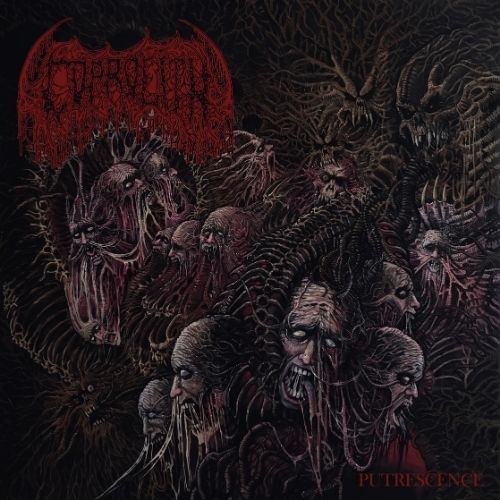
The cover artwork and overall aesthetic language similarly center the idea of decay in a way that aligns tightly with the music. However, this alignment does not introduce additional conceptual layers; it functions more as a strict reproduction of genre visual codes. The relationship between visual identity and sound is direct, but not expanding—more confirmational than generative.
Ultimately, Putrescence stabilizes the triad of riffs, tempo, and production within a consistent intensity regime typical of the death/doom tradition. What defines the listening experience is not dramatic narrative development, but the perception of small shifts within a sustained density field. Rather than pushing the boundaries of the genre, the album occupies a position of refinement—executing established aesthetic codes in their most coherent and physically articulated form, without claiming to redefine them.
OZAN
coprolith.bandcamp.com
mesacounojo.com
mesacounojo.bandcamp.com
facebook.com/mesacounojo