
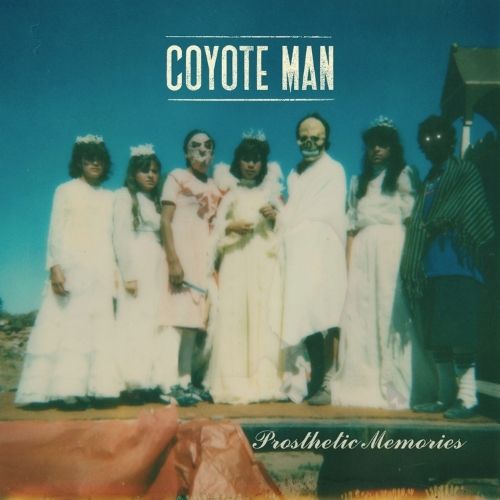
ALBUM REVIEW
COYOTE MAN - Prosthetic Memories
Progressive metal, independent of lyrics.
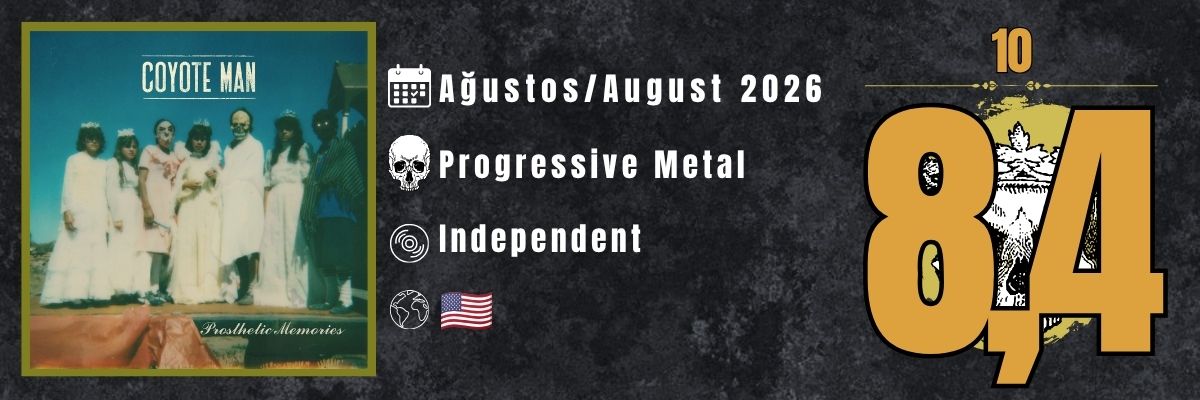
Chicago-based instrumental power trio COYOTE MAN brings riff-driven weight, melodic layers, and cinematic atmospheres together under the same compositional framework on "Prosthetic Memories". Built around a vocal-free approach to storytelling, the band turns its songs into a controlled musical language shaped not merely by technical display, but by rhythmic movement and dynamic contrasts. Released in 2026, the album does less to expand the boundaries of progressive metal than to sharpen COYOTE MAN’s identity by rearranging familiar genre codes through varying degrees of intensity and texture.
The defining element of the album is not the absence of vocals in instrumental metal, but the way guitar, bass, and drums construct a narrative. The Chicago trio uses riffs not simply to generate weight, but as structural tools that continually redirect each song. Rather than presenting its instrumental nature as a limitation, the album therefore establishes its own narrative language through melodic development, rhythmic shifts, and dynamic contrasts.
The opening track, 'Coping Mechanism', is the most direct example of this approach. Augie Portugal’s guitar begins with hard-edged, angular riffs, while Ian Wheeler’s drums and percussion keep the track moving forward instead of confining it to a static groove. When the arrangement transitions into extended melodic sections, the heavy rhythmic foundation does not disappear completely; the guitar melody rises above that density. As a result, the song treats its heavy and melodic passages not as two disconnected personalities, but as different intensities within the same composition. This is where the momentum established in the album’s opening minutes comes from.
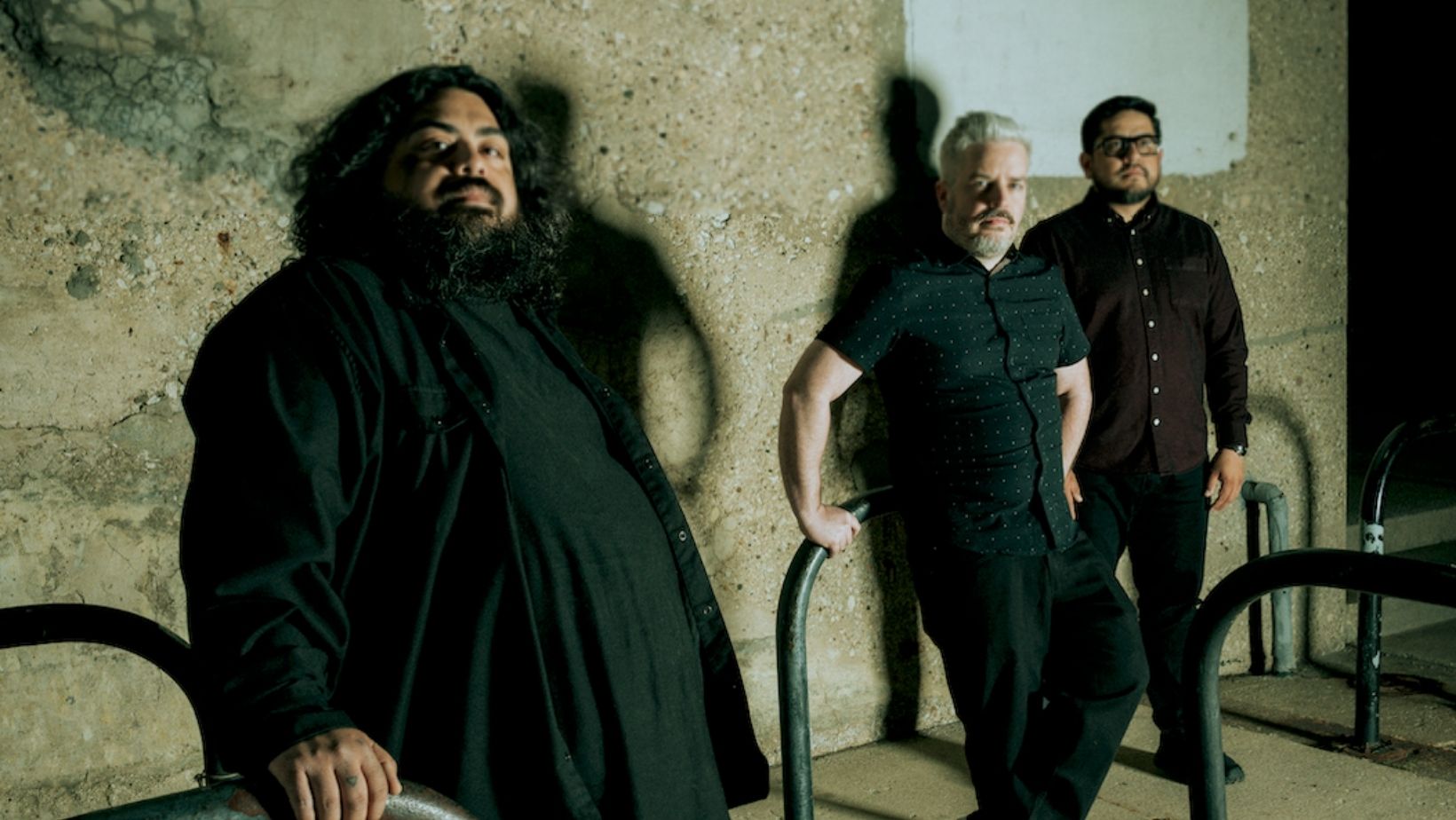
'War Hatchet' reveals another side of the band. The combination of synths and guitars evokes the cinematic and electronic metal aesthetics of the 1980s in certain passages, but the weight of the riffs and the contemporary production keep that reference from becoming a nostalgic exercise. The real strength of the track lies in the transitions between groove-based sections and expansive melodic passages. Rene Rodriguez’s bass is not merely there to fill out the guitars; it acts as a connective element that helps preserve the rhythmic weight. Because the idea of conflict represented by the title cannot be conveyed through lyrics, it is instead translated directly into the dynamic structure of the instrumentation.
'Zealotry', meanwhile, is one of the album’s moments that moves closer to an industrial direction. The industrial touches are not dominant enough to alter the song’s fundamental metal framework, but they sharpen the mechanical character of its riffs. This distinction matters: COYOTE MAN is not attempting a radical transition between genres here; it is inserting a different surface into an existing riff architecture. The experimental element is therefore functional, but it does not become a tool capable of redefining the album’s identity on its own.
The intensity is deliberately pulled back with 'Interpreting Dreams'. The lighter character of its opening passages expands the album’s dynamic range rather than simply repeating the weight of the preceding tracks. The melodic approach here highlights one of the key advantages of COYOTE MAN’s instrumental format: because the melody does not have to be led by a vocalist, the guitar can move directly into the narrative center of the composition. That does not mean the structure is left completely open-ended, however. The clearly defined beginnings and endings of the songs keep the band’s progressive approach under control.
The album’s less effective section is 'Holographic Heirloom'. There is no question about the track’s technical competence; the issue is that the rhythmic and melodic contrasts that were more pronounced in the preceding compositions do not produce an equally strong compositional result here. This becomes particularly apparent after the high intensity of the album’s first three tracks. COYOTE MAN has the ability to make its material more complex, but complexity in itself does not always produce an equally convincing dramatic structure.
'Inadequate' largely closes that gap. Overlapping rhythms, technically demanding guitar passages, and prominent lead sections shift the track’s center of gravity upward again. Here, technical showmanship works because it supports the movement of the riffs rather than taking precedence over the composition. In particular, the way the rhythmic layers work against one another creates a dense arrangement without making the limitations of the trio format apparent. The way Augie Portugal’s melodic and technical guitar work complement each other within the same track makes this one of the album’s strongest compositional moments.
The album’s most debatable decision comes with 'Faith In A Burning Room'. Chris Pacific’s vocals introduce a distinct external narrative element into a seven-track instrumental framework. There is nothing inherently wrong with the idea; however, considering the instrumental language established across the previous six tracks, the arrival of vocals feels less like a natural extension of the album’s architecture and more like a disruption of the existing form. Given that COYOTE MAN is already strong enough at conveying ideas without words, using vocals on the closing track weakens the consistency it has established rather than expanding its identity. The idea is therefore interesting, but the result falls short of the level reached by the band’s instrumental approach elsewhere.
The production is also consistent with these structural choices. The guitars are positioned not merely as high-frequency weapons, but with enough breadth to carry melodic layers and heavy riffs within the same mix. The drums, meanwhile, become a central force in determining the momentum of the songs, particularly during the more intense passages. In this respect, "Prosthetic Memories" occupies a balanced sonic space that does not completely surrender to the excessively sterile production tendencies of contemporary progressive and atmospheric metal, while also avoiding any pursuit of analog nostalgia.
It also makes sense for the band to occupy the same listener space as names as disparate as Russian Circles, Mastodon, and Deftones, but COYOTE MAN does not directly imitate any of these references. There are points where the album approaches Russian Circles’ instrumental narrative logic, Mastodon’s riff-centered weight, or Deftones’ atmospheric contrasts, but its real character emerges from the way these influences are combined within the limitations of a trio format. Here, the “progressive” label is defined less by technical showmanship than by the way the individual structures are connected.
The album’s concept of false or borrowed memories, reflected in the title "Prosthetic Memories", also overlaps with its musical construction to a certain extent. Familiar metal structures are rearranged through electronic textures, melodic expansion, industrial tones, and cinematic transitions. Yet the album’s success does not come from its conceptual explanation, but from the fact that most of these ideas are integrated directly into the compositions. When the synths, atmospheric passages, and technical guitar sections cease to function as separate embellishments, the album’s narrative logic becomes stronger; in its weaker moments, however, these elements do not carry the same structural weight.
For this reason, "Prosthetic Memories" is not an album attempting to compensate for the absence of vocals in instrumental metal. A more accurate description would be a work attempting to build an instrumental compositional language strong enough to make vocals unnecessary. COYOTE MAN is most successful when it continually reframes its heavy riffs through melodic development and rhythmic movement; it is less successful when certain ideas fail to carry the same weight within that overall coherence. Rather than simply showcasing the technical capacity of contemporary progressive metal, the album positions itself as an examination of how intensely that capacity can be transformed into a narrative space within a three-piece configuration.

https://www.facebook.com/coyotemanband
https://www.instagram.com/coyotemanband
https://www.x.com/coyotemanband
https://coyoteman.bandcamp.com/community
https://soundcloud.com/coyotemanband
https://open.spotify.com/artist/1mqc3fdLNurDY2jNIvbeHF
https://www.youtube.com/@coyotemanband