
Album Review
Crimson Day - Dark Dimension
Crimson Day’s “Dark Dimension” positions itself within a line of modern European heavy metal that leans on safe yet well-executed production standards. The common thread across the three texts is that the album is built around a riff-driven, traditional heavy metal framework, layered with melodic and, at times, power metal-adjacent elements. However, despite the stated “variety,” this structure also creates a sense of repetition, with compositions largely circling around similar structural templates.
The opening track, “War Machine,” lays out the album’s core compositional idea with clarity: mid-tempo, marching rhythm guitars built on clearly defined downstroke-heavy riff sets, supported by a straightforward but tight drum performance. Here, Janne Ollikainen’s drumming avoids technical exhibitionism, instead focusing on stabilizing the rhythmic backbone of the guitars. This choice reinforces the track’s “marching” feel while simultaneously narrowing its groove spectrum; the riffs progress not through melodic development, but through rhythmic repetition.
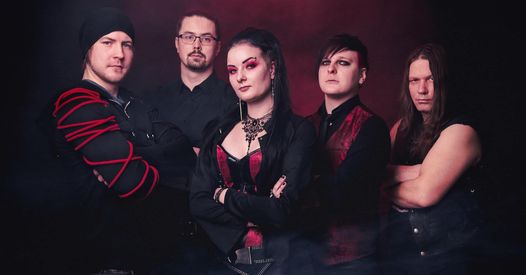
Milka Uusitalo’s vocal performance stands as one of the album’s structural focal points, and arguably its strongest asset. On tracks such as “False Prophet” and “Give Me The Pain,” the vocal line functions as the primary element that disrupts the linear nature of the riffs. In particular, the transitions between metallic, higher-register vocal thrusts and lower, semi-spoken tones expand the guitars’ otherwise fixed harmonic space. At this point, the more restrained use of the semi-spoken passages inevitably comes to mind, as alternative interpretive approaches could have been explored more extensively. Had these sections been used more sparingly, the album could have generated more varied internal dynamic layers in terms of progression. Milka clearly possesses a powerful voice; the heavy metal scene is no longer in its golden 70s and 80s era, and there is a certain creative stagnation in terms of output. From another perspective, the space occupied by female vocalists in this genre is already quite narrow. For this reason, Milka should not hesitate to push her limits further.
“The Outsider” represents the most pronounced stylistic shift on the album. The guitars adopt a looser, bounce-driven groove structure, with riffs moving away from traditional heavy metal march patterns toward more modern alternative metal rhythmic sensibilities. The chorus hook is written in a more openly melodic direction; however, this openness feels partially detached from the rest of the composition, rather than being fully integrated. The central issue here is that the groove and vocal melody do not serve the same structural motivation, leaving the track suspended between two distinct aesthetic zones.
The title track, “Dark Dimension,” stands as one of the most balanced compositions on the album. The guitars operate with wider sustain-based chords and more pronounced lead transitions. The aggressive vocal interventions in the mid-section briefly disrupt the otherwise homogeneous melodic flow, creating a momentary dynamic fracture. However, this disruption does not evolve into a new structural section; instead, it remains a contrast effect embedded within the existing form.
On “Song of Fire,” keyboard layers are introduced. This usage functions more as harmonic filling than as a transformation of the riff architecture. The keyboards create a background texture that supports the neoclassical-leaning lead guitar lines, but they do not provide rhythmic or formal direction. As a result, although the track approaches power metal references, it remains structurally anchored to a traditional heavy metal framework. The short shred passages in the guitars similarly function not as structural reconfigurations, but as surface-level variations.
Tracks such as “Black Wolves’ Night” and “Winter Is Here To Stay” represent the album’s attempts at expanding its speed and structural diversity. “Black Wolves’ Night,” in particular, leans toward speed metal through faster tremolo and palm-muted riff combinations, yet the tighter grid-based drum–guitar synchronization prevents any real rhythmic expansion. “Winter Is Here To Stay,” on the other hand, attempts to construct a broader compositional framework through its multi-part structure; however, transitions are often driven by tempo shifts rather than thematic development. This leaves its claim to an epic form somewhat superficial.
Mid-tempo tracks like “Song of Fire” and “Valleys of Oblivion” most clearly reveal the album’s production aesthetic. The bass guitar, with its thick, reverb-enhanced presence, fills the low-frequency gaps beneath the guitars but does not assume an independent melodic role. This reflects the album’s overall mixing approach: instruments operate within a block structure that serves one another, rather than engaging in individual contrapuntal interplay.
The production is generally clean and aligned with contemporary European metal standards. The guitars are compressed yet kept within a defined midrange, which enhances riff readability but limits natural dynamic range. The drums, meanwhile, largely carry a sample-supported clarity, reducing the sense of live performance and instead creating a mechanically stable foundation.
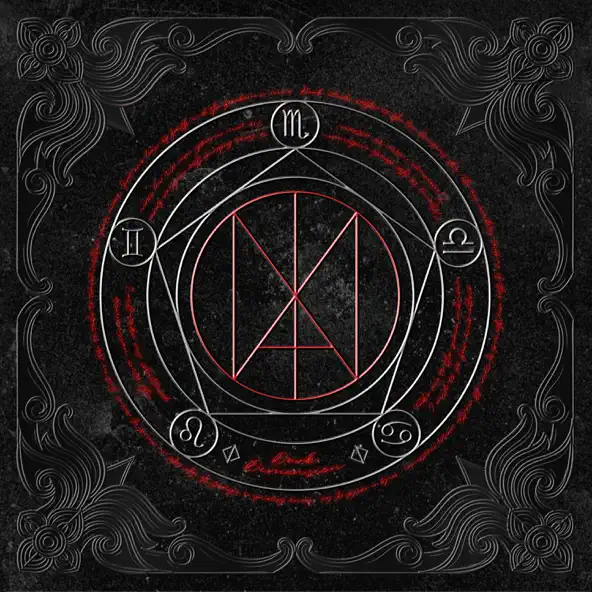
The visual and conceptual layer of the album—centered around ideas such as “dark dimension,” internal conflict, and alternate realities—does not directly translate into the musical structure. While these themes serve an atmospheric function at the lyrical level, they do not play a decisive role in shaping the formal composition. As a result, the concept remains a thematic frame rather than a structural transformation within the music.
“Dark Dimension” ultimately positions itself as a well-executed but risk-averse example of modern melodic heavy metal. While the tracks are technically consistent in terms of riff writing and vocal performance, they largely operate through variations of established compositional templates. What the album asks of the listener is not a reinterpretation of form, but an engagement with different melodic and dynamic versions of an already familiar framework. This places it in a position that is reliable within its scene, yet hesitant to expand its own boundaries.
OZY
https://crimsonday.bandcamp.com/
https://www.facebook.com/crimson.day.band
https://www.crimsonday.com/
https://www.instagram.com/crimsonday_official/
https://x.com/CrimsonDayBand