
Album Review
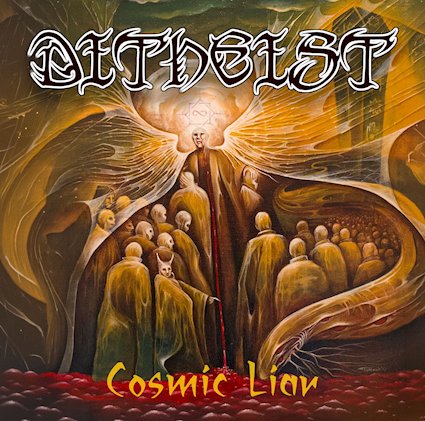
Ditheist - Cosmic Liar
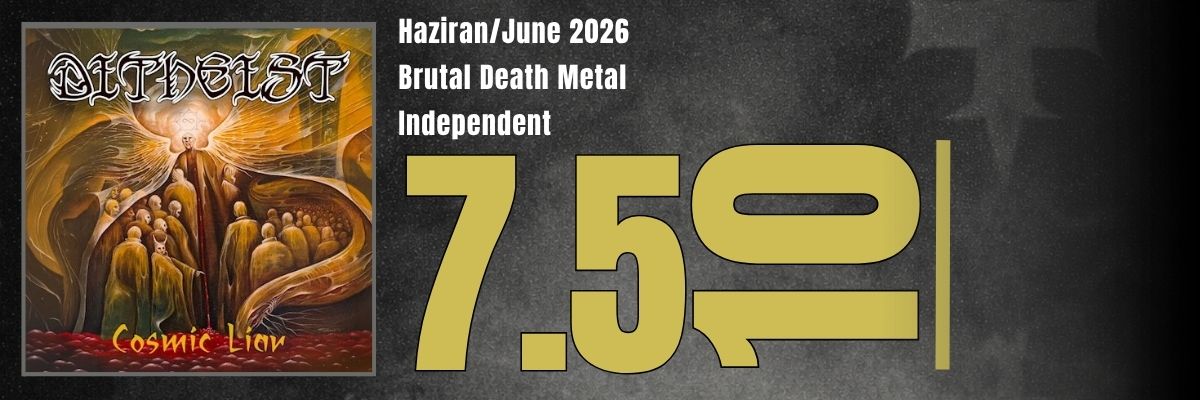
Ditheist’s return after a decade, with Cosmic Liar, can be read as more than the end of a prolonged silence; it also functions as an attempt to realign the Chicago death metal tradition with contemporary standards of production and composition.
From its opening moments, Cosmic Liar leans on a riff-centric aesthetic of aggression; however, this aggression is constructed not solely through speed, but through constantly shifting articulation and rhythmic feel. From the first track onward, the guitars are low-tuned, concentrated in the mid-low frequency range, and driven primarily by palm-muted riff sequences. This framework produces a tonal character that sits close to the more controlled strain of post-Glen Benton-era Deicide, while maintaining a sense of rhythmic discipline associated with Vader and Morbid Angel.
The drum performance is the primary structural backbone of the album. Blast beats are not deployed as a continuous display of velocity, but rather as structural devices that sharpen transitions between sections. In particular, the shifts from double-kick 32nd-note flows into triplet-based breaks prevent the songs from progressing along a linear speed trajectory, instead generating constant micro-directional changes. This approach becomes more pronounced in closing tracks such as “Singularity,” where the half-time sections function not merely as dynamic drops, but as spaces that render the harmonic weight of the riffs more exposed and visible.
The vocal approach is shaped less by the deep-end extremity typical of brutal death metal and more by a mid-frequency growl presence. This choice prevents the vocals from being buried within the guitar wall in the mix, while increasing lyrical intelligibility. At the same time, the vocal line carries a parallel rhythmic emphasis to the riffs, reinforcing the songs’ “command-like” structure; in other words, the vocals function not just as a top layer, but as a secondary percussion line that directs riff rhythm.
One of the most notable aspects of the album is the inclusion of auxiliary instrumentation within a traditional brutal death metal framework. The pan flute-like texture in the introduction of “Nyarlathotep” establishes a brief atmosphere, but this atmosphere quickly dissipates without being integrated into the riff structure. Similarly, acoustic passages and instruments such as the oud and Irish low whistle appear not as compositional center-shifting elements, but as surface-level layers of contrast. The critical distinction here is that these additions do not reorganize the logic of the riffs; rather, they insert decorative ruptures into the standard blast–mid-tempo–blast cycle. As such, while they carry the potential for expansion, they rarely reach a role that transforms the compositional backbone.
On the guitar work side, technical proficiency is clearly present. In particular, the lead passages in tracks such as “Nyarlathotep” and “Mouth of Hell” employ a melodic yet controlled shred language reminiscent of Ralph Santolla’s approach. However, these solos often function as independent blocks placed atop the riff structure; the integration between riff and melody thus unfolds as a segmented arrangement rather than an organic fusion.
The production carries a level of clarity aligned with modern death metal standards. Guitars are compressed yet defined, while bass frequencies occupy the lower spectrum without clashing with the guitars. The drums are mixed with particular clarity centered around the kick drum, preserving rhythmic resolution in fast passages. At the same time, the production is not entirely sterile; the feel of real amplifiers and acoustic drums is preserved, which creates a physical impact rather than a mechanical coldness, especially during blast-heavy sections.
The album’s overall compositional logic oscillates between technical density and “catchy” riff cycles. Riffs are often presented as short motifs, sustained through repetition to generate memorability; however, this memorability is achieved more through cyclical riff economy than through structural diversity. This places the album neither fully within technical death metal nor pure brutal death metal territory, but in a controlled, low-risk transitional zone between the two.
When viewed in relation to the Chicago death metal scene, Cosmic Liar retains its roots in the classic American brutal/death metal tradition while fully embracing contemporary production standards. This positions the album not as a work of reinvention within the scene, but rather as a tightening and refinement of an already established language.
Ultimately, Cosmic Liar offers a disciplined framework in terms of riff organization, drum dynamics, and production clarity, yet its auxiliary instrumentation and atmospheric additions rarely develop into tools that reshape the compositional core. The listening experience demands constant adaptation to shifting tempos and frequent riff changes; however, these changes operate more through micro-level variation than through large-scale structural ruptures. This situates the album within familiar genre codes, operating inside a controlled field of intensity rather than pushing beyond its established boundaries.
OZY