Album Review
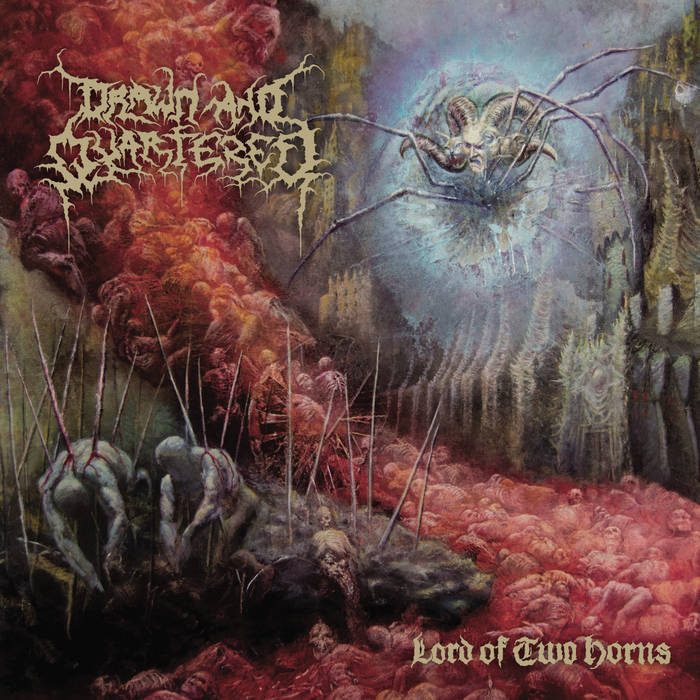
DRAWN AND QUARTERED - LORD OF TWO HORNS
Nuclear Winter Records
Death Metal
08/10
Every death metal album carries its own darkness. Some creep in with a quiet sense of tension, while others hit you head-on with an unstoppable force that seeps straight into your core. Lord of Two Horns by Drawn and Quartered firmly belongs to the latter.
Hailing from Seattle, this cursed quartet still retains its suffocating aura nearly three decades in. But this time, they go beyond delivering just another death metal record—they leave behind something deeper, something carved into the listener’s psyche like a sigil. It echoes with the voices of ancient times, carrying the weight of a curse that feels centuries old.
The album strikes hard with “Black Castle Butcher,” a blow so immediate it barely lets you catch your breath. It feels like standing above a tremor rising from beneath the earth. This opening defines the album’s core identity: not straightforward aggression, but a creeping horror that slowly tightens its grip around your throat before breaking you down from the inside.
Kuciemba’s guitar work is densely layered with technical detail, woven into an almost suffocating intensity. On tracks like “Three Rivers of Poison (Blasphemous Persecution),” that density mutates into a grotesque balance—equal parts intoxication and alienation, leaving you alone with the hollow space that poison carves into your soul.
In many ways, Lord of Two Horns feels like a continuation of Congregation Pestilence, but one that’s harsher, more hostile, and far less forgiving. There are minor rough edges in the production—especially in the drum mix and the bass’s grimy, splintered tone—but they never disrupt the album’s cohesion. If anything, that rawness feeds directly into its cursed atmosphere.
The title track, “Lord of Two Horns,” plays out like a full-blown ritual. Serpentine solos, guitars teetering on the edge of madness, and suffocating vocals that seem to crawl through your body pull the listener into something closer to a death rite than a song. The closing solo doesn’t overstay its welcome—but like a final mark carved into a tombstone, it lingers.
One of the album’s most striking moments comes with “The Devil’s Work Is Never Done.” The doom influence is unmistakable, yet it doesn’t feel like a slowdown—it feels like the darkness the album has been building finally shifting shape. Crawling riffs, echoing gutturals, and mud-heavy bass lines turn the track into a pit—something deep and inescapable. Then “Grimoire of Blood” arrives to seal it shut; whatever’s left inside is no longer getting out.
New guitarist Brandon Corsair also leaves a strong imprint. His presence is especially felt in the harmonic dissonance that shapes much of the album’s warped sonic character. The guitars don’t just cut—they haunt. They scream, and at the same time, they etch old nightmares into your subconscious. The labyrinth built by Kuciemba and Corsair disorients you completely, and that sense of disarray becomes one of the album’s greatest strengths.
At 34 minutes, this death march doesn’t rely on length—it thrives on density. In today’s death metal landscape, hearing something this filthy, this uncompromising, this unapologetically dark still feels almost miraculous. Lord of Two Horns isn’t a nostalgia piece; it’s a record that steps out of the past’s shadow and proves it can still curse the present.
This is not an album that expands or resolves—it festers. It has a darkness entirely its own, one that doesn’t just hit the ears but goes straight for the nervous system.
If you’re wondering whether pure, unfiltered, venomous death metal still exists in a living form, Lord of Two Horns is waiting for you.