

Album Review
Finsterforst - Still
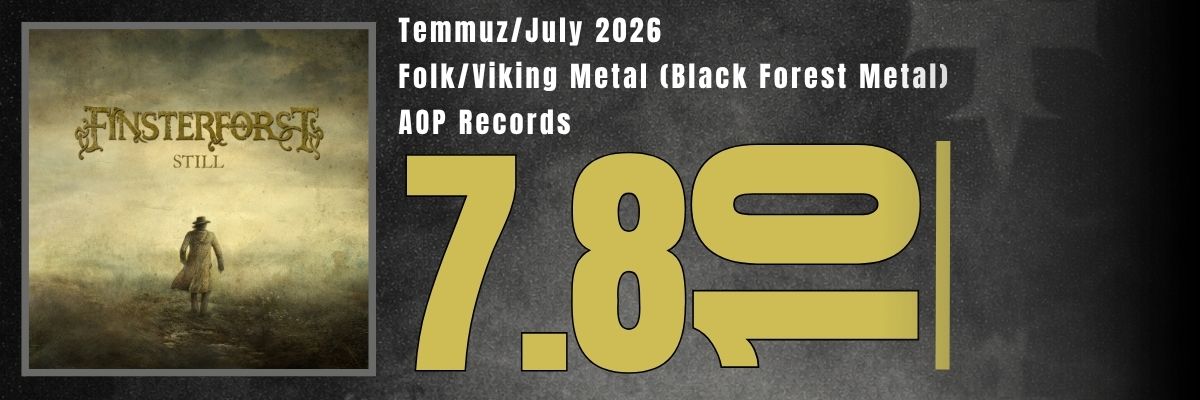
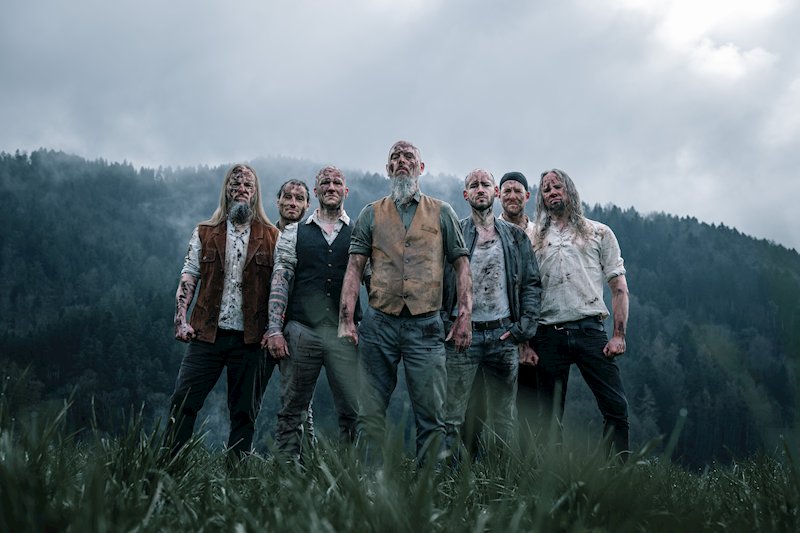
Finsterforst occupies a distinct space under the “Black Forest” banner within Germany’s Folk/Viking metal scene, positioning itself as a long-standing collective that fuses folk-derived melodic frameworks with the expansive scope of epic post-metal inside extreme metal. The band has steadily constructed its own definition of “Black Forest Metal” by continuously stretching black metal’s aggressive core through orchestral density, acoustic folk passages, and large-scale compositional structures. Across more than two decades of output, Finsterforst has developed an approach that places not the dissolution of genre boundaries at its center, but rather the tension between those boundaries as a primary compositional method.
The band’s sixth full-length album Still is positioned as an attempt to reconfigure the epic Black Forest Metal framework they have built over the past decade into a more fragmented yet more controlled compositional trajectory. The decision to distribute its 78-minute runtime across nine tracks may appear as a step back from the single-track, long-form experiments of the Jenseits era, but this retreat should instead be read as a redistribution of structural density. The issue here is not duration itself, but the rate at which riff material is exhausted and subsequently reorganized.
The opening framework clearly leans on guitar writing: tremolo lines rooted in black metal are continuously interrupted and reassembled through folk-derived modulations. These interruptions are not used purely for atmospheric expansion, but to disrupt the linear flow of the riff itself. Early impressions, particularly through “Stille Nacht,” indicate that the band constructs sharp transitions between aggressive blackened layers and expansive acoustic-folk blocks. However, a significant portion of these transitions operates less as genuine harmonic integration between two worlds and more through a logic of contrast: distortion-heavy riff sections and clean guitar/acoustic passages stand side by side, yet rarely transform one another.
Within the rhythmic section, the role of the drums is primarily to stabilize this separation. Blast beats and double-kick passages function as the main structural backbone carrying the guitar wall, especially in denser sections. More notably, however, is the drum writing’s role in transitional softening: as the music shifts from black metal tempos into post-metal slowdowns, fills function not only as rhythmic bridges but also as mechanisms of tonal decompression. This makes the movement from heaviness to atmosphere structurally necessary rather than purely dramatic.
The bass guitar generally operates as a submerged layer within the guitar wall, reinforcing low-frequency harmonic density rather than establishing an independent melodic voice. This approach strengthens the band’s “monumental” sonic identity, but it also at times blurs mid-frequency separation. This blurring creates a slight delay in riff definition, particularly in full-band returns following extended acoustic passages. In another approach, during the breathing spaces of “Herbstwanderung,” where vocals and drums come to the fore, the bass could have moved more independently and stepped slightly further into the foreground. Both the sound design and the structural nature of these passages call for a more pronounced sense of perceptible bass mobility.
The album’s most pronounced area of expansion emerges in its orchestral and keyboard layers. Synth and string-like textures function less as reinforcement for riffs and more as spatial construction around them. However, this orchestration more often remains a secondary thickening layer of the existing structure rather than a factor that actively redirects composition. Orchestral density increases, but harmonic directional transformation remains limited. This reinforces a sense of “epic expansion” without proportionally increasing compositional risk.
The vocal approach is built on a dual-layer structure: aggressive black metal screams constantly alternate with clean, melodic vocal lines. Clean vocals, especially when tied to folk passages, create a narrative contrast; however, because this contrast is rarely supported by rhythmic or riff-based transformation, its impact remains largely timbral. In other words, vocal variation decorates the composition more than it reshapes it.
Folk elements—particularly acoustic guitar and accordion usage—form one of the album’s defining identity layers. The critical point, however, is whether these elements genuinely rewrite the form. Within the current framework, folk passages mostly function as transitional blocks; not as a core that transforms riff logic, but as atmospheric corridors between two extreme metal sections. This suggests that rather than expanding the band’s “Black Forest Metal” definition, the album refines its existing contrast-based aesthetic into a more polished surface.
Extended-form sections such as the 25-minute “Leere” indicate that the structural ambition of the album has not been entirely abandoned. These compositions reaffirm that, within Finsterforst’s compositional thinking, linear song form is ultimately a flexible frame, while the primary organizing principle remains the sequencing logic of riff blocks. Yet the central question persists: does this length generate a new developmental language, or does it simply scale up an existing contrast cycle?
On the production side, the Iguana Studios mix maintains strong low-end presence while introducing a certain haze in the midrange. This choice supports the album’s “monumental” ambition, but it also pushes guitar articulation slightly into the background in certain sections. Especially when dense orchestral and vocal layers enter simultaneously, riff detail tends to dissolve into a unified mass.
The cover artwork and overall aesthetic presentation align with the music’s large-scale, dramatic contrast logic, yet this alignment largely remains on a thematic level. The visual language frames the album’s atmospheric ambition from the outside rather than directly reflecting its structural tensions. As a result, aesthetic cohesion is reinforced, but the musical narrative itself is not pushed further forward.
In conclusion, Still can be read as a recalibration of Finsterforst’s long-standing epic-contrast model within extreme metal. While the album offers notable density and variety in riff writing and orchestration, a large portion of these elements operate as parallel layers rather than mutually transformative forces. The listening experience therefore unfolds not as a continuously escalating dramatic arc, but through controlled cycles of tension and release. This structure may strengthen the album in live or collective listening contexts, but it also establishes a framework that limits the compositional radicality of individual tracks.
OZAN
finsterforst.de
aoprecords.de
facebook.com/aoprecs
artofpropaganda.bandcamp.com