Album Review
Fournier - Fournier
New Zealand-based Fournier position themselves with their debut demo through a form that directly taps into the harsh, riff-driven core of old-school death metal. Shaped between 2023 and 2025, this recording presents a compositional approach that oscillates between brutal intensity and controlled structural maneuvers. While it shares the same reference line as contemporary representatives of the genre, it remains in a transitional state, still unclear in how far it will push this language forward.
Fournier’s first demo carries sufficiently clear references that it could, on the surface, be read as a conventional “old-school death metal revival,” yet structurally it is better framed as a riff-centred exercise in density. Across these four tracks, the guitars function less as atmospheric generators and more as a continuously forward-driving, uninterrupted block logic. The transitions between tremolo passages and downstroke-heavy riffs are shaped through a rhythmic framework that shifts between 6/8 and straight double-time feels, resulting in a persistent lack of any truly stable sense of “grounding” within the compositions.
“Cast Adrift,” the opener, establishes the scene with an introduction carrying ambient noise and a sense of mechanical decay in its first minute, but its defining character is ultimately determined by a riff flow anchored in 6/8. Here, the guitars operate less through harmonic darkness reminiscent of Morbid Angel’s lineage and more through narrow-range, repeating motifs. This repetition transforms the riffs into a mechanical loop rather than a technical showcase. The drums constantly shift position between blast beats and half-time groove, intensifying rather than breaking this loop established by the guitars. The vocal approach, delivered in low guttural form, functions less as a foreground layer in the mix and more as a percussive impact element embedded within the rhythmic structure.
“Constructing the Ark” expands this framework through a more fragmented rhythmic architecture. Here, the use of china and ride cymbals goes beyond ornamental coloration, functioning instead as timing markers that signal riff transitions. The guitars’ occasional hardcore-leaning downstroke weight merges with sharper riff ruptures evoking Immolation-like influence. However, rather than producing continuous shifts in direction, this sharpness manifests as brief surges in intensity before returning to the central riff loop. This enriches the track on a technical level while creating a more closed-circuit sense of composition.
“Supreme Ornaments” contains the EP’s most distinct structural deviation. The slow, almost void-like guitar texture in its opening establishes a doom-leaning weight. However, this atmospheric space never evolves into a reconfiguration of the riff logic, instead remaining a preparatory layer. When the track accelerates, the resulting tremolo movement and irregular blast structures fail to translate the initial tension into compositional transformation; they function more as contrastive effect. Still, the second half’s rhythmic disintegration suggests Fournier are at least open to experimenting with segmented structures rather than purely linear aggression.
The closer, “An Angel With a Bullet,” revisits the intensity model of the previous tracks in a more compact form. Here, a hybrid language emerges between NYDM-influenced heavy downstroke rigidity and early Slayer references. However, the overall architecture of the track does not open new directions thematically, instead compressing variations of earlier material into a condensed structure. The noise-based ending mirrors the introductory atmosphere, yet this framing operates more as a structural signature than a compositional idea.
On the production side, the recording delivers a relatively balanced mix despite its demo status. The low-end density of the guitars combined with kick drums focused on body rather than click creates a physical weight consistent with brutal death metal tradition. The snare’s metallic but present character enhances rhythmic clarity, particularly during faster transitions. However, this production approach at times turns the guitar layers into a homogeneous block, reducing micro-dynamic separation and emphasizing mass impact over detailed articulation.
Vocals are deliberately not pushed fully to the front of the mix. This choice integrates them as part of rhythmic violence rather than a narrative vehicle. While this disrupts the traditional “front-loaded vocal dominance” of death metal, it also introduces moments where compositional direction becomes less defined.
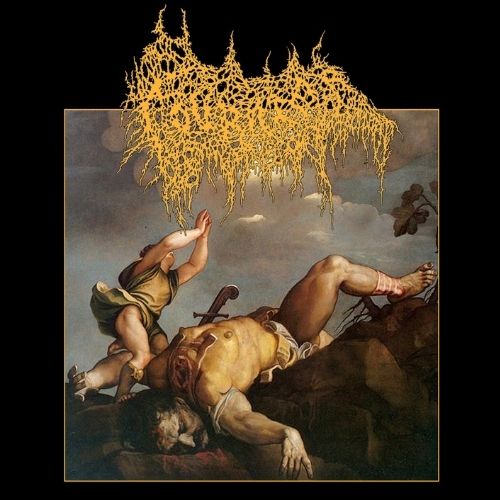
Visually, the illegible logo and deliberately “disordered” design language establish an aesthetic that runs parallel to the music. However, this parallel remains largely superficial: the rhythmic and riff-based tightness of the music does not fully translate into a cohesive visual concept aligned with the chaotic illegibility of the artwork. It functions more as a genre-faithful marker of “death metal seriousness” than as an integrated artistic statement.
With this first release, Fournier carve out a riff aesthetic close to the modern brutal/death metal axis associated with bands like Hyperdontia and Phrenelith, though these references have not yet been pushed into a level of compositional risk-taking. While the tracks demonstrate strong riff-writing capability, there is still no fully developed compositional framework that forces this material into broader structural transformation. For the listener, this EP offers a space of continuously reproduced linear aggression, though the boundaries of that space remain clearly defined for now.
OZAN