
Album Review
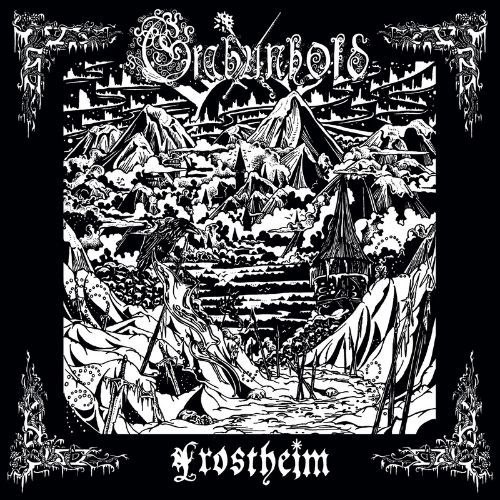
Grabunhold - Frostheim
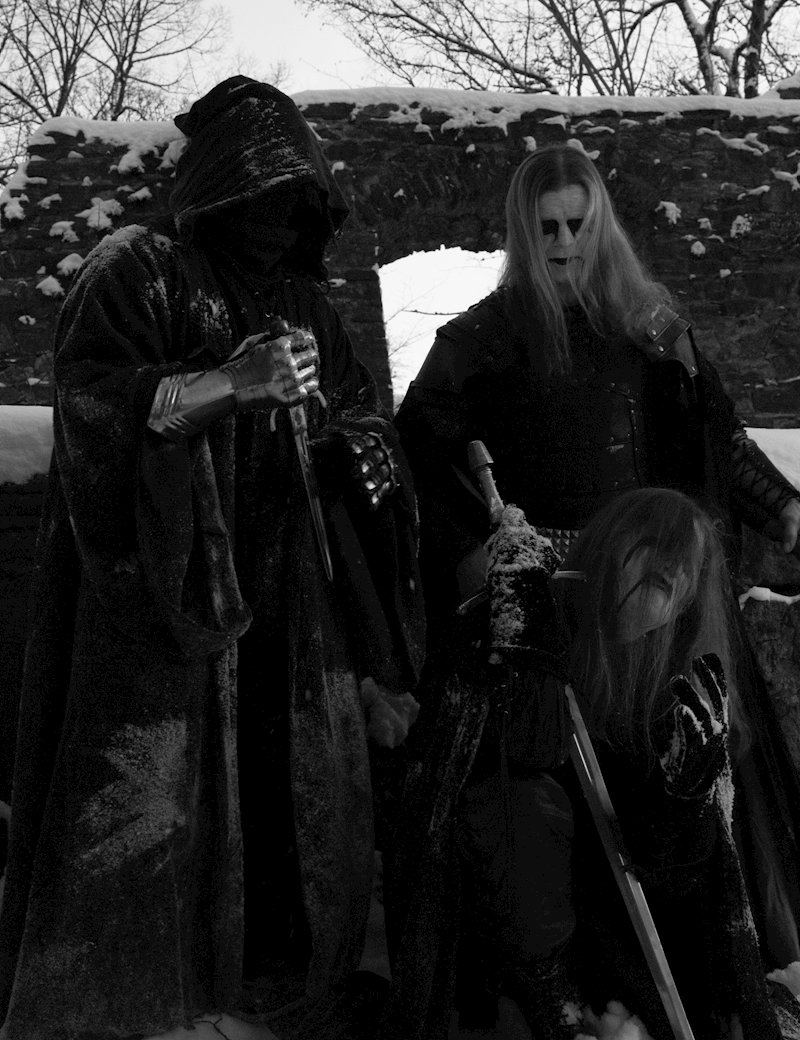
Germany’s Grabunhold continue to pursue an approach that merges the classic codes of second wave black metal with a medieval aesthetic and a pagan thematic framework. Since their debut in 2019, they have built a discography shaped by riff-driven songwriting and an “old world” atmosphere. “Frostheim” stands out as the band’s second full-length, revisiting this trajectory with more controlled production and expanded dynamics.
The album constructs its riff architecture around a continuous “deferral of tension.” Tremolo lines often progress like rising, nearly completed melodic sentences; however, the expected half-time breaks or moments of dramatic release are systematically delayed. This choice is not merely a compositional device, but also a structural principle defining the album’s rhythmic engine: the blast beat flow advances not by acceleration but by upward propulsion, and when the moment of resolution finally arrives, this delay creates a genuine sense of “exhalation” in the listener’s perception.
The guitar writing remains firmly rooted in the second wave black metal tradition. Thin, high-frequency tremolo lines generate direction rather than harmonic fullness; the riffs behave more like unfinished sentences. A key rupture point emerges through production choices: the pulling back of mid frequencies and the noticeable suppression of the bass guitar reduce the guitars to a kind of “surface texture.” This leaves the space beneath the drum kit relatively unfilled. While kick and snare remain in focus, the heavy burial of cymbal layers within the mix strips rhythmic continuity of the genre’s traditional bright upper spectrum. As a result, the drums function less as an encompassing field and more as a direct, mechanical driving force.
At this point, the album’s most controversial aesthetic decision becomes apparent: the combination of low body, recessed cymbals, and sharply cutting guitars deliberately rejects orchestral or harmonic density. The guitars, which generate speed but not mass, become especially exposed in passages where medieval instrumentation (woodwind and string textures) enters the arrangement. The natural resonance of these acoustic or semi-acoustic layers creates a contrast with the “emptied-out” tonal profile of the electric guitars; however, this contrast does not always expand the composition, sometimes remaining limited to a transition between two separate sonic surfaces. In other words, these additions function more often as atmospheric layers rather than elements that restructure the compositional framework.
The drumming tends less toward breaking traditional blast patterns and more toward sustaining them. Notably, fills and transitional variations serve momentum preservation rather than dramatic punctuation. This approach becomes particularly evident in the mid-sections, where “reconstruction” moments emerge. A long interlude—featuring war drums, wind effects, and choral layers—constructs a spatial scene rather than a standard ambient transition. Such passages do not operate as narrative ruptures but rather as deliberate reset mechanisms within the rhythmic cycle.
The vocal performance maintains the classic high-pitched black metal delivery. However, due to its placement in the mix, the voice rarely sits in front of the guitar wall, instead functioning as a “vector of harshness” embedded within it. As reverb expands toward the final sections, the vocals shift from character-driven expression to a carrier of spatial density.
In the album’s longer-form pieces, particularly the closing composition, riff cycles proceed with minimal variation while micro-level increases in drum intensity become apparent. The eventual emergence of more pronounced cymbals operates as the delayed spectral completion that has been withheld throughout the record. This becomes the clearest realization of the structural idea of “deferred resolution.”
The aesthetic position of “Frostheim” is less about reproducing the historical templates of second wave black metal and more about reorganizing them within a compressed production logic. Pagan/epic references, Tolkien-derived thematic framing, and the “old world” imagery do not function as narrative content in themselves, but rather as an external framework supporting the directional logic of the riffs. However, this framework tends to anchor the music to a fixed iconography rather than expanding its structure; especially in the acoustic and dungeon synth passages, the melodic material at times remains a decorative layer rather than being integrated into the core riff architecture.
On the whole, the album represents an approach within contemporary black metal that favors controlled space over excessive density. Yet this control does not always translate into dynamic variety; in certain sections, the tension between riff cycles and the rhythmic engine settles into a stable repetition rather than a sustainable developmental arc.
Listening to “Frostheim” requires engaging less with a linear flow and more with mechanisms of delay, accumulation, and postponed resolution. The album does not entirely break the classic rise-and-fall dramaturgy of black metal, but continuously suspends and re-times it. This positions the record neither as a radical deviation nor a pure reiteration, but rather as a variation built on temporal engineering within an existing syntactic framework.
OZAN
facebook.com/grabunhold
ironbonehead.de
ironboneheadproductions.bandcamp.com
facebook.com/ironboneheadproductions