Album Review
HEAVEN SHALL BURN - HEIMAT
Century Media Records
Melodic Death Metal/Metalcore
09/10
Heaven Shall Burn’s tenth studio album Heimat greets the listener with a truly devastating opening. The orchestral transitions constructed between “Ad Arma” and “Inter Arma” resonate like the harbingers of an inner conflict. These two atmospheric pieces establish the album’s thematic framework: confronting a war waged both from within and without, opening the gates to a layered narrative that invites reflection, emotion, and resistance.
The album challenges the notion of “heimat” (home, homeland), often perceived as a so-called “safe harbor.” On the contrary, it offers an antidote to the way this concept has been tainted in the hands of fascism. “My Revocation of Compliance,” for instance, stands as a rebellion manifesto adorned with crushing riffs: “Your silence is consent,” Bischoff declares, against the blind darkness nourished by silence. “Confounder,” on the other hand, acts as its companion—calling for reckoning and redefinition: a stubborn resistance rises here against passive complacency.
The refined orchestration and rallying choirs don’t just elevate tracks like “War Is the Father of All”; they shape and empower the entire album like a cinematic construct. This epic vein feels less like a nod to the classic metal golden age and more akin to something organic—like the recordings at Bolshoi or Pilgerkirche—imbued with a sense of laying its soul bare. As Weichert aptly puts it: in these lands, words are a battlefield—and so is music.
One of Heimat’s undeniable peaks is “Dora.” It lands like a Bolt Thrower–influenced sledgehammer, making the reality of war felt with visceral pain. Meanwhile, “Ten Days in May” and “A Whisper From Above” sweep the listener away with heavy yet hopeful melodic lines. And of course, “Numbered Days” is reborn here—a Killswitch Engage classic revived with the guest appearance of Jesse Leach. While some may argue it doesn’t carry the same electric charge, this collaboration, in my view, amplifies the album’s global resonance.
Instrumentally, the album masterfully blends technical prowess with emotional intensity. The guitars navigate fluidly between melodic structures and brutal riffing, while the drums drive forward with a force that keeps the listener constantly engaged. The bass guitar provides both a rhythmic backbone and a layer of dramatic depth, reinforcing the album’s dark tonality. Orchestral layers and electronic touches further enhance the thematic cohesion. All instruments align seamlessly within a careful production that balances fury and melancholy.
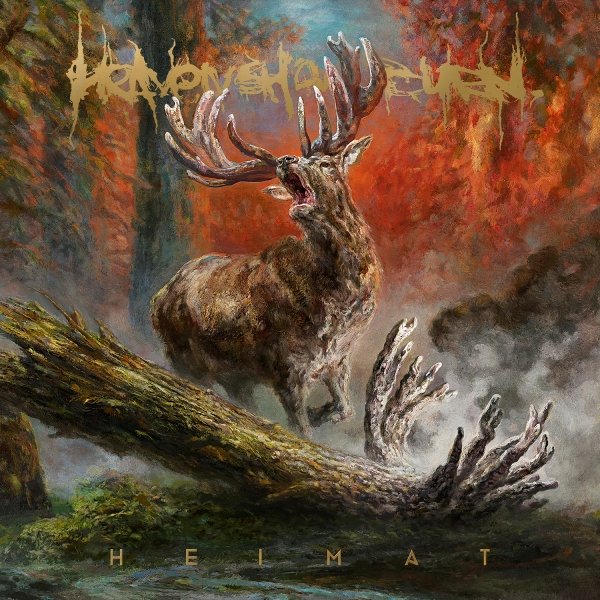
The production, bearing Tue Madsen’s signature, is tightly honed: clear, sharp, yet retaining a natural grit. The imagery on the album cover—a deer, a bear, an owl—presents an unsettling pastoral narrative, a striking metaphor that transforms kitsch into an act of defiance. Heimat is not merely heard; it is felt—it provokes, it questions.
This time, Heaven Shall Burn come across more introspective, more political, and at the same time like a home from our childhood that has never quite let go of us; it accuses, provokes, and embraces us. So what will our next step be? Perhaps the answer lies in a reimagined idea of “home” we build together—in a shared consciousness and a memory that refuses to shy away from confrontation.