Album Review
Hexenaltar - Descending Curse
Hexenaltar’s “Descending Curse”, at first glance, appears to proceed through a fairly familiar iteration of the blackened thrash formula, yet through its structural decisions and production approach it deliberately positions itself as a work that avoids giving a definitive answer to the question of how far this space can actually be pushed. The album’s core impulse is built around riffs engineered to create a constant forward-driving momentum: short-form, speed-focused thrash riffs are frequently layered with the sharper tremolo runs of black metal, often occupying the same surface. Rather than generating a genuine transformation between these two languages, however, the record opts for a continuous velocity state in which each element feeds the other without interruption.
The guitar writing operates on a largely consistent logic across nearly all tracks. Opening riffs typically enter through simple, punk-informed speed patterns, quickly shifting into variation or repetition density within a very short span. The compositional framework here leans more toward cyclical structuring than development: riffs do not progress so much as intensify through repetition. This creates a homogeneity that makes it difficult, particularly in the first half, to clearly distinguish between individual tracks. As tempo surges and solo sections are introduced in the second half, the structures gain a sudden “breakout” effect, though these moments often feel less like a natural consequence of what precedes them and more like a structural necessity imposed onto the material.
The rhythm section stands as the album’s most stable component. The drums maintain a continuously propulsive double-time approach, reinforcing the guitars while rarely allowing any space for breathing. This unrelenting forward drive aligns closely with the “controlled chaos” aesthetic often associated with blackened thrash, though here the chaos is largely dissolved into a metronomic continuity. The bass guitar, meanwhile, is mostly buried within the guitar wall in the mix, functioning as low-end reinforcement rather than generating any distinct counterpoint; this reduces harmonic depth and instead produces a flatter, block-like sonic mass.
The vocal performance operates as a more functional layer atop this structure. The screams and rasped tones serve less to interrupt the riff flow than to function as rhythmic markers within it. In this sense, the vocals act less as a narrative center and more as a kind of command line sharpening the continuity between guitars and drums. This approach preserves the classic aggression of the black/thrash aesthetic while preventing the vocals from evolving into a separate dramatic layer. Marc Butcher delivers a solid performance across both vocal styles, though there are rare moments where breath control falters and slight vocal cracks become audible. These details suggest areas that could have benefited from more dedicated and refined work.
One of the most contentious aspects of the album is its production and mixing approach. One critical line of thought suggests that the production is overly polished, sanding down all rough edges; paradoxically, this also makes the structural repetition of the music more exposed. The guitars are clear, separated, and highly legible, but this clarity reduces the friction in the low end, softening what could otherwise have been a more “dirty speed” aesthetic. What results is not raw aggression but a controlled, almost sterilized velocity flow. This choice foregrounds technical execution while pushing the historically messy, volatile energy of the genre into the background.
At the compositional level, one of the most notable issues is the excessive similarity between tracks. The album’s roughly half-hour runtime is divided into very short songs, yet most of them follow the same two-phase structure: an initial acceleration built around a core riff, followed by a mid-to-late section tempo increase and a solo-driven escalation. Over time, this schema evolves less into a dramatic architecture and more into a predictable sequence of movements. While this is more pronounced on Side A, Side B does occasionally attempt to break this pattern, though not on a scale that meaningfully alters the overall architecture.
Within this homogeneity, certain tracks still manage to stand out in specific ways. Sections that lean more heavily into aggressive thrash articulation or bursts approaching war metal intensity briefly disrupt the album’s overall flatness. However, these moments function more as exceptions within the existing framework rather than redefining its broader compositional logic.
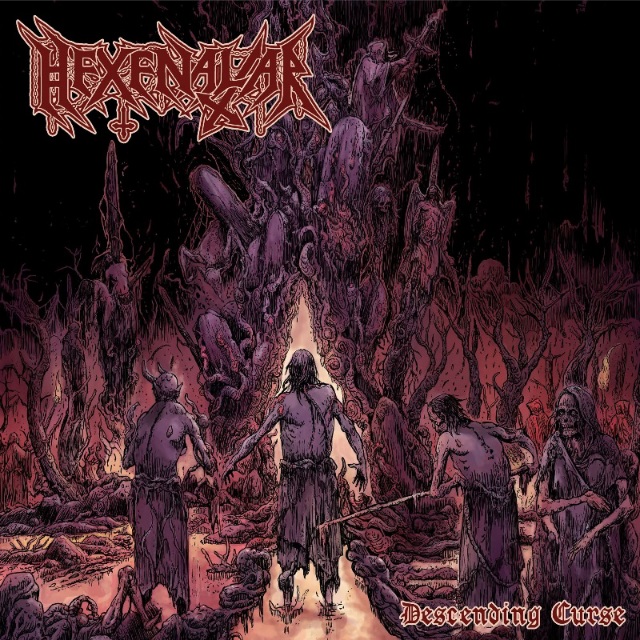
The visual language of the album carries a similar tension. The old-school leaning cover aesthetic, according to some interpretations, presents a surface that does not fully match the character of the music, highlighting a lack of complete alignment between visual identity and sonic world. While the music delivers a fast, compact, and technically precise aggression, the visual side remains more caricature-like and closer to genre clichés. This ultimately divides the album’s identity into two separate aesthetic layers rather than reinforcing a unified whole.
“Descending Curse” does not attempt to rewrite the blackened thrash formula so much as it seeks to sustain and tighten its existing parameters. For the listener, the defining factor is therefore not innovation, but how consistently the band can carry this familiar structure. With its short runtime and constant emphasis on speed, the album proposes a form designed less for focused analytical listening and more for continuous flow. Yet that very flow, due to structural repetition and the polished nature of the production, can at times reduce the record to the impression of a single extended composition.
In this respect, the album situates itself within contemporary black/thrash tendencies as something that is tightly executed but risk-averse: neither a fully retro reconstruction nor a boundary-pushing expansion of the genre. Instead, it occupies an intermediate position that refines the existing aesthetic without fundamentally redefining it.
OZY
https://hexenaltar.bandcamp.com/
https://www.facebook.com/Hexenaltar
https://www.instagram.com/hexenaltar_speed