
ALBUM REVIEW
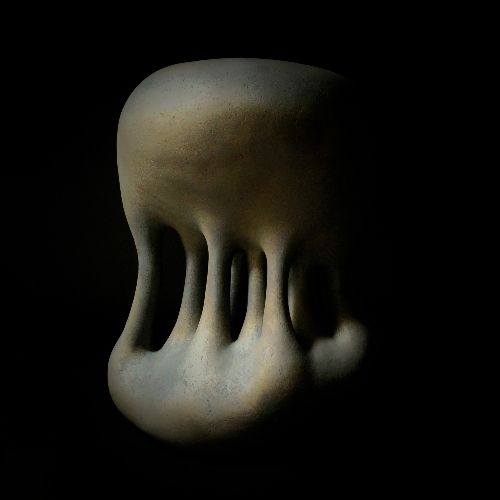
HOLLOW BONE – Onar
Strong atmosphere, limited compositional development throughout.
HOLLOW BONE are an experimental post-metal band from Milan. Their musical approach brings together post-metal, electronic textures, downtempo rhythms and experimental arrangements. Their second studio album, "Onar", takes its title from the Greek word for “dream” or “vision”. The fact that all seven tracks originated in dreams offers an important clue to understanding why the music steers clear of conventional songwriting. Rather than explaining its ideas through words, the band leaves them to the associations evoked by the sounds themselves. The use of vocals as part of the instrumentation, rather than as a vehicle for conveying meaning, is central to this approach.
The album opens with 'Amigdala', gradually taking shape through drones, ambient layers and widely spaced guitar chords. The vocals, hovering close to a whisper, lend the track a ritualistic quality, while the drums guide the music's movement rather than establish a clearly defined rhythmic framework. As the grunge-inflected guitars become more prominent, they lend greater physical weight to the otherwise restrained arrangement. One of the opening track's strongest qualities is the way HOLLOW BONE build intensity by layering sounds rather than introducing sudden surges in dynamics. 'Innocence' follows a similar path, with tribal drumming, indistinct vocal textures and spacey synthesizers deliberately blurring the boundaries of the composition. However, the expansiveness of the melodies and the limited rhythmic movement sometimes allow the atmosphere to overshadow the music's development.
Elements of TOOL's rhythmic and atmospheric approach can be heard in HOLLOW BONE's music. This affinity is particularly apparent in the way the drumming guides changes within the tracks. Even so, the similarities never quite reach TOOL's intricate rhythmic interplay or pronounced dynamic contrasts. HOLLOW BONE rely instead on slowly evolving textures, the hypnotic effect of repetition and the expansive sonic spaces created by their guitars. While this approach helps the band establish its own aesthetic territory, it also places certain limitations on the progression of the compositions.
'Meltdown' and 'Oceti' are where these limitations become more apparent. Variations in the drumming and ambient effects attempt to keep the music from stagnating, but repeated passages sometimes stretch on without introducing any meaningful development. The concentrated lower-mid frequencies in 'Oceti' in particular give the guitars and other sonic layers a fuller, more cohesive presence. Yet this physical density is not matched by equally compelling compositional development. The fact that the tracks change internally does not necessarily mean those changes lead to convincing climaxes. More pronounced dynamic shifts and more carefully constructed crescendos could have made the existing ideas considerably more effective.
The album's second half reveals another dimension of the band's approach. 'Presence Of Eagles', 'Shasta' and 'Wounded Knee' operate within wider dynamic ranges than the preceding tracks. Rather than building an ever-rising wall of sound, this additional space allows silence and the gaps between sounds to play a greater role. 'Shasta' is particularly notable for occasionally turning the album's prevailing restraint into something more unsettling. The track's intensity stems not simply from its volume, but from the sense of pressure created as its dynamic range expands. This shift demonstrates how HOLLOW BONE's slow-moving structures can produce different emotional effects.
The album's conceptual framework also becomes important here. The name HOLLOW BONE draws on the concept of the hollow bone associated with Lakota medicine man Frank Fools Crow, which describes becoming a channel through which experiences can pass rather than a source in one's own right. The band's connection to this idea finds expression in its use of wordless vocals and its reluctance to explain things directly. Garof's particular emphasis on silence when discussing his musical approach to Lakota culture adds further meaning to this framework. Nevertheless, drawing on such a cultural reference does not automatically guarantee artistic depth. What matters is how fully the concept is reflected in the music's form. By pushing words into the background, "Onar" leaves room for the listener's own interpretation, but that openness does not mean every track offers an equally meaningful sense of progression.
From this perspective, the closing track 'Wounded Knee' stands out as one of the album's most striking decisions. Garof has explained that he could not write a song directly addressing the Wounded Knee Massacre of 1890, but could instead dream of the silence that followed it. This gives the track's place on the album greater significance. As the shortest and quietest piece on the record, the closing track derives its impact from refusing to build towards a grand finale. Its near-silent dynamics bring a different meaning to the expansive sonic landscape established throughout the preceding tracks. This is one of the rare moments when the conceptual approach extends beyond the explanation accompanying the album and finds direct expression in the compositional decisions themselves.
The production of "Onar" reinforces this approach by preserving the dynamic differences between tracks rather than flattening everything to a uniform level. The concentrated low frequencies, expansive guitar chords and ambient textures that emerge at various points make the music feel defined more by space and weight than by detail. However, the sonic landscape's tendency to maintain a similar level of intensity also causes the atmosphere to become somewhat self-contained at times. The seven tracks are designed to flow into one another as a continuous listening experience, strengthening the album's overall coherence while limiting the impact of individual pieces when heard separately. For this reason, "Onar" does not fully reveal itself through a randomly selected track; it becomes more meaningful when experienced as a complete work.
HOLLOW BONE carve out their own territory by combining post-metal's forward-thinking approach, heavy rhythms and extended atmospheric development with electronic and experimental textures. The album's cultural and conceptual framework gains significance when it connects directly with the musical choices, particularly on 'Shasta' and 'Wounded Knee'. At the same time, repetition that fails to generate new tension and tracks that struggle to establish a clear trajectory weaken the overall impact of this approach. Rather than meeting the genre's familiar expectations of intensity and crescendo, "Onar" invites listeners to turn their attention to the spaces between sounds. The artistic value of this decision is felt most strongly in the moments when silence becomes a deliberate means of expression.

https://www.facebook.com/hollowboneofficial