Album Review
Horn - Apokalyps 1618
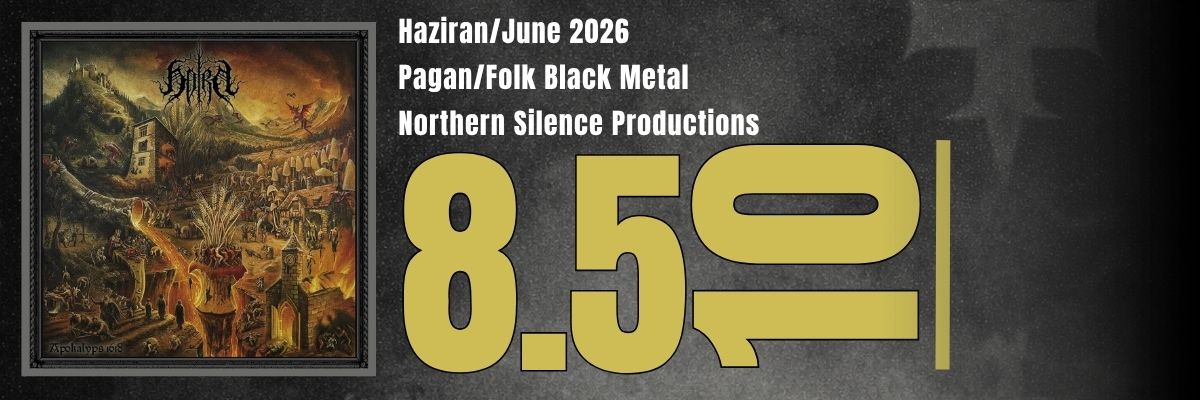
One of the long-standing names in the German pagan black metal scene to preserve its own internal aesthetic language, Horn approaches “Apokalyps 1618” by simultaneously revisiting the melodic pagan black metal formula while expanding the atmospheric backbone the band has spent years constructing into something more fragmented, more uneasy, and at times deliberately disassembled in a controlled manner. That underlying approach becomes apparent from the very beginning of the album: preserving traditional epic black metal melodies while disrupting the riff architecture through more dissonant transitions, building dramatic intensity not solely through speed but through tonal tension as well.
The opening synth layers and clean guitar passages initially evoke expectations of classic atmospheric pagan black metal. Yet as the album progresses, it becomes clear that this atmosphere is not being used merely as decorative backdrop. When the guitars’ constantly high-mid-driven melodic character collides with the drums’ harsher blast-beat sections, the music stops functioning as a tale of “heroism” and instead begins carrying the unease of a world in dissolution. Production plays a crucial role here. The record is remarkably clean and controlled, yet never slips into the sterile gloss often associated with modern productions. The texture of the tremolo riffs remains grainy, preventing the album’s folk/pagan roots from fully surrendering to a cinematic surface.
One of the most striking aspects of “Apokalyps 1618” is the way it places transitions between melodic black metal and more discordant riff structures directly at the center of the songwriting architecture. “Die Ahren gleich als mit dem Huf” in particular deliberately erodes the more romantic melodic approach associated with HORN’s earlier era. The riffs here do not create a clear sense of resolution; the chord progressions continuously evade stable tonal centers. As a result, the album’s medieval thematic framework does not remain confined to the lyrical layer alone, but extends into the actual behavior of the music itself. Historical collapse, religious unrest, and social fracture are not conveyed through “dark atmosphere” clichés, but through tonal instability.
The album’s use of folk elements is similarly restrained. String instruments and pagan-style chants are not employed simply to generate an “epic” effect; instead, they function more as transitional devices that broaden the dramatic tension within the songs. In that sense, HORN’s approach distances itself from the excessively romanticized pastoral aesthetic commonly found within the contemporary folk black metal scene. Rather than creating a sense of retreat into nature, the album uses folklore as a vessel for historical and cultural decay.
“Barhout” stands as one of the album’s riskiest maneuvers. The experimental vocal placements and unconventional dramatic structure reveal Horn consciously stretching the traditional black metal vocal framework. That said, this experimental approach does not always feel entirely organic. In some transitions, the vocal layers behave less like integrated extensions of the riff flow and more like a separate idea hovering above the composition. Still, this becomes significant in terms of the album’s broader aesthetic objective, because HORN is not merely attempting to add atmosphere here, but to dismantle and reshape its own compositional habits.
The closing track “At Our Bleakest” shifts the album’s tonal direction entirely. Carrying echoes of Type O Negative and Ulver, this more melancholic, semi-ballad approach may initially seem detached from the rest of the record. In reality, however, the intention is not to change genres, but to slow down black metal’s aggression-centered energy and sustain the same sense of pessimism within a different dramatic form. The song’s more spacious structure transforms the atmosphere of historical decay that permeates the album from physical aggression into a feeling of exhaustion by the time the record closes.
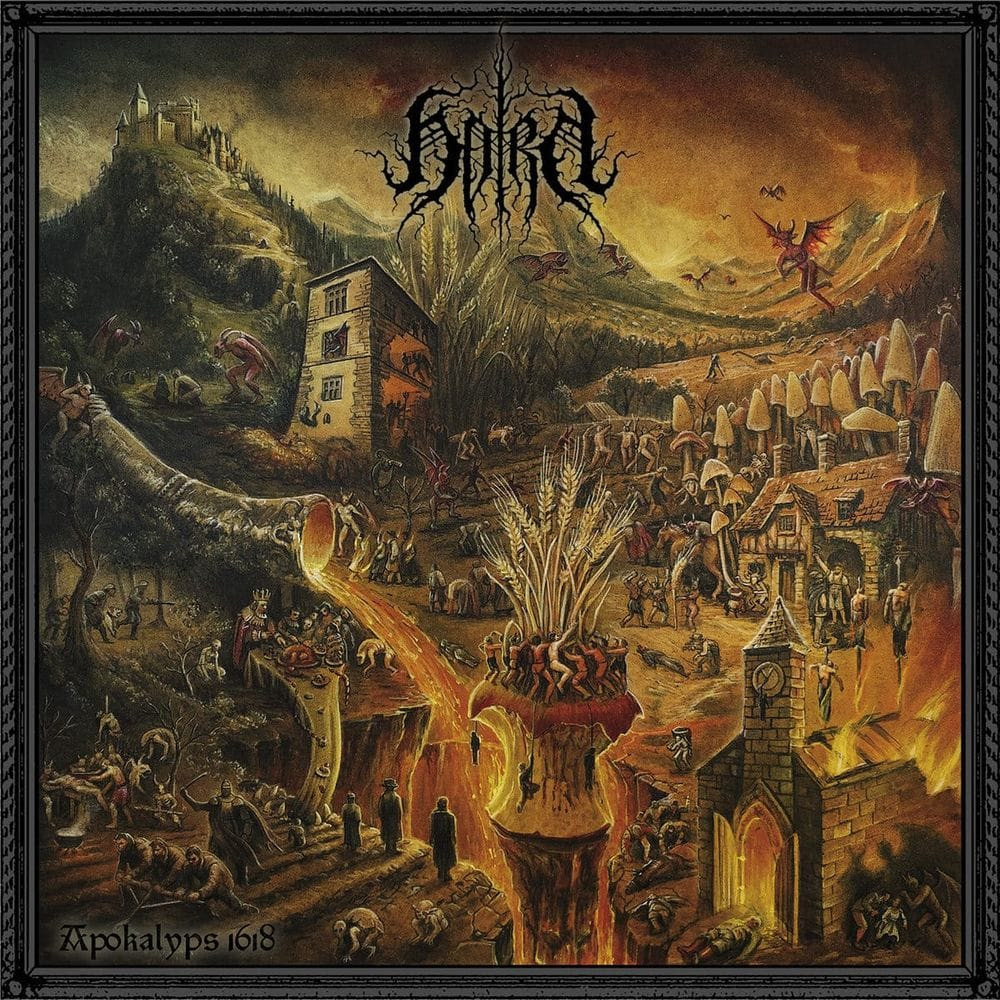
The album’s visual aspect reinforces this direction as well. The cover artwork, recalling the aesthetic language of Hieronymus Bosch, rejects the minimalism or nature-centered iconography commonly associated with black metal in favor of an excessively dense, layered, and chaotic visual identity. The choice aligns closely with the music itself, because “Apokalyps 1618” similarly avoids building itself around a single atmosphere, instead constructing a constantly shifting framework filled with new details and tonal fractures. The visual identity functions not merely as thematic decoration, but as an extension completing the album’s fragmented compositional logic.
The most important thing Horn accomplishes on this album is carrying pagan black metal’s traditional melodic backbone into a more uneasy and irregular form without abandoning it entirely. The album is not a radically genre-transforming work, yet it approaches the expansion of its own aesthetic boundaries with far more awareness than previous HORN records. Through its use of dissonance, experimental vocal arrangements, and more fragile song transitions in particular, “Apokalyps 1618” evolves beyond being a record aimed solely at nostalgic pagan black metal listeners and becomes an album that establishes a more direct relationship with the contemporary atmospheric black metal landscape as well.
OZY
Facebook: https://www.facebook.com/HornOfficial
Bandcamp: https://hornlichterlischt.bandcamp.com
Metal Archives: https://www.metal-archives.com/bands/Horn/17452
Facebook: https://www.facebook.com/NorthernSilenceProductions
Bandcamp: https://horn-northernsilence.bandcamp.com
Facebook: https://www.facebook.com/TimonKokottArtWork
Instagram: https://www.instagram.com/official_horn
Instagram: https://www.instagram.com/timonkokott
Instagram: https://www.instagram.com/northernsilenceproductions