
Album Review
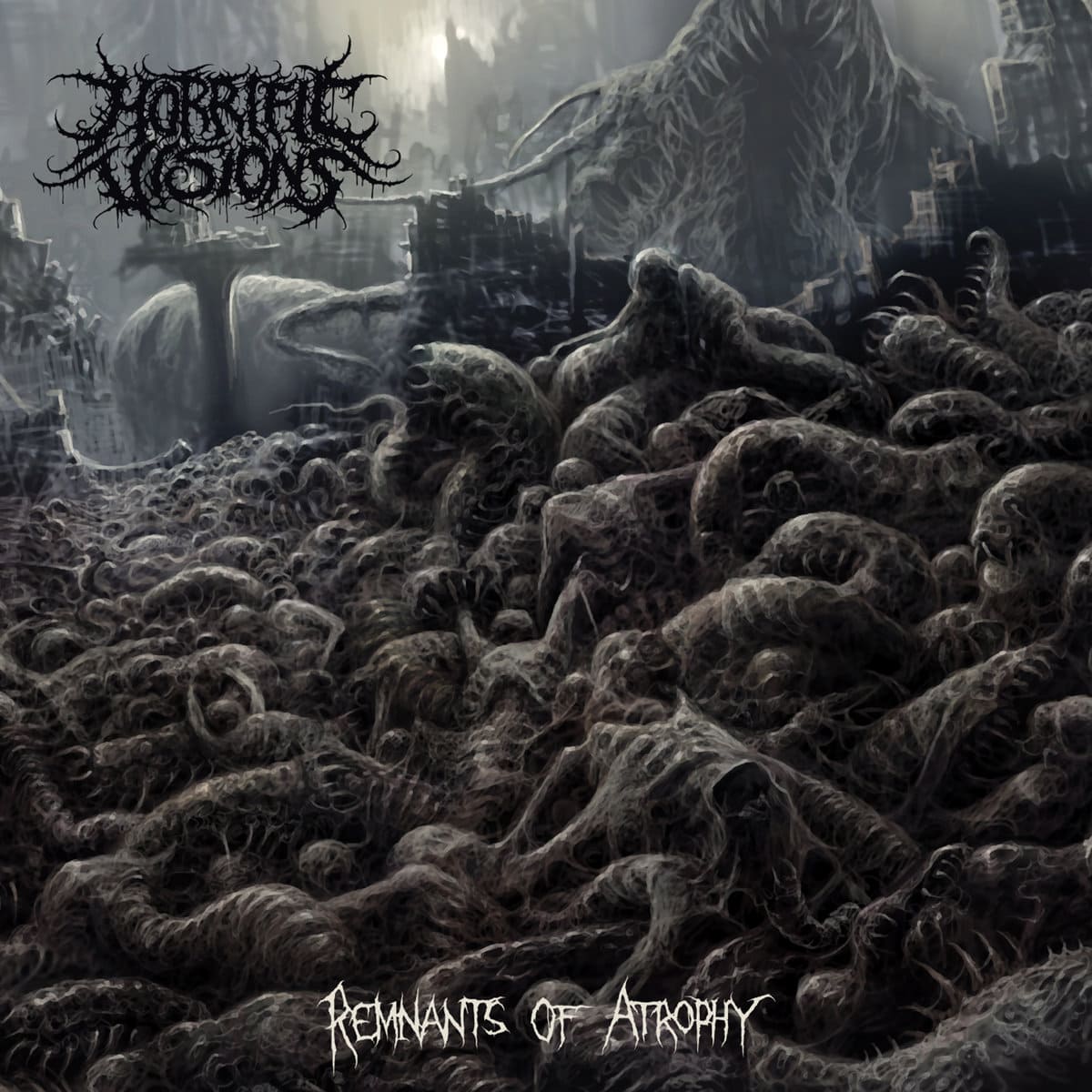
Horrific Visions - Remnants of Atrophy
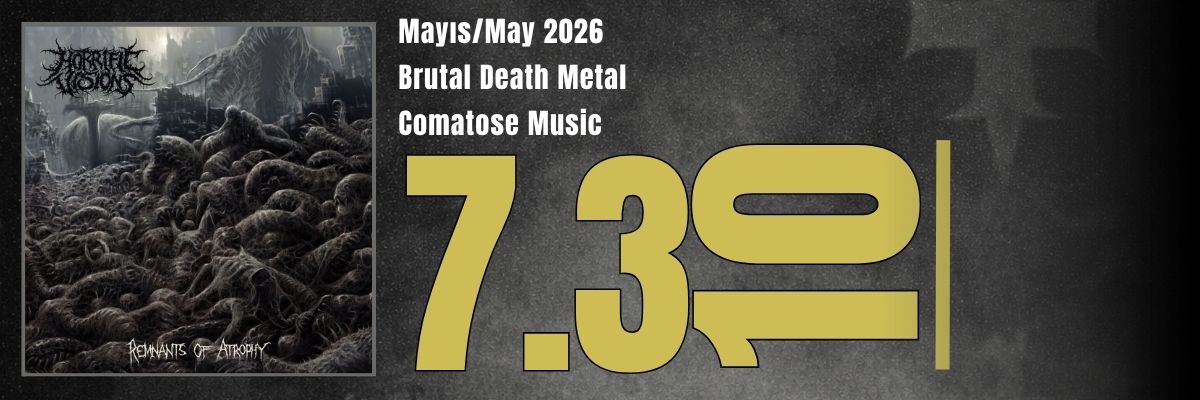
At first glance, “Remnants of Atrophy” is built on a framework that moves with the reflexes typical of a classic brutal death metal debut: fast-paced compositions, a dense layer of blast beats, and an almost constant wall of low-end frequency. Yet the album’s true identity is shaped less by how this basic template is arranged, and more by how tightly it is compressed and how little breathing space it allows. Over the course of its 25-minute runtime, the structure leans less toward dynamic expansion and more toward an architecture of uninterrupted pressure.
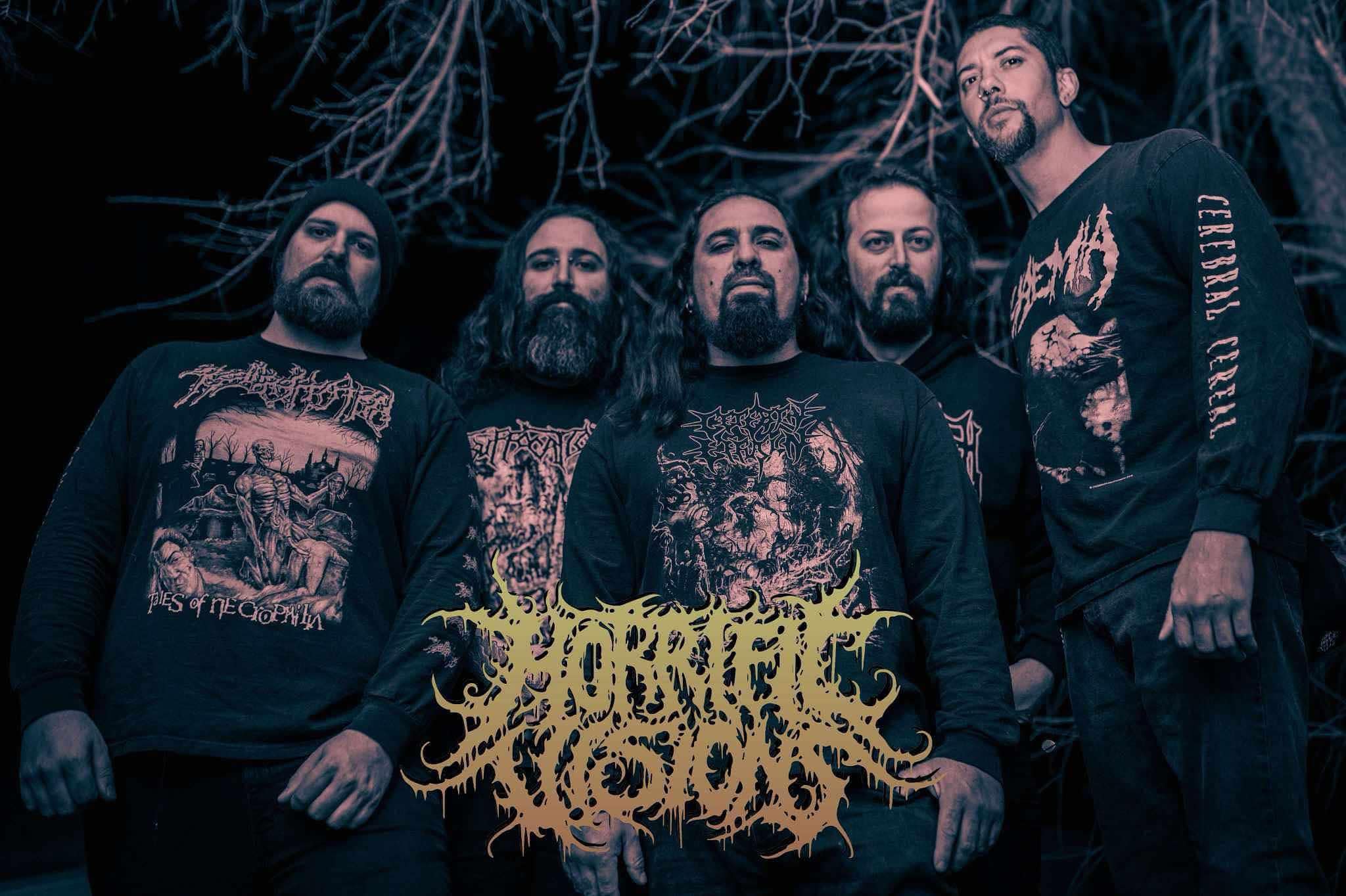
The guitar work largely oscillates between low-tuned, palm-muted slam passages and tremolo-based classic death metal riffs. The sample heard at the opening of “Malnutrition” functions as a kind of atmospheric threshold placed immediately before these riff blocks; however, this threshold is not maintained for long. Once the riffs enter, the composition shifts its focus from atmosphere-building to continuous assault. In tracks such as “Deranged Perversion” and “Primal Regression” in particular, the guitar writing is driven by the repetition of short motifs and sudden groove disruptions. While these breaks facilitate transitions into mosh-oriented mid-tempo sections, the fact that riffs are presented in blocks rather than developed internally limits the tracks’ capacity to leave a lasting imprint.
The drum performance is the main structural driver of this framework. While blast beat usage establishes a constant underlying motion, the density of the double bass creates an almost metronomic compression effect. Rene Martinez’s playing is technically clean and controlled, but compositionally it is often held at a similar intensity level throughout, meaning dynamic variation is largely confined to transition points. The tempo shifts heard before and after “Synaptic Decay” stand out as the most noticeable breathing spaces on the record.
The vocal performance sits at the extreme end of the brutal death metal tradition: a low-frequency growl layer pushed to the edge of articulation. Conrad Heinemeyer’s vocals do not operate as a separate channel within the mix but rather as another embedded layer of aggression within the overall wall of sound. This approach strengthens the rhythmic dimension of the vocals while rendering lyrical intelligibility almost entirely secondary. Although consistent with the genre’s established aesthetic codes, this choice also limits the album’s capacity for distinctive character separation, as the vocals dissolve into the same intensity plane as the riff structures rather than sitting above them.
The bass guitar is one of the least distinct elements in the mix. Even so, it can be perceived as a “shadow layer” that reinforces low-frequency support in certain transitions. Particularly in high-speed sections, it merges with the guitars to form a single dense frequency mass. This approach aligns with a production aesthetic commonly found in modern brutal death metal: rather than separating instruments, the goal is to collapse them into a unified sonic block. Had the opposite approach been taken—allowing for tonal differentiation or more independent bass movement in certain sections, pushing against the traditional boundaries of brutal death metal—the album’s position within the scene could have been rendered more distinctive. While the outcomes of such decisions are difficult to predict without experimentation, the structure of the material itself suggests that this kind of approach would have been worth exploring.
The overall production character is one of the key factors defining this aesthetic. Mason Vickers’ mixing and mastering approach creates a deliberately raw but not entirely chaotic sense of density. However, at certain points this density flattens the micro-dynamic detail of the instruments. Guitar articulation and drum transitions in particular can adhere to a uniform surface due to heavy compression. While this reinforces the album’s “controlled chaos” ambition, it simultaneously reduces the layers available for detailed listening.
From a compositional perspective, the most notable breaks in the album’s structure emerge around “Crippled Under The Weight Of A Hollow World” and “Synaptic Decay.” The former attempts to create contrast through slower passages, but instead of expanding the character of the riffs, it simply reduces the speed level as a means of differentiation. “Synaptic Decay,” on the other hand, functions as a spoken-word and sample-based interlude. However, this type of transitional material does not fully align with the album’s overarching logic of uninterrupted assault; in certain moments it interrupts the natural continuity of flow, creating a dramatic void, yet this void is not compositionally reintegrated.
Stylistically, the album is firmly rooted in the US brutal death metal tradition: technical density in the vein of Suffocation, Cryptopsy, and Origin is combined with slam-oriented low-tempo outbursts. However, this synthesis operates less as a proposal for a new structure and more as a compressed version of existing genre codes. The “20% difference” attributed to atmospheric and dynamic deviations is present in places, but never occupies a central enough role to reshape the overall compositional logic.
In more aggressive tracks such as “Enlightenment Through Excruciating Torture,” both speed and chaos levels increase, yet this escalation does not generate new formal structures; instead, it simply steepens the existing intensity curve. This exposes the album’s central tension: despite strong technical execution and performance, compositional variation often amounts to little more than the same language of aggression reproduced at different velocities.
Ultimately, “Remnants of Atrophy” positions itself as a work that adheres closely to the traditional production logic of brutal death metal, employs modern standards of sonic density, but keeps its compositional expansion space deliberately limited. The listening experience is driven more by continuity and pressure than by structural variety. This places the album in a safe representational zone within the scene, while its ambition to extend genre boundaries remains confined to only partial gestures.
OZY
https://horrificvisions.bandcamp.com/
https://www.facebook.com/hvsabd/
https://www.instagram.com/horrific_visions/