
Album Review
Kybalion - Make the World Bleed
Kybalion’s Make the World Bleed EP opens by fully embracing the “dissonant density + atmospheric collapse” axis modern black metal has increasingly cornered itself into over recent years, yet it constructs this not as one-dimensional aggression but through constantly mutating short-form segments. Particularly on the opening track, the riff writing is built not around deploying the classic tremolo flow as a linear assault, but around repeatedly fracturing it through micro-breakdowns. As the guitar layers stack upon one another, the tonal center never stabilizes; this reveals that the songs are organized not around a “fixed riff” but around clusters of motifs inclined toward disintegration. This approach is a common trait within modern dissonant black metal — especially in its rhythmically destabilized strain — yet Kybalion reframes it here with d-beat eruptions at specific dramatic thresholds instead of allowing it to dissolve into a completely amorphous structure.
The drum performance stands as one of the EP’s defining structural components. The constant transitions between blast-beat sections and more pacing, almost march-like strikes prevent the material from remaining locked into a single energy level. These shifts are not random; at the very moments when the guitars begin to unravel, the rhythmic foundation becomes more defined, keeping the composition’s disintegration under control. As a result, the EP generates not chaos, but the sensation of controlled fragmentation.
The bass layer and the use of soundscapes create a distinct sense of a “second plane.” More often than functioning as a supportive line beneath the riffs, the bass transforms into a low-frequency foundation filling the voids opened by the guitars. Seditio’s soundscape contributions interrupt those spaces not with ambient continuity, but with industrial and dark cinematic textures. This choice demonstrates that the noir cinema references do not remain merely aesthetic signifiers; they operate as an actual layer of contrast within the mix. Still, this soundscape layer does not always function as a structural element pushing the compositions forward. In certain sections, it remains more like “added atmosphere” laid over the riff logic, creating surface-level density rather than directly reshaping the rhythmic movement.
While the vocals preserve black metal’s standard shriek articulation, the transitions between English and Italian passages — particularly the spoken Italian section near the end — create a narrative rupture. However, this rupture functions less as a dramatic reorganization within the musical structure and more as a character monologue emerging during the finale. In other words, the vocal layer remains less a force that redirects the compositions than a narrative marker imposed upon the existing structure.
The EP’s four-“act” structure is reflected in the lengths of the tracks as well: short opening and closing pieces frame two compositions in the middle that are allowed more room to breathe, establishing a kind of sequence of consciousness layers. Yet this “act” concept operates less as a genuine thematic transformation in musical form and more as a method of packaging the micro-shifts occurring within the songs themselves. For instance, although Hollow offers a broader rhythmic field, it does not structurally open a new language; instead, it reproduces the existing dissonant riff paradigm at a more diluted tempo.
Tenebra and Angst, meanwhile, carry the EP’s conceptual weight most explicitly. Particularly on Tenebra, the parallel established between the Italian text and the guitars’ tendency toward dissolution is where the composition most directly conveys its consciousness/collapse theme. Here the riffs display less “progressive” variation, instead forming a cycle in which recurring motifs gradually lose meaning. Angst, on the other hand, functions through a more rhythmically grounded closing logic; the more controlled use of blast beats gives the piece not the feeling of disintegration, but of a restrained conclusion.
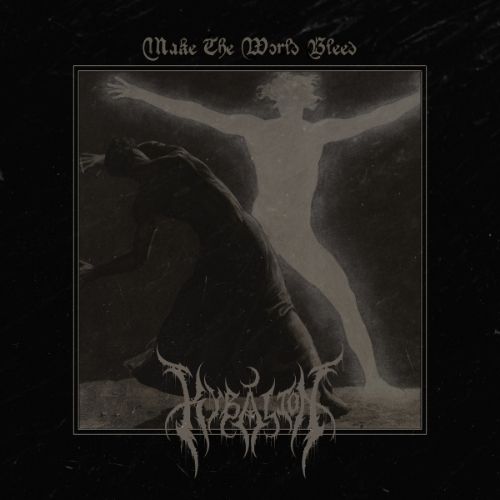
The choice of Sascha Schneider’s The Astral Body as the cover artwork establishes an aesthetic framework that directly aligns with the musical structure. Yet the critical point here is this: the visual component does not truly assume a compositional role within the EP’s sonic world; rather, it functions as an “outer frame” for the concept itself. There is no complete reciprocal exchange between the visual language and the music — the artwork thematically frames the sound instead of transforming its internal logic.
Overall, Kybalion compress the dissonant and cinematic dimensions of modern black metal into tightly controlled short-form compositions. Yet that same control occasionally prevents the songs from reaching a genuinely form-breaking threshold. While the dissonant guitar language and rhythmic instability establish a strong technical backbone, the soundscape and conceptual layers often orbit around that backbone instead of reshaping it.
Listening to this EP means being exposed to a field of rhythmic and tonal displacement that constantly shifts without ever fully transforming into an entirely new structure. Kybalion’s position here is clear: rather than inventing new vocabulary within the expanded lexicon of black metal, they continuously dismantle and reconstruct the syntax of the existing language. Yet this fracture does not always generate new meaning; at times, it merely redistributes the existing intensity into a different configuration.
OZY
NON SERVIAM:
https://www.non-serviam-records.com/
https://non-serviam-records.bandcamp.com/
https://www.facebook.com/nonserviamrecords
KYBALION:
https://linktr.ee/kybalion.bm
https://kybalion.bandcamp.com/album/kybalion-ad-unum-omnes-split
https://www.facebook.com/kybalion.bm