

ALBUM REVIEW
Ministry – Hate To Go – Take Out Or Delivery
Industrial fury meets dystopian political criticism.
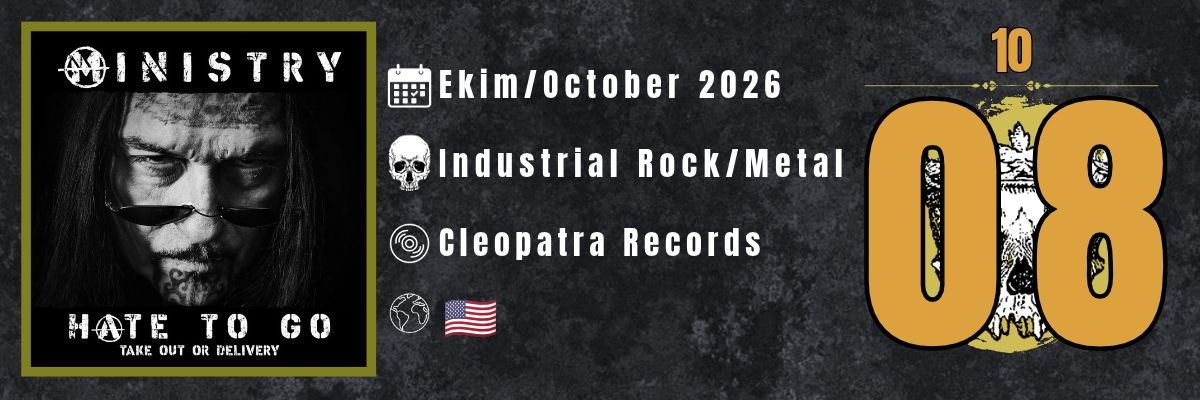
Hey everyone, how’s it going? As I said, I’ve taken my foot off the gas a little and decided to let things roll downhill. I’ve also come to the conclusion that it’s time to say goodbye to certain things. I guess, as they say, the older you get, the more you start turning into a bit of a “grumpy old goat.” Life becomes something you approach with more irritation, more anger, and increasingly little patience. It seems Jourgensen and I see eye to eye on a few things. I think we agree that the world is becoming increasingly uninhabitable, or that we’re the ones making it that way. It’s fair to say that Ministry, too, may be approaching the end of the road. Al Jourgensen had previously hinted at farewell with The Last Sucker (2007) and From Beer To Eternity (2013), only to find a way back each time. This time, however, his message is pretty clear: “I'm fucking done!” The 68-year-old Jourgensen seems entirely at peace with the idea of calling time on his musical career. In fact, he plans to spend his post-music life doing things with absolutely no connection to music, such as herding goats, reading books, or collecting shopping carts at Walmart. Ministry's 2027 world tour, announced as the biggest tour of the band's career, also looks set to serve as the final chapter of this long-running saga. Apparently, after spending more than enough time describing our dystopian world, Jourgensen would like to hang out with some goats for a change.
Hate To Go – Take Out Or Delivery arrives at a time when Ministry are preparing to bring their turbulent 45-year career to a close. Musically, there's a clear attempt to recapture the spirit of albums from the band's golden era, such as The Mind Is a Terrible Thing to Taste and Psalm 69. Thrash metal riffs, industrial rhythms, grooves capable of getting a dance floor moving, various spoken-word samples, and Jourgensen's vocals, still every bit as aggressive as ever, all come together here. The mechanical, hard-edged musical framework Ministry have spent years developing is now fuelled by more contemporary concerns. Managing to remain memorable without losing its anger, the album looks back at the band's past without relying on nostalgia alone.

The source of Jourgensen's anger, meanwhile, hasn't changed much. Wars, political corruption, the climate crisis, and social decay are among the issues he has been railing against for nearly four decades, and their continued relevance only reinforces his bleak outlook on the world. Oligarchs, careerist politicians, dystopian AI, and the negative effects of social media on people form the album's central targets. Ministry have never been a band to dress up what they want to say. And as Jourgensen steps up to the microphone for what may be the last time, he's not pulling his punches either. He has even revealed that he used AI to create some of the album's audio samples, describing the experience as both frightening and amusing. In the end, he has parted ways with AI, too. It seems there isn't much left for Jourgensen to pick a fight with.
Crickets, the album's opening track, immediately establishes its political atmosphere through spoken-word samples featuring Barack Obama and a call to take the country back from the oligarchs. Voices Of Hate follows, bringing Ministry's aggressive side to the forefront with an uncompromising, punishing rhythm reminiscent of the Psalm 69 era. Clown Car stands out for Monte Pittman's ferocious guitar work and its rhythmic structure, which brings together influences from Killing Joke and Slayer. One of the album's singles, We Hate, continues the band's provocative streak with its German-language line "Er ist ein Schwein" and accompanying video.
Clocking in at over six minutes, Grifter shifts the album's pace with its slower, psychedelic, and atmospheric approach. Ministry's normally high-revving mechanical machine gets a little room to breathe here. Singularity explores the increasingly mechanised effects of AI and technology on human life, reinforcing the album's dystopian edge. Burned Out, meanwhile, stands out with touches that reach back to the band's early-'80s synth-pop and new wave roots. It's a welcome reminder that Ministry's musical history extends beyond industrial metal.
The album's closing track, We're Still Here, carries a significance of its own. Paul Barker, one of the most important collaborators of Ministry's classic era, reunites with Jourgensen, contributing bass and programming. His return takes the track beyond the role of an ordinary album closer. After all the years they spent shaping the Ministry sound together, this reunion feels like an emotional nod to the band's past. Bringing one of the era's most important creative partnerships back under the same roof for one last time makes the album's farewell atmosphere all the more pronounced.
Time will tell whether Al Jourgensen actually keeps his word this time. Ministry have slammed the door and walked away before, only to return to the stage again. But Hate To Go – Take Out Or Delivery offers a rather ambitious attempt to bring the band's 45-year musical journey to a close. Rather than taking refuge in past glories, Ministry are directing the fury of industrial metal at today's rotten system and preparing to have the final say. The days when Jourgensen can finally be left alone with his goats may be approaching. Until then, though, we'd better turn those volume knobs up a little further. Because Ministry's farewell doesn't look like it's going to be a quiet one.

https://al-jourgensen.squarespace.com/#al-jourgensen