Album Review
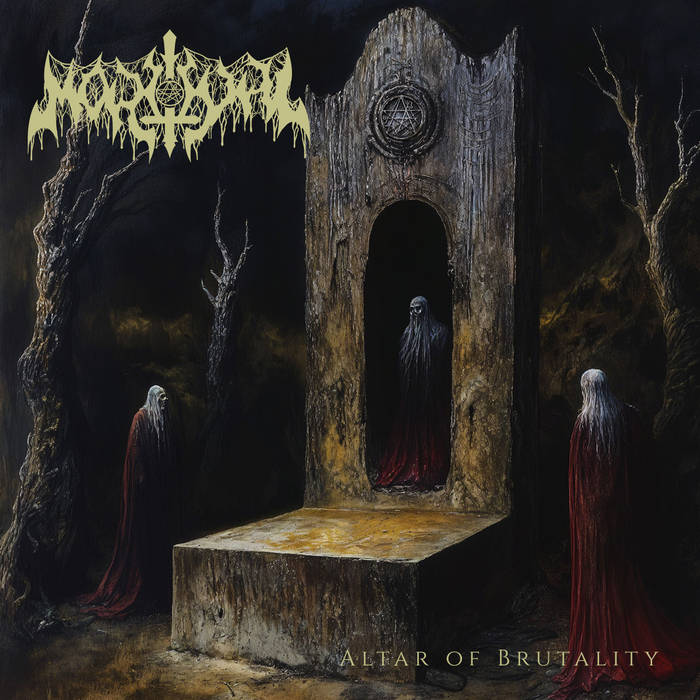
MORTUAL - ALTAR OF BRUTALITY
Nuclear Winter Records
Death Metal
09/10
This is not one of modern death metal’s ritualistic triumphs. Altar of Brutality feels more like an enraged echo rising from the silence of a crypt long since collapsed… Emerging from the purifying rains of San José, Mortual step forward with their first full-length manifesto after a death-dust-laden march of three EPs: this eight-track sacred curse is not merely a music album, but a blood oath to decayed faith, fanatical devotion to darkness, and a seething hatred for all things holy.
The production isn’t mechanical or sterile—but that’s no flaw; rather, it is the very element that grants Mortual’s music its underground authenticity, an almost archaic sense of worship. The deliberate choice to keep the drum tones from being overly loud allows the blast beats to function not merely as an assault mechanism, but as fracture points within the compositions, generating tension at key moments. Particularly on tracks like “Morbid Oath,” drummer Chalo’s (a recruit from Chemicide) playing—at times rib-crushing, at others ritualistic in its pacing—carries the album’s dynamic structure. Here, the band exhibits a rare discipline, never losing control even while skirting the edges of extreme speed and chaos. Altar of Brutality is a cauldron of rage that feels on the verge of eruption at any given moment, yet never spills over—making it all the more dangerous.
The guitar work is woven at the crossroads of classic Floridian death metal (with clear influences from Monstrosity and Malevolent Creation) and the savage death/thrash lineage of South America in the vein of Mortem and Masacre. “Mortuary Rites” lays out this vision in full within its very first minute. By the second minute, the tempo abruptly slows, the guitars collapse inward, and it becomes clear that Mortual are not merely interested in pressing the gas pedal, but in making decay felt step by step. These structural shifts recur throughout the album: passages that suddenly drop from a riff-driven inferno into funeral-paced sections offer a mysticism that dissolves the listener’s sense of time and space.
Vocalist Justin Corpse’s performance goes beyond the genre’s typical guttural approach: especially on “Dismember the Martyr,” the suffocated groans that reverberate feel like part of a ritual of bodily dismemberment, not just musically but thematically. In this sense, the vocals function as an extension of the instrumentation—melding into the fabric of the music rather than dominating it—and this is precisely what makes the album’s cohesion so compelling.
Another striking cornerstone is Mortual’s complete lack of fear toward “stagnation.” Each track is structured like a spiral: it begins, ascends, resolves, and then transforms into a new variation. Songs like “Possessed By Ritual” seem to narrate a different curse with every riff change—sometimes with a blade carved from a rib bone, other times with a rusted chain buried in grave soil. Encountering this many ideas within such a short runtime (around 35 minutes) is anything but typical for a debut album. Mortual waste no moment, as if they have been waiting for years to unleash this curse.
Yet this rage is not merely physical violence. While Altar of Brutality may initially appear as a flesh-tearing, blood-spewing record, deeper listening reveals an almost ritualistic intensity embedded within its aggression. It is as though this musical carnage exists not solely to destroy, but to serve as a conduit for a greater search for meaning. Tracks like “Abominable Devotion” stand out not only for their brutality, but for a near-heretical spiritual defiance. This grants the album a dark ecstasy—not only on a sonic level, but in its very essence.
Ultimately, Altar of Brutality is not just a strong debut; it is a well-defined, expertly carved, and deliberately agonizing one. The album not only cements Mortual’s place on the underground map, but also declares that the band has begun digging its own grave. Because to wield such controlled fury within this genre demands that the next step be even darker, even more destructive. If this is a sacrificial altar, it is not the music being torn apart—it is us. And in that dismemberment, worship itself is born.