
Album Review
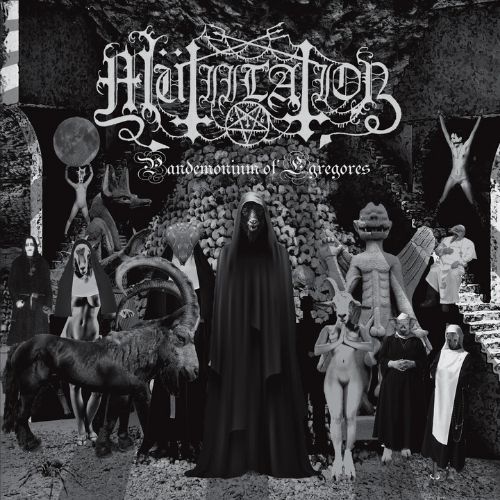
Mütiilation – Pandemonium of Egregores
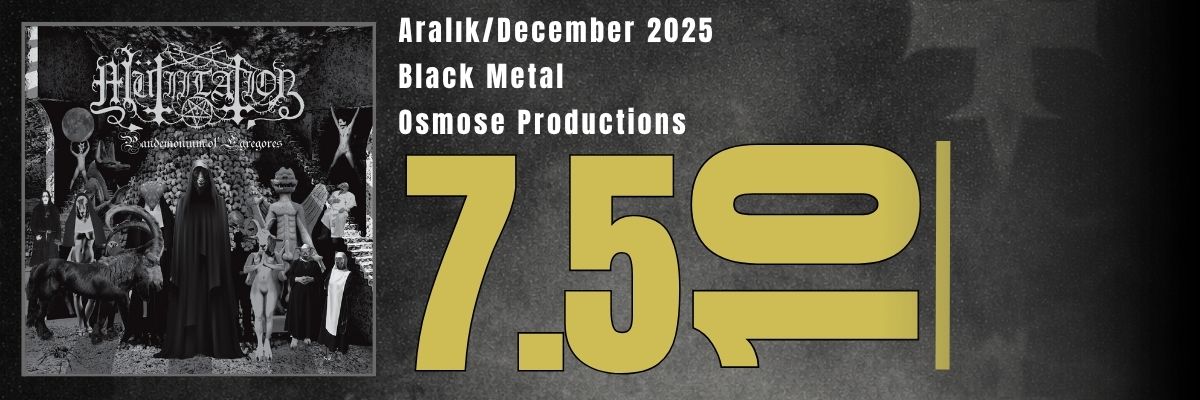
Mütiilation stands as one of the earliest and most defining entities of the French black metal scene, positioned among the bands that embodied the dark, lo-fi extremes of the raw black metal aesthetic that took shape in the mid-90s. Built around Meyhna’ch’s singular creative control, the project developed a language over the years that oscillated between deliberate disorder, low-resolution production, and a form of dramatic nihilism. Throughout its discography, the band represented one of the key French counterpoints to the more systematic structures of the Norwegian scene, carrying a more anarchic and experimental current. The new-era recordings following a long silence indicate a shift of this raw aesthetic toward a more controlled, at times even melodic framework. “Pandemonium of Egregores” stands precisely along this trajectory of transformation, emerging as a work that exposes the tension between Mütiilation’s past legacy and its current search for compositional direction.
The opening track, “Overture,” is designed less as a traditional introduction and more as an uncontrolled mass of sound that expands without a clear riff-centered core. Rather than establishing a defined harmonic structure, the guitars operate through layered tremolo surfaces and scattered frequency blocks, placing the listener into a state of tonal uncertainty instead of presenting a direct thematic anchor. Yet unlike the raw chaos aesthetic of earlier Mütiilation recordings, this ambiguity does not feel entirely unstructured or directionless; the layering within the mix is more controlled, and the negative space is deliberately shaped.
With “Shadows Over the Valley,” the album shifts toward a more defined riff logic. The guitar writing here is built around two to three core chord centers, forming a repetitive yet non-linear structure. The first clear break in tempo also occurs here: while blast-driven aggression is not fully abandoned, mid-tempo transitions and more open tremolo passages come to the forefront. This choice marks one of the most significant deviations in the album’s character, as a more legible compositional framework now exists beneath the chaotic surface.
“Fifty Winters” represents the clearest crystallization of this structure. The guitars foreground melodic lines, while the drums move away from constant blast patterns toward a more controlled, transition-oriented role. Built on repetitive two-chord movements in the rhythm guitars, the composition at times approaches a near punk-like austerity. However, this austerity does not simplify the atmosphere; instead, it intensifies a sense of coldness within a tightly contained frame. The bass remains largely submerged in the mix, yet functions as a midrange reinforcement that supports the weight of the riffs.
The title track is where the melodic direction becomes most explicit. Tremolo melodies are no longer treated as surface decoration but as guiding compositional elements. At moments, the guitar lines generate a folk-like flow, only to be interrupted by abrupt dissonant fractures. Here, the album’s central tension fully emerges: a continuous pull between linear melodic progression and fragmented, intrusive dissonance. While this tension forms the strongest compositional idea of the record, it does not operate with equal consistency across every track.
The closing piece, “Hashischin Cage,” brings this tension back into a more aggressive framework. Drums once again approach harsher blast patterns, while the guitars do not fully abandon melodic lines; instead, these lines are reduced to fragmented motifs that no longer establish a stable sense of direction. The vocal performance remains harsh and largely fixed on a single tonal axis, though occasional attempts at variation struggle to assert themselves within the density of the mix. In particular, the occasional flattening of the vocal tone becomes a limiting factor in moments that otherwise aim for dramatic rupture.
From a production standpoint, the album presents a tighter framework compared to earlier Mütiilation releases. The stability of drum tempos and the more structured transitions indicate a clear departure from the one-take ethos of raw black metal tradition. While this occasionally softens the natural chaotic energy of the material, it also introduces a sense of order that prevents the compositions from dissolving into structural collapse.
This raises the album’s central point of contention: does this melodic expansion and structural tightening genuinely open a new expressive space, or does it merely compress earlier raw aesthetics into a more controlled form? Mütiilation does not abandon the dissonance and sense of disorder characteristic of the French black metal tradition, but it now frames them within more readable riff architectures. This framing strengthens the music in some passages while simultaneously reducing the spontaneity of its tension in others.
Considering Meyhna’ch’s recent discographic trajectory, the album suggests a more consciously constructed compositional approach. However, this awareness does not always translate into the creation of a new language, but rather a more organized iteration of an existing one. The increased use of melody, in particular, does not consistently result in structural transformation, often remaining a surface layer applied over the underlying riff logic.
Ultimately, “Pandemonium of Egregores” positions itself as a record attempting to recalibrate the balance between chaos and structure without pushing that recalibration into radical reinvention. Through more controlled guitar writing and a stabilised rhythmic framework, the album avoids complete dissolution into disorder; however, it leaves open the question of how far this control actually transforms Mütiilation’s historically defining raw fragility. In that sense, it stands less as a statement of renewal and more as a tightened reconfiguration of an established aesthetic.
OZY

https://osmoseproductions-label.com/mutiilation-pandemonium-of-egregores/
https://tinyurl.com/mutiilation-store
https://osmoseproductions.bandcamp.com/album/pandemonium-of-egregores