ALBUM REVIEW
NEKRODAWN - Covenant Of Carnage
Swedish death metal, darkly reshaped with precision.
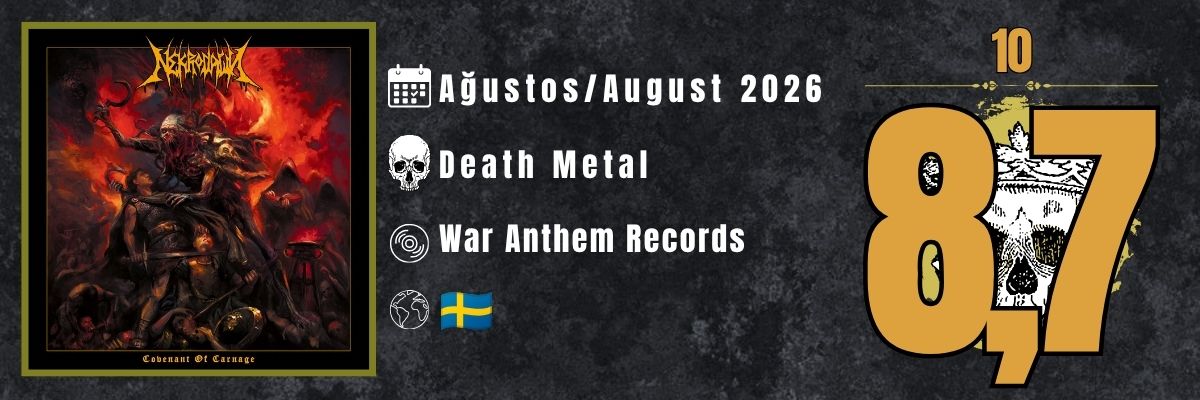
Sweden’s long-established death metal riffing tradition is used on NEKRODAWN’s "Covenant Of Carnage" not merely as a nostalgic reference point, but as the foundation for a darker and more varied musical framework. Built around crushing guitar riffs, powerful bass lines and shifting tempos, the album incorporates black metal and doom influences into its arrangements without compromising the genre’s fundamental heaviness. In doing so, NEKRODAWN reshapes the familiar language of classic Stockholm death metal through a contemporary production approach and a broader compositional perspective.
The album is still built on razor-sharp guitar riffs, thick low-end bass frequencies and hard-hitting drum transitions; however, the band’s real achievement lies in using these elements without confining themselves to the aesthetics of 1990s Stockholm death metal. Traces of the ENTOMBED, DISMEMBER and GRAVE tradition can be heard throughout NEKRODAWN’s music, yet the result is less an exercise in nostalgia than a contemporary interpretation of that language.
"Neath Skies Of Iron" is a direct summary of this approach. As the riffs move with speed and precision, the dirty character of the guitar tone evokes classic Swedish death metal; however, melodic touches and the prominent bass presence keep the track from becoming merely a reference to the genre’s past. Jonas Kjellgren and Mika Lagren’s guitars often serve distinct functions rather than simply reinforcing one another; the physical weight created by the main riffs is balanced by the brief melodic and harmonic movements introduced by the lead guitars. As a result, the album’s aggression does not remain at the same intensity throughout.
This variation becomes particularly apparent on tracks such as "Massacre Eternal" and "Covenant Of Carnage". "Massacre Eternal" pulls back into more controlled tempos, giving the riffs room to breathe; its use of pinch harmonics and memorable chorus section strengthens its melodic imprint without taking the track completely outside the framework of classic death metal. The title track that follows combines the energy of its fast opening with a more mid-paced structure. This is where one of NEKRODAWN’s strengths becomes apparent: the band does not need to remain at high speed to preserve the genre’s intensity.
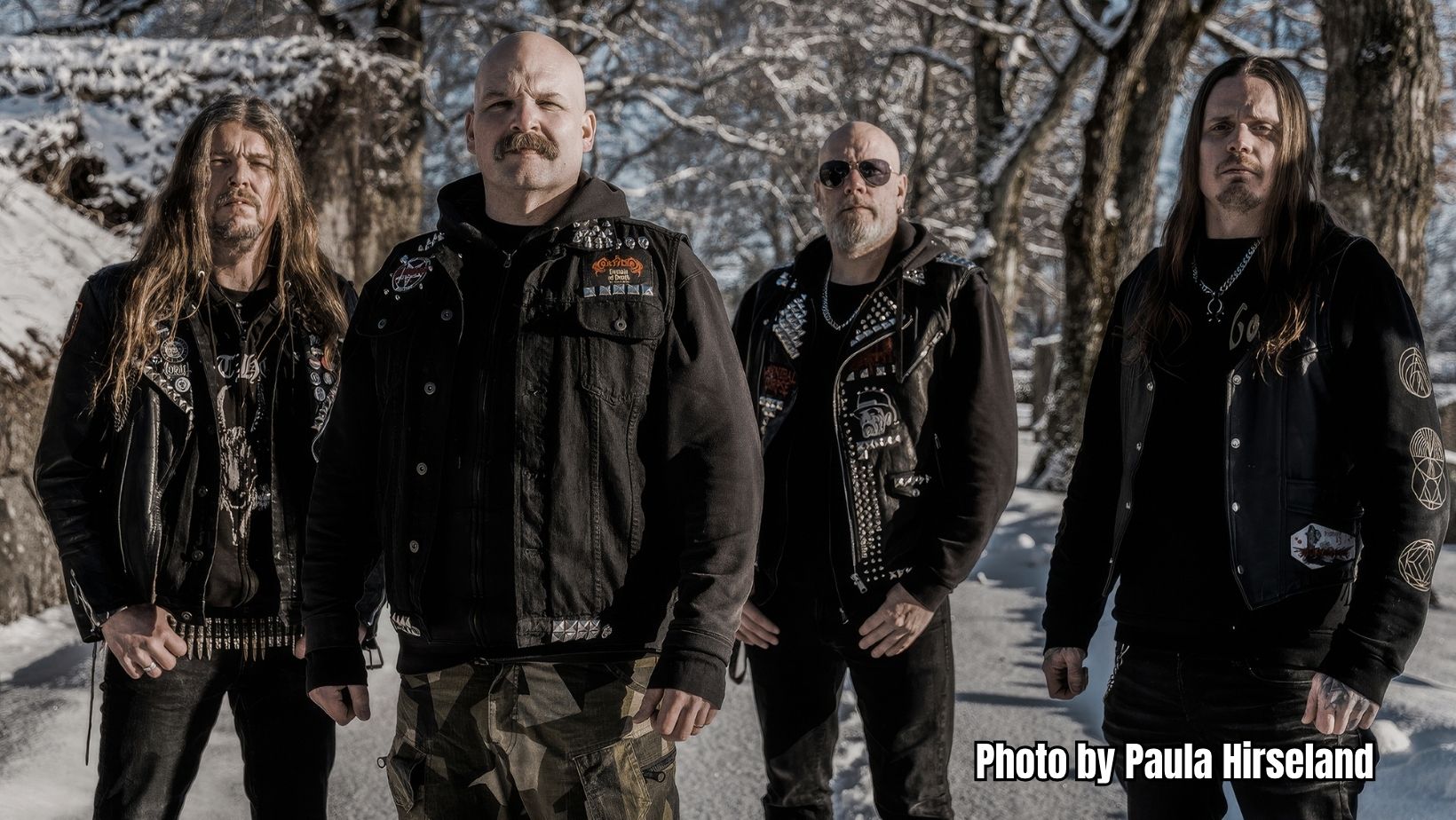
"Feeding The Greed Machine", "Condemned To Existence" and "Claws Of Pestilence" represent the heavier side of this approach. Mid-tempo passages and occasional doom-inflected slowdowns bring the guitars’ low-end weight to the foreground, sharpening the threatening character of the tracks. Johan Jansson’s bass work is particularly important here. The bass does not merely remain a supporting layer beneath the guitars; it sits prominently enough in the mix to define the body of the riffs, creating a heavier counterpoint to the guitars’ sharper upper frequencies.
The strength of the rhythm section, meanwhile, does not come solely from the physical weight of the drums. Henrik Axelsson uses blasts and rapid-fire patterns in the faster sections, while bringing the groove into sharper focus at mid-tempo, giving the riffs a different sense of movement. "Liberty’s Pyre" is a good example. As the tempo rises noticeably in the second half, the momentum generated by the drums drives the guitars into a more ferocious mode. Given the more controlled sections that precede it, this transition is not merely a display of speed but a functional turning point in the song’s architecture.
"Crowned Devourer" brings out the album’s traditional death metal side most clearly. Grooving rhythm guitars, classic death metal dissonance and traditional solos come together within the same structure. Yet the track is not simply a collection of elements borrowed from the genre’s past; variations in the drumming and vocal placement prevent the arrangement from becoming a monotonous old-school exercise. Jonas Kjellgren’s vocals are particularly effective here as well. Deep growls establish the fundamental character, while his expansion of the vocal line during more aggressive and expressive sections means that the songs’ dynamics are not built solely through the instrumentation.
"Incarnate Doom" contains one of the album’s more intriguing ideas. As the track takes on a stronger melodic character, the use of lead guitar becomes more pronounced, while the deployment of slide guitar within a death metal context becomes more than a superficial gimmick, integrating directly into the grimy texture of the riffs. The value of this experimental element does not lie simply in its unusual nature, but in the way it alters the track’s existing guitar language. Johan Jansson’s prominent bass lines also avoid getting lost among the guitars here, giving the arrangement an additional melodic weight.
"Thy Spineless" is one of the album’s strongest compositions. The atmospheric guitar work in the intro is one of the moments where the band brings its black metal influence directly into the riff structure. The track then moves between high-speed passages, doom-inflected sections and mid-tempo transitions while retaining the tension established by its dark opening. The black metal touch here does not remain a decorative "darkening" effect; it shapes the track’s harmonic and atmospheric character. This is also one of the most convincing examples of NEKRODAWN’s ability to move between genres.
"Drones Of Deceit", by contrast, compresses its idea as much as possible. Within its roughly one-minute runtime, the track moves from an extended chordal intro straight into an intense death metal attack, creating a deliberate contrast with the album’s longer and more varied compositions. The closing "Desolation Reigns", however, does not generate an equally strong finale. The track is not out of step with the album’s overall language, but after the riff variety and arrangement decisions heard earlier, it proves less distinctive. Likewise, while "Feeding The Greed Machine", "Condemned To Existence" and "Claws Of Pestilence" are solid tracks, they follow a more conventional path compared with the album’s most characteristic moments.
This also reveals the central paradox of "Covenant Of Carnage". NEKRODAWN work within an extremely familiar genre language, yet the album’s strongest moments emerge when they stretch the boundaries of that language through small but effective interventions. Black metal tones, doom-inflected slowdowns, melodic leads, slide guitar and different rhythmic shifts do not transform the music into another genre. More importantly, most of these elements are not used merely as surface decoration; they intervene in the songs’ tempo, atmosphere or riff organization.
The production supports this balance as well. Unlike modern extreme metal mixes that pile everything on top of one another to create a wall of sound, "Covenant Of Carnage" carries a powerful yet organic weight. The guitars retain their sharpness, while the audible bass fills out the album’s low end and the drums remain sufficiently distinct, particularly during transitions. This approach allows the music to retain its old-school character without abandoning contemporary production standards. The album’s "retro" feel therefore does not stem from the guitar tone alone; the arrangements and production work together to create a sound that references the past while operating within a contemporary framework.
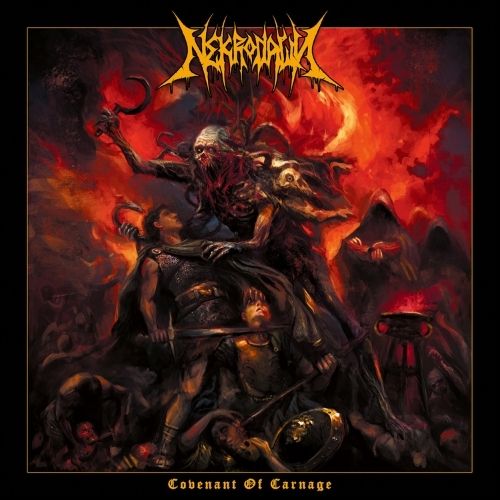
The cover artwork by Mitchell Nolte also fits this aesthetic direction. Its visual approach reinforces the album’s dark and aggressive death metal identity without clashing with the blackened atmosphere running through the music. Here, the visual presentation functions not as a separate concept attempting to overshadow the music, but as a natural extension of the aesthetic world the band has established.
What NEKRODAWN accomplish with "Covenant Of Carnage" is not to rewrite the vocabulary of Swedish death metal, but to demonstrate how flexible that vocabulary can still be. Following "Sculpted By Torture", the band has chosen not to expand its core formula so much as use it with greater precision. That is why the album’s strongest moments emerge not when it abandons the genre’s rules, but when it finds unexpected directions within them.
"Covenant Of Carnage" is an album that rewards listeners who follow the compositional instincts beneath its surface-level nostalgia. At first glance, it presents itself through the sheer force of classic Swedish death metal, but its real character emerges through its tempo changes, bass-guitar interplay, darkened harmonies and unexpected guitar ideas. NEKRODAWN are not inventing a new genre here; they are doing something more valuable by demonstrating that even within an extremely familiar framework, there is still room for personal decisions.

https://www.facebook.com/WarAnthemRecords
https://www.instagram.com/war.anthem.records
https://www.facebook.com/Nekrodawn666
https://www.instagram.com/nekrodawn
https://nekrodawn-war.bandcamp.com/album/covenant-of-carnage