

ALBUM REVIEW
NIRRITI – Dhrupad Anutpada
Anatomy of Black/Death Noise Chaos

NIRRITI stands out as a pan-international project operating at the most extreme edges of black/death metal, merging noise and war metal aesthetics with a logic of structural disintegration. With its first full-length “Dhrupad Anutpada,” the project pushes this approach further, transforming riff-centered extreme metal tradition into a fragmented, claustrophobic, and perpetually dissolving sonic architecture. In this review, we will not only address the chaotic surface the album produces, but also the compositional and aesthetic mechanisms operating beneath that chaos.
NIRRITI’s debut full-length constructs the concept of the riff not through classical notions of “continuity,” but through fragmented blocks of momentum. From the opening moments, the guitars do not generate clear motifs; instead, they form a texture based on constantly deforming, skronk-like midrange accumulation. The drums accompanying this layer retain the logic of traditional blast patterns, yet operate through accent shifts that continually fracture metric stability; thus, the rhythmic skeleton becomes less of a “supporting structure” and more of a trigger collapsing beneath the guitar and vocal mass.
The presence of the bass guitar in the mix is particularly striking: unlike many similar bestial/war metal recordings where it is buried in the background, here it emerges as a constantly “ringing” element adding a metallic body. This choice prevents the low end from completely dissolving even within the album’s suffocating and hyper-compressed production aesthetic; on the contrary, it gives the chaotic upper layers a tangible physical weight.
The vocal performance operates beyond classic black/death articulation, functioning instead as a form of “degraded communication” layered with feedback-like reverberation. Rather than words, it positions itself as a rhythmic noise generator, creating not a separate layer within the instrumental structure but a fluidity that increases the overall level of distortion in the mix.
The album’s most defining compositional approach lies in its constantly shifting, almost semi-improvisational segment transitions rather than fixed riff development. However, this “freedom” is not entirely uncontrolled; especially the micro-repetitions and abrupt stop-start structures within the drum performance reveal that the pieces are in fact organized through a strict internal logic. In other words, the sense of chaos is not produced by randomness, but by a deliberate strategy of rhythmic fragmentation.
Another notable element in the guitar writing is the use of dissonance not as a harmonic preference, but as a “flow obstruction mechanism.” Chord structures are inherently unstable; no tonal center remains stable for long. This turns the album into an acoustic field that continuously collapses and reconstructs itself, rather than following a traditional black/death progression.
The drum performance functions like a motor heavily influenced by grindcore and early war metal, yet this motor does not move in a straight line. Fill sections that sometimes appear completely disconnected actually mark points of directional change in the guitars. In this sense, the rhythm section is not merely a tempo driver, but a compositional guide.
The production character of the album is deliberately “hyper-close” and congested. Instead of expanding the frequency spectrum, it narrows it through stacked layers. This choice creates a physical sense of suffocation, particularly throughout the longer tracks; however, this sensation is not purely aesthetic but a direct result of the musical organization itself. In other words, the mix is not an independent effect layer, but a tool that carries the structure itself.
The noise/black metal fusion accompanying the conceptual framework functions here not as a decorative element, but as form itself. Industrial-leaning noise layers or feedback-adjacent guitar abrasions that emerge in certain passages do not embellish the riff structure; rather, they dissolve and redefine the riff itself. In this regard, NIRRITI’s approach diverges from the common contemporary extreme metal practice of “adding noise”: here, noise is not an addition, but a structural, deconstructive skeleton.
Even the track titles support this compositional approach; particularly the long, philosophical names (“In The Hallways of Pure Existence…”, “One Foot on Samsara…”) indicate that the musical flow is not linear but divided into conceptual blocks. However, this conceptual density does not become a narrative force guiding the music; instead, it remains a framing layer imposed upon an already chaotic structure.
In terms of its position within the genre, NIRRITI aligns closely with the extreme war/noise metal axis represented by names such as Tetragrammacide and Nyogthaeblisz; however, the key difference lies in its preference for a more fragmented, dispersed organization rather than riff-centered destruction. In this sense, while its approach shares affinities with the ritualistic aggression of bands like Intolitarian and Nuclearhammer, NIRRITI focuses less on “pure assault” and more on structural disintegration.
Released under Iron Bonehead Productions, the album stands as an extreme example of the label’s recent cultivation of an “interstitial zone between noise and war metal” aesthetic. Yet the critical point here is that the highly conceptual language and metaphysical references (Neti-Neti, apophatic structures, etc.) do not always translate into a corresponding compositional transformation within the music itself. Thus, while the philosophical framework is strong, the music often prefers to remain within it rather than expanding it.
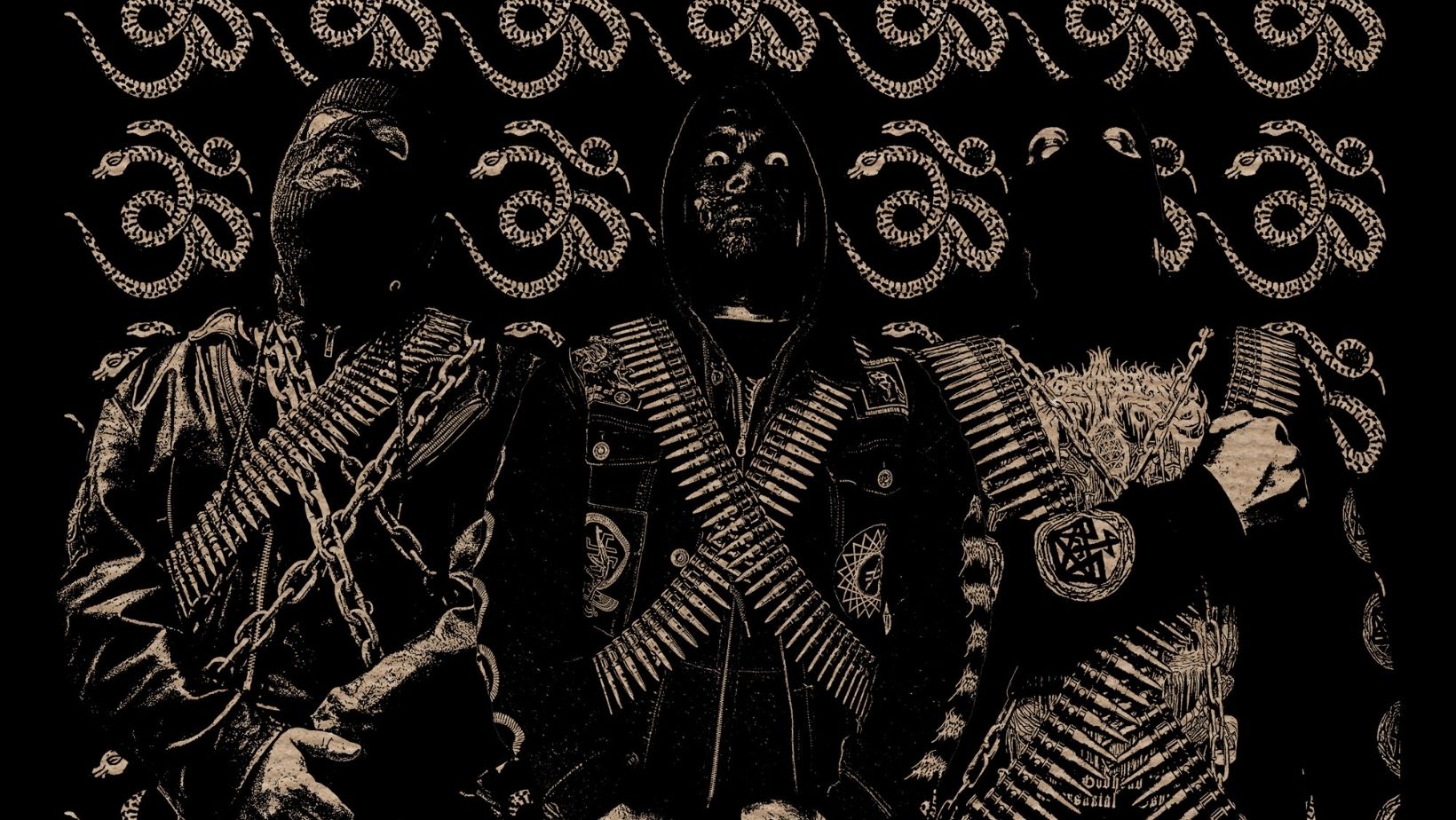
On the visual side, the cover artwork by Orryelle Bascule Defenestrate Orryelle Bascule Defenestrate constructs a visual language aligned with the album’s intensely dense and fragmented structure; however, this alignment remains primarily atmospheric. The visual narrative functions less as a force shaping the musical form and more as a surrounding surface layer.
Ultimately, “Dhrupad Anutpada” constructs a sonic architecture based not on linear riff development, but on continuously dissolving and recombining structures. For the listener, this makes traditional extreme metal flow impossible to follow, as the music operates through shifting blocks of intensity rather than the logic of discrete “songs.” Rather than expanding the boundaries of war metal and noise extremity, the album aims to eliminate the very idea of control between these two domains; however, this process of elimination does not always produce a new compositional language—it sometimes merely intensifies the existing one until it collapses into itself.
OZAN
nirriti.bandcamp.com
ironbonehead.de
ironboneheadproductions.bandcamp.com
facebook.com/ironboneheadproductions