
Album Review
Pharmacist - Vertebrae After Vertebrae
Pharmacist has, since the early 2020s, stood out as a Japanese duo building a distinct sense of density within the deathgrind and goregrind spectrum by placing the classic Carcass lineage at the center of their approach. The project fuses the medical grotesquery of early British and American extreme metal with a modern production sensibility, establishing a line of aggression that feels both nostalgic and contemporary. Across their discography, the band has combined fragmented, short-form grind structures with a riff-oriented death metal mindset, drawing particular attention through riff variety and tempo shifts. With their 2022 breakthrough, Pharmacist developed an approach that prioritizes structural density over sheer velocity. In this context, “Vertebrae After Vertebrae” is positioned as a new phase, built upon their earlier work and extending this aesthetic framework into broader compositional territory.
Now, taking a closer look at the album itself, “Vertebrae After Vertebrae” immediately establishes a familiar frame of reference: the riff-driven, medically charged deathgrind aesthetic of early Carcass records. Yet the album’s defining characteristic does not lie in reproducing these references, but in how it stretches them across longer-form compositions. When the short, fragmented grind structure is replaced with tracks approaching the 5–7 minute mark, the fundamental logic of the music shifts: riff bursts are no longer sequential micro-attacks, but larger structures that carry one another forward and at times progress through friction.
The opening track, “Propelled Inward,” demonstrates exactly how this expansion operates. The guitars maintain the continuous tremolo-based, attack-oriented riff flow typical of deathgrind, but the transitions are divided into more clearly defined segments. Riffs are connected not through abrupt cuts, but via short blocks of repetition, creating a controlled sense of directionless motion rather than outright chaos. On the drum side, dense double-bass work and snare accents establish a mechanism that constantly pushes the music forward. This structure evokes a more fluid grind/death hybrid that leans less on pure velocity logic in the vein of Napalm Death, and more on weight generated through shifting tempo.
One of the album’s key structural moves is its tempo variability. Instead of the uniform speed associated with traditional goregrind flow, Pharmacist frequently shifts into half-time sections and mid-tempo, crushing passages. These transitions bring guitar articulation into focus: in faster sections the guitars function as dense textural noise, while in slower moments they crystallize into more defined motifs. At this point, certain melodic cores become more visible, revealing brief melodic inflections that approach Carcass’ “Heartwork” era. However, these melodic elements never evolve into an independent aesthetic layer; they remain brief contrasts embedded within heavier rhythmic blocks.
The drum performance functions as the album’s structural backbone. Blast beats are not used solely to generate speed, but to segment riff transitions. The kick–snare relationship does not cut against the guitar density; instead, it forms a framework that continuously propels it forward. In certain passages, the drums’ mechanical repetition creates a deliberate tension against the complexity of the guitar riff changes, preventing the tracks from settling into a purely linear flow.
The vocal approach is built around a classic Carcass-derived tripartite structure: guttural growls, sharp barks, and higher-pitched screams are layered together. Yet the vocals function less as a central narrative element and more as a rhythmic texture. Within the mix, guitars retain priority, while vocals behave like a floating layer of articulation across the surface of the tracks. This choice shifts the focus away from individual performance toward riff architecture.
One of the more contentious aspects of the album is its production character. Different sources describe the sound as both “murky and dirty” and “clear with an analog feel.” This apparent contradiction actually reflects the dual nature of the mix: guitars generate a dense midrange haze, while the drums—particularly snare and kick—are rendered with distinct separation. This creates two outcomes simultaneously. On one hand, it reinforces the chaotic deathgrind aesthetic; on the other, it pushes articulation in longer riff sequences into the background, leading some repetitive passages to feel more homogenized than intended.
The album’s extended-form experimentation becomes particularly evident on tracks like “Endogenica.” Here, the structure moves away from the short-burst logic of grind composition and leans instead into cyclical riff development. Riffs evolve not through repetition alone, but through incremental variation. This approach forms a hybrid between the mid-tempo destruction logic associated with Slayer and Kreator and the velocity-driven framework of deathgrind. However, this expansion does not consistently produce the same effect: while some sections generate a strong sense of flow through riff density, others amplify the perception of repetition within the same material.
In the closing stages of the album, this structure produces a more pronounced tension. Longer pieces such as “Zenith Of Mnemonic Forensication” test the limits of compositional expansion. What stands out is that the structure is not built around a single riff, but rather a sequence of constantly shifting segments placed side by side. However, this method does not always generate a sense of dramatic progression. Particularly in the mid-sections, recurring riff cycles occasionally interrupt the natural flow of the track. Still, towards the end, half-slow, groove-oriented passages form some of the album’s clearest structural moments.
Pharmacist’s guitar approach is generally rooted in high-density riff construction. The emphasis is not on technical virtuosity, but on how riffs are organized in sequence. At times, more articulated riff ideas reminiscent of Death briefly emerge, but they never become dominant. As a result, the album functions as a constantly shifting field of references: Carcass foundations, thrash-inflected transitions, and grindcore velocity aesthetics all occupy the same surface in continuous rotation.
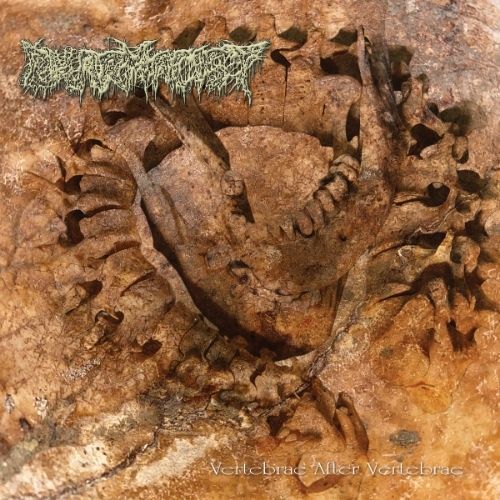
Aesthetically, the album’s cover and visual language remain faithful to the classic goregrind tradition. Built around anatomical fragmentation and medical grotesquery, this approach runs in direct parallel with the riff density and structural chaos of the music. However, the visual design functions more as a complementary frame for the established aesthetic rather than a force that deepens the album’s structural ideas; it does not actively shape the compositional logic.
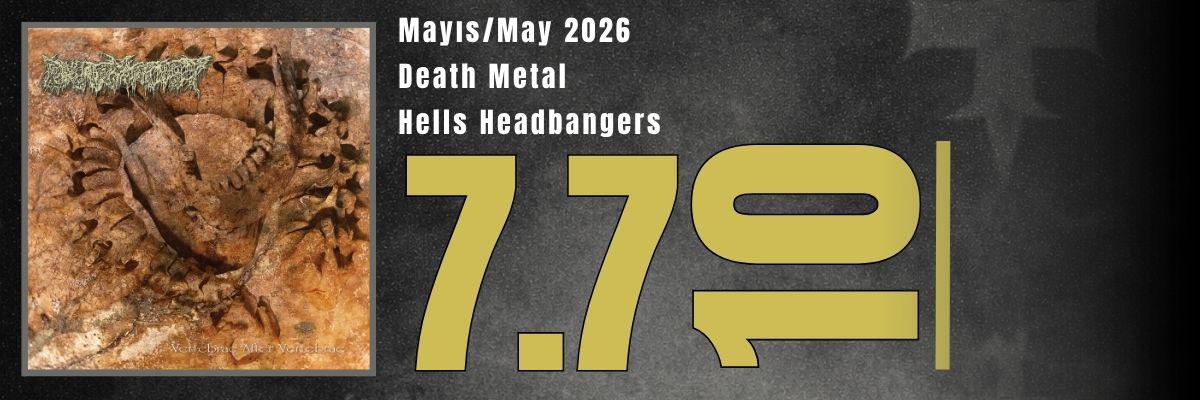
Ultimately, “Vertebrae After Vertebrae” reads as a work that does not alter Pharmacist’s core aesthetic, but attempts to expand it. While extended song structures and groove-oriented mid-tempo shifts aim toward a more “structural” form of deathgrind, this expansion does not consistently deliver the same level of impact. In some passages, riff organization generates a strong sense of flow, while in longer sections repetition begins to overshadow composition. The album demands a more attentive listening approach focused not only on speed, but on tracking riff transitions; however, it does not always construct a refined enough framework to fully sustain that demand. As a result, the record remains a variation that pushes forward the Carcass-rooted modern deathgrind line rather than a point of rupture that fundamentally transforms it.
OZAN
hellsheadbangers.com
facebook.com/hellsheadbangers
hellsheadbangers.bandcamp.com
instagram.com/hellsheadbangers
twitter.com/hellshead666
youtube.com/user/hellsheadbangers666