
Album Review
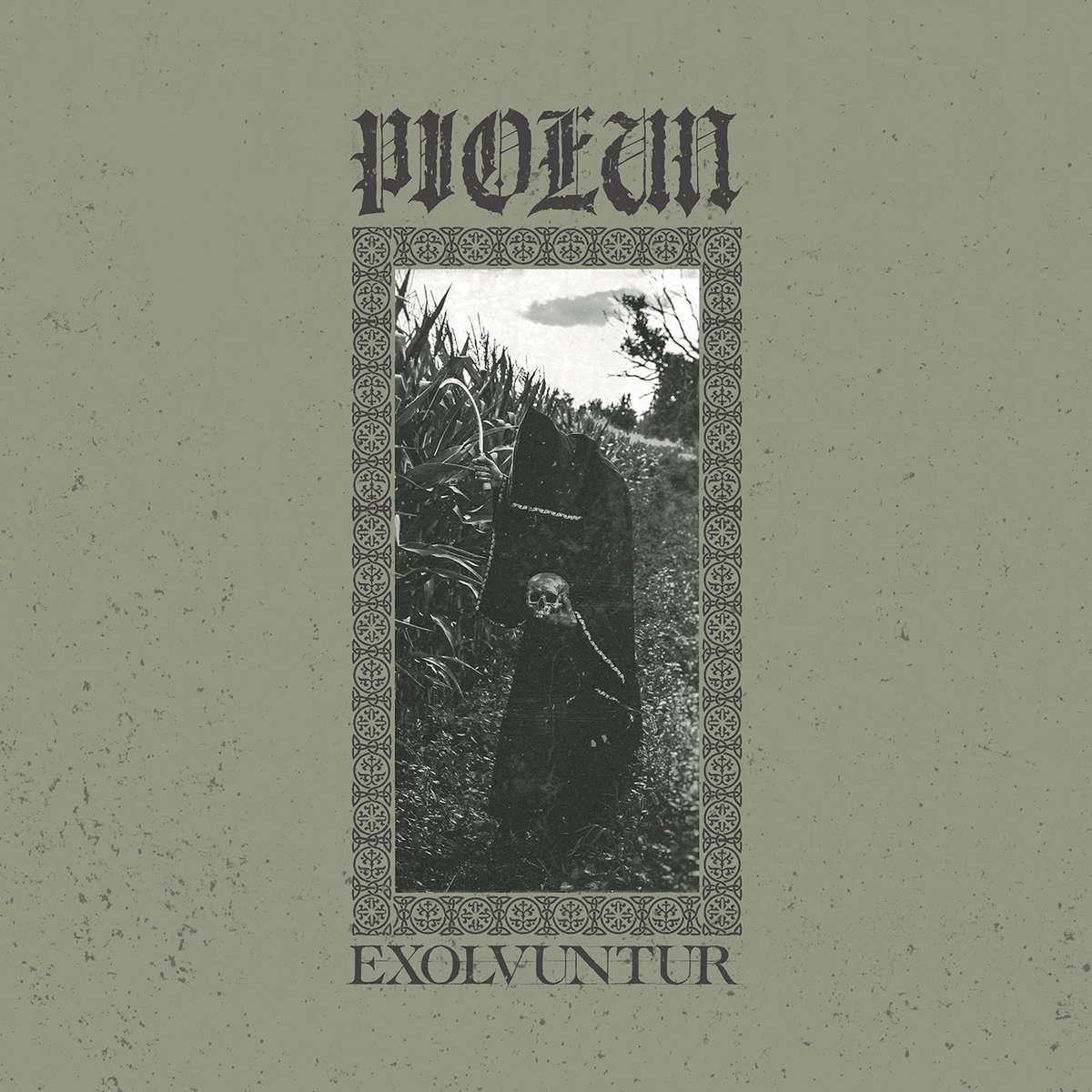
Piołun - Exolvuntur
Piołun’s Exolvuntur immediately defines itself not through grand riff gestures, but through a controlled economy of movement. The guitar writing progresses almost entirely along a tremolo-based line, and these lines frequently converge on a single melodic center, forming a cyclical structure. This cyclicity is reinforced especially by the recurring return of upper guitar melodies that could be described as “uplifting,” yet because these returns unfold through minimal deviations rather than variation, they create the impression of a deliberately narrowed space for dramatic expansion. The album’s compositional language attempts to balance second-wave black metal with the melodic-military discipline of the Polish scene, yet it constructs this not through an expanding framework, but via a riff core that reiterates itself internally.
The drum writing is the most decisive, yet also the most problematic carrier of this structure. The tracks generally oscillate between two poles: mid-tempo marching rhythms and standard blast beat variations. However, because transitions are often not supported by fills or connective phrases, tempo shifts result in mechanical interruptions rather than an organic dramatic flow. This directly affects the melodic continuity created by the guitars; particularly in faster sections, guitar lines and vocal articulation occupy the same frequency range and begin to mask one another. The production’s generally “clean yet compressed” character at times amplifies this overlap rather than resolving it.
In the vocal performance, Łukasz Barański’s approach is based on a constant stabilization of intensity between scream and harsh vocal delivery. When the vocal line attempts to sit above the guitars rather than align rhythmically with them, the resulting tension occasionally creates a deliberate contrast, yet this contrast is not always compositionally structured. Especially in denser passages, the simultaneous effort of vocals and guitars to occupy the foreground creates a narrowed focal point in the mix, which compresses expression rather than strengthening it.
On the guitar side, the most defining feature of the album is the derivation of melodic motifs from a very limited set of core forms. Although the tremolo riffs vary technically, their interval structures remain remarkably close, creating a sense of melodic kinship between tracks such as “Sierpniowy-brzask” and “Hiems,” while also reinforcing a pronounced sense of repetition. Tracks like “Manifest-kresu” and “Koło-życia” attempt to break this pattern through more rhythmic propulsion; in particular, stop-start transitions and off-beat entries generate brief moments of dynamism, yet these gestures remain surface-level accents rather than transformations of the broader compositional logic.
The album’s atmospheric ambition relies heavily on the upper melodic lines carried by the guitars. However, these melodies more often produce a sense of “incomplete resolution” rather than harmonic closure. While this opens a space aesthetically close to melancholy, it simultaneously creates a non-diversifying loop of tension on a structural level. Especially in tracks such as “Próba-sznura,” where a more pronounced melodic climax is expected, the central motifs continue to circle within the same scale, repeatedly deferring that peak.
On the production side, there is a dense mid-frequency wall bearing the signature feel associated with Grunberg. The guitars are layered but not clearly separated from one another; while this is intended to create a “blooming” atmosphere, it does not fully integrate with the timbral character of the drums. The snare, perceived as sharp in some moments and almost muted in others, weakens the micro-dynamic balance of the mix. This imbalance causes all instruments, particularly in faster passages, to become trapped within a single blurred field of motion.
At the conceptual level, the themes of nature, death, and cyclicity do not translate into a direct narrative form in the music; instead, they are represented through the repetitive structure of the compositions. The critical point here, however, is that while the idea of cyclicity aligns with the repetition in riff writing, the lack of compositional variation within these repetitions makes it feel less like a thematic correspondence and more like a structural limitation. For this reason, the relationship between concept and musical construction is not always equally mutually reinforcing.
Piołun’s connection to the Polish black metal scene is clearly audible: the “uplifting” character of melodic lines, mid-tempo marching structures, and moments of epic emphasis evoke the aesthetic codes of the post-Mgła era. However, Exolvuntur tends to preserve rather than expand these codes. Its claim to be more dynamic and melodic is largely resolved through denser repetition of an already established riff language, which positions the album closer to a controlled practice of reiteration than to any form of structural expansion.
Ultimately, Exolvuntur is structured in a way that demands the listener’s acceptance of its repetitive cycle rather than active engagement with transformation. It remains within a riff-centered melodic black metal framework, and even in moments where it attempts to step outside this frame, it does so not through a new compositional logic, but through variations of existing motifs. This positions the album on a line between “reproduction” and “reinterpretation,” leaning toward the latter, yet never fully crossing into it.
OZY
https://piolunbm.bandcamp.com/album/rzeki-goryczy
https://www.facebook.com/piolunpbm/
https://www.instagram.com/piolun_pbm/