Album Review
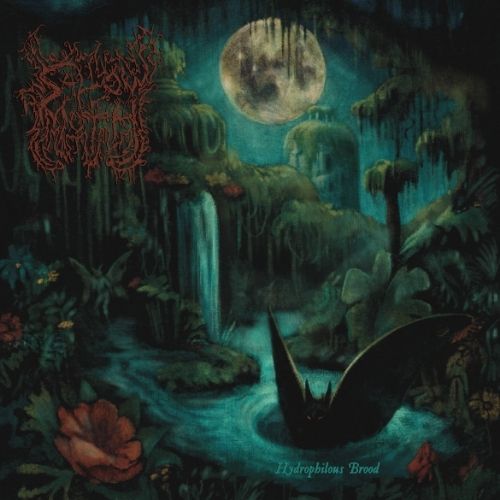
Sallow Moth - Hydrophilous Brood
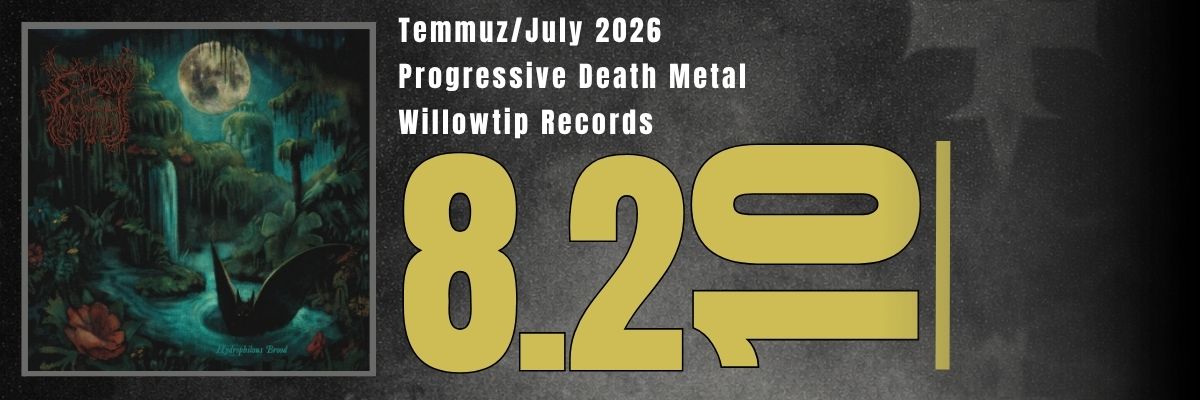
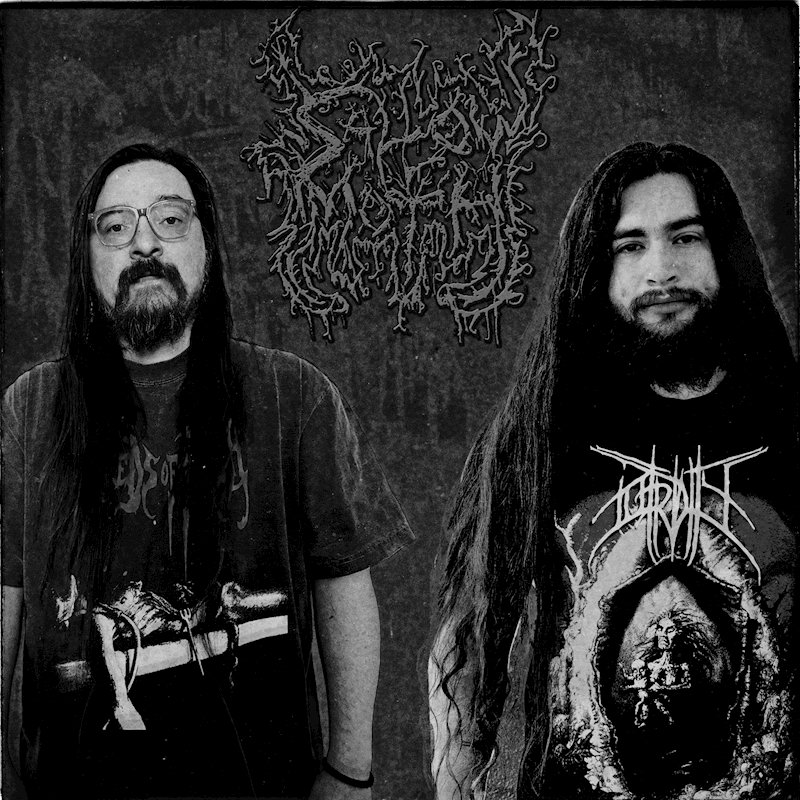
Sallow Moth, as a progressive/technical death metal duo from Dallas, positions itself around a constantly shape-shifting compositional approach centered on Garry Brents. What sets the project apart from its peers is its refusal to maintain a fixed line between technical death metal and brutal death metal, instead constructing a framework that constantly shifts between the two and redefining this fluidity with each release. “Hydrophilous Brood,” as one of the most intense and controlled manifestations of this approach, clearly highlights both the band’s aesthetic direction under Willowtip Records and its increasingly sharpened, technique-driven writing language.
From its very first minutes, the album makes it clear that its riff architecture is built not on “producing stability,” but on a continuously destabilized technical flow. The guitars largely move through low tunings, sharp attacks, and rapid tremolo / palm-muted transitions, organizing this material not along classic brutal death metal linearity but through constantly fractured phrase structures. The riffs often function less like complete sentences and more like intersecting micro-fragments, creating a compositional logic that deliberately sabotages any sense of continuity in the listener.
The rhythmic backbone of this approach must be read in relation to the elevated technical capacity of the drum performance. Allen Gingerich’s contribution on drums uses blast beat variations not merely to generate speed, but as a structural framework that stabilizes the irregularity of the guitar layers. However, this stabilization never fully takes hold, as within-measure shifts, sudden stops, and unexpected groove ruptures continuously loosen this framework. This pushes the music toward a state that is less chaotic and more “tending toward controlled disintegration.” In particular, breakdown transitions often open up new rhythmic problem spaces rather than delivering the expected release.
This tension between guitar and drums clearly defines the album’s positioning between technical death metal and brutal death metal. Sallow Moth produces an intensity that leans close to the Wormed and Deeds of Flesh axis, yet instead of a purely linear brutal assault, it occasionally introduces prog-death-inflected harmonic deviations. These deviations are generally short-lived; rather than building atmosphere, they function as temporary openings that interrupt the rigidity of the composition.
One of the album’s most distinctive traits is the dual control of tonal precision and structural fragmentation by guitarist and producer Garry Brents. While the bass guitar remains low in the mix in terms of presence, the low frequencies consistently create a sense of compressed density. This reduces the “readability” of the riffs while simultaneously making it harder for technical details to fully surface. The use of keys, meanwhile, functions more as a layer filling transitional spaces than as an atmospheric driver; while it occasionally adds brief harmonic shadows, it is not decisive enough to alter the structural center of the album.
The vocal performance follows the deep guttural tradition of brutal death metal, but here the goal is not solely to generate weight; it is to create a “non-human layer of articulation” between rhythmic blocks. Particularly the high screams and additional vocal contributions (layered through guest appearances) create a spectral sense of crowding in certain sections, yet this layering often remains a texture that increases density rather than expanding the composition.
One of the most notable structural tensions of the album lies in the imbalance between its claim of “unpredictability” and its controlled repetition. The tracks frequently change direction; however, these shifts do not always generate new musical ideas. Some transitions—especially abrupt groove breaks and near-random-sounding breakdown entries—are technically impressive, yet do not feel equally justified in terms of compositional intent. This creates moments where the distance between structure and idea becomes more pronounced.
At a conceptual level, the “Pamugara” universe and the post-“Mossbane Lantern” transformation idea are aligned with the continuously mutating nature of the music. However, this concept does not always find an equally strong direct musical correspondence. In other words, while the idea of transformation is present in riff writing and structural flow, the pieces themselves tend to remain focused on continuous variation rather than turning this transformation into a dramatic narrative. This leaves the concept–music relationship more at the level of an accompanying framework.
Guest contributions on the album, particularly high vocal layers and guitar solos, occasionally introduce new colors into the structure, but these additions are generally not elements that redirect the composition. A more striking example is the use of trumpet; an unusual timbre in an extreme metal context, it surfaces during a transitional moment but, due to its short duration and limited integration, functions more as a momentary contrast rather than rewriting the compositional logic. At this point, the question arises: do such instrumental additions truly create structural transformation, or are they merely surface-level colors that fragment density? The album in most cases leans closer to the latter.
The production approach is compressed and detail-oriented in line with modern technical death metal standards. However, the overall density of the mix makes long-term distinction of micro-details difficult. This results in a character that feels “impressive on first listen, but requiring decoding on repeated plays,” although the process of decoding often feels less like revealing new layers and more like re-examining the same wall of intensity from different angles.
Ultimately, “Hydrophilous Brood” aims to produce a controlled yet fragmented intensity that constantly oscillates between technical brutal death metal and progressive tendencies. Rather than expanding genre boundaries, Sallow Moth attempts here to rewrite the existing technical death metal vocabulary through extreme densification. However, when certain compositional ideas—particularly unpredictability and momentary ruptures—are not developed deeply enough, this intensity at times generates a cyclical sense of repetition within itself.
This is not an album for passive listening; it requires an active mode of engagement that follows rhythmic fragmentation, guitar–drum interaction, and micro-transitions. Yet this demand for attention does not always result in new structural discoveries; it more often reveals different surfaces of the same density architecture. In this sense, “Hydrophilous Brood” positions itself less as a record that expands its field, and more as a work that compresses the existing technical brutal paradigm into a tighter, more brittle form.
OZAN
https://bit.ly/hydrophilous-willowtip