ALBUM REVIEW
Thy Killing Hand – Infernal Commands
The Ritualistic Face of Black Metal
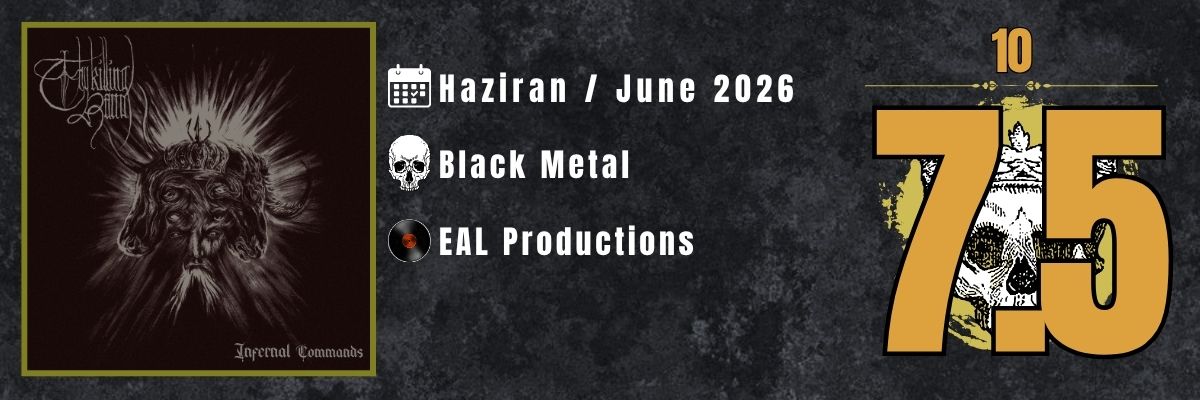
Polish anonymous duo Thy Killing Hand are positioned as a project drawing on ritualistic and slow-moving forms of black metal. Infernal Commands pushes the raw, ceremonial aesthetic established on the band’s earlier tape releases into a denser and more compressed framework. Released via EAL Productions, this debut full-length carries the intent of constructing a deliberately “dirty” and closed-off black metal language operating outside of standard scene conventions.
Infernal Commands is not built on black metal’s reflex for speed, but on an idea of pressure rooted in weight and continuity. Rather than relying on high-frequency tremolo surfaces, the guitars inhabit the lower-mid register, circling around riff cells that remain in constant “forward motion” without ever fully resolving. This approach produces a rhythmically constrained sense of marching rather than a flow based on the classic blast beat–tremolo synchronization. Instead of reaching clear cadential points, the riffs often fold back into themselves in cyclical patterns, shifting the music away from any structural notion of “ending” and into a continuous line of tension.
The drum performance is the most critical element supporting this framework. Blast beat passages are not entirely absent, but they do not form the backbone of the album. More decisive is the way kick and snare are locked into an almost ritualistic marching tempo. This choice makes the tracks operate less through speed and more through “distribution of weight.” In particular, the midtempo sections rely on repetition of the same impact pattern rather than rhythmic variation, creating a sense of inevitability. This leans closer to monotony than technical diversity, yet it can be read as a functional decision in service of the ritualistic harshness the album is aiming for.
The role of the bass in the mix is positioned noticeably outside conventional black metal standards. Rather than disappearing as a supporting layer, it behaves as a physical pressure system continuously pushing up from beneath the guitars. The saturation of low-mid frequencies deliberately blurs the harmonic clarity of the riffs. This blurring produces a sense of tonal decay rather than harmonic resolution; the music avoids settling into any stable tonal center, remaining in a constant state of drift.
The vocal approach does not completely abandon the high-pitched scream tradition, but it does not limit itself to a single mode of expression. Whisper layers accompanying the screams, along with occasional ritualistic spoken passages and chants, transform the vocal line into a multi-layered “communication system” rather than a singular voice. In particular, the chant sections do not provide a melodic counterpoint to the riffs but function as a ceremonial element filling rhythmic space. This reinforces the idea that the vocals operate structurally rather than narratively.
The most defining compositional decision is the controlled asymmetry in tempo distribution. The tracks move between three speed regimes: suppressed midtempo marching, short bursts of blast-driven acceleration, and more sporadic atmospheric slowdowns. However, these shifts are not presented as dramatic contrasts; instead, they are designed as different intensities of the same weight-bearing force. This approach turns the album from a collection of songs into a single extended ritual flow.
Synth usage and choral textures operate as secondary but non-decorative layers within this structure. The synths do not aim to add brightness or melodic expansion, but function as a low-resolution atmospheric fog. The choir-like vocal layers open a space that reinforces ritual connotations, yet these elements do not reshape the riff architecture. In other words, the atmosphere expands, but the compositional skeleton remains unchanged. At this point, the album sits between atmospheric black metal and ritualistic dungeon/occult aesthetics, yet structurally leans closer to the latter.
90s black metal references are particularly audible in riff writing and production choices, though these references do not amount to a direct reconstruction. Instead of choosing between lo-fi or modern clean production, the album adopts a denser yet rough-edged mix. The guitars do not cut with sharp precision; they behave more like eroded metal surfaces. This suggests an attempt not to nostalgically recreate older aesthetics, but to reassemble them as a physical texture.
In several tracks, clean guitar passages and short instrumental sections are used not to break the album’s monolithic structure, but to mark internal voids within the ritual. However, these moments rarely open new compositional directions, instead functioning as temporary thinnings of the existing atmosphere. Likewise, melodic lines do not transform the riff framework, but remain surface movements orbiting around it.
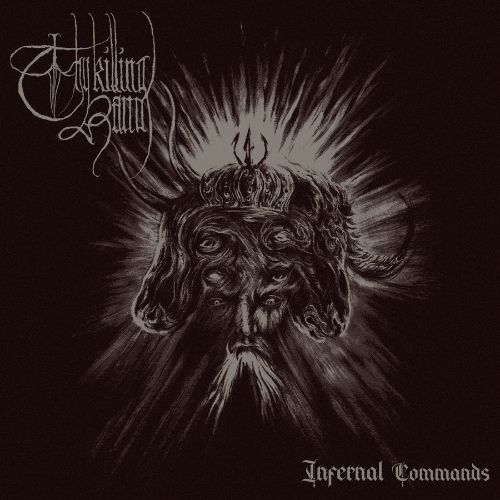
The visual identity constructs a direct parallel with the music. The multi-headed crowned figure and intense backlighting on the cover clearly reflect the album’s central idea of “authority as deformation.” However, the primary function of this visual language is not to build narrative depth, but to translate the music’s already existing sense of compression and decay into iconography. The artwork does not explain the music; it symbolically reiterates it. The alignment is strong, but its capacity to add an additional conceptual layer remains limited.
From a broader compositional standpoint, Infernal Commands does not align itself with the hyper-technical tendencies or atmospheric overexpansion often found in contemporary black metal. Instead, it builds a structure that insists on a single idea, at times even using repetition as a deliberate aesthetic tool. While this repetition can limit compositional diversity in certain passages, it reinforces the album’s core premise of constructing ritual through pressure.
Ultimately, Infernal Commands demands a listening approach that rejects linear song progression in favor of shifting intensities. Rather than establishing clear dramatic separations between tracks, it presents different compression states of the same dark material. This positions the album less as an attempt at technical innovation within the contemporary scene, and more as a systematic reconstruction of a specific ritualistic black metal language.
OZAN