
ALBUM REVIEW
TRAUMATOMY - Ascension of the Ineffable
Raw, repetitive, groove-driven slam brutality.
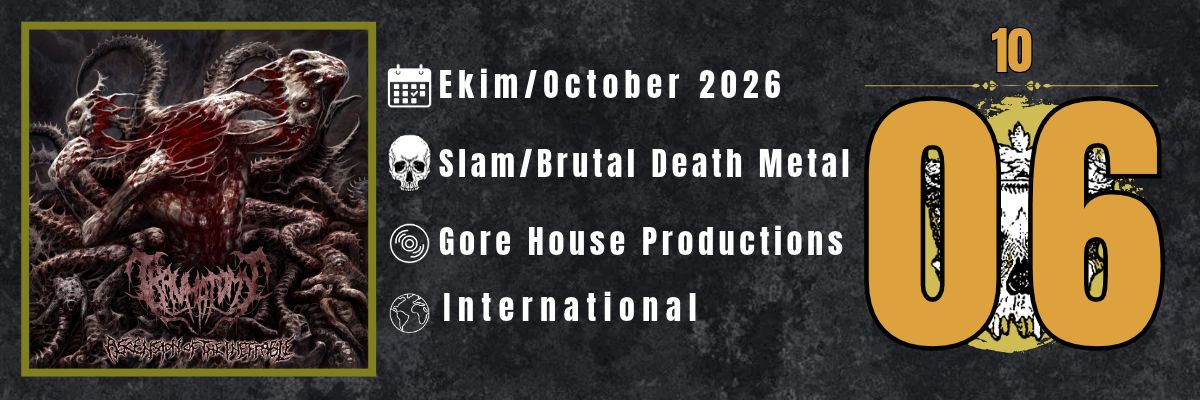
Formed in 2012, TRAUMATOMY have built their musical identity around the familiar conventions of Slam Brutal Death Metal. This approach, already evident in their earlier material, returns with "Ascension of the Ineffable", the band's first release in a considerable time. Issued through Gore House Productions, the eight-track album clocks in at approximately 24 minutes, adhering to the genre's tradition of short, concentrated and uncompromising material. Its thematic framework, drawing inspiration from H.P. Lovecraft's cosmic horror and the darker world of crime television, further complements the music's grotesque character.
Opening track 'Entropic Obliteration' provides a brief introduction to the album's atmosphere through its background sounds and vocal elements, before the ensuing riffs and rhythmic shifts establish the band's primary approach. 'Pervigilium of the Obsolesced Xenolith' explores a more dynamic side of this formula, combining fast passages with crushing groove sections. In TRAUMATOMY's songwriting, blast beats, sudden tempo changes and slam passages do not function as isolated elements; they serve as the fundamental tools shaping each track's progression and establishing the genre's familiar dynamics. Nevertheless, the predictability of these transitions becomes increasingly apparent as the album unfolds.

'Endoneural Parasitosis' and 'Repugnant Coalescence' bring the record's extreme character into sharper focus, particularly where punishing guitar riffs collide with deep guttural vocals. The latter's extensive use of slam sections makes the band's emphasis on rhythmic weight abundantly clear. The title track follows a similar approach, retaining its riff-driven and breakdown-focused structure despite its brief running time. The emphasis here is less on technical showmanship than on arranging each passage to convey its full physical weight. Written by Constantine Chevardin, the compositions remain firmly within the genre's established boundaries. This choice lends the album its directness, but also limits its musical variety.
Despite running just over two and a half minutes, 'Visceral Maceration' is one of the album's most effective moments. The concentration of massive riffs and forceful rhythmic accents into such a short space makes the track's potential in a live setting particularly evident. 'Autognathic Avulsion', meanwhile, creates a more sustained sense of velocity through its blast beat-driven drumming and dark riffs. Closing track 'Xeno-Homeostasis' completes the album's overall picture with its deep vocal delivery and dense instrumentation. However, there are very few melodic or structural ideas capable of giving these tracks a lasting individual identity. While the songs are functional in their own right, the compositional choices rarely establish enough distinction between them.
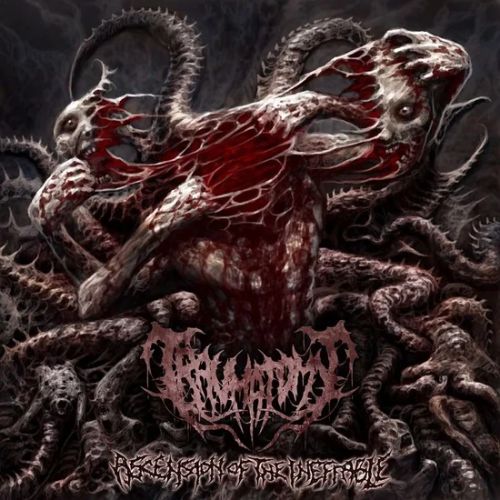
The album's organic, raw character is particularly noteworthy on the production front. Konstantin Ogarkov's mixing and mastering support the sharp, abrasive sound the band set out to achieve. The weight of the guitars, the rhythmic aggression of the drums and the depth of the vocals come together without resorting to an excessively sterile sound. This approach lends the music a degree of naturalness within a genre whose mechanical tendencies can easily become overwhelming. Jon Zig's cover artwork, with its grotesque visual language, also fits the album's thematic world of cosmic horror and brutality. In this respect, "Ascension of the Ineffable" maintains a coherent aesthetic identity across both its sound and visual presentation.
The central issue is not TRAUMATOMY's reliance on the genre's established elements, but rather their failure to develop those elements into a sufficiently distinctive compositional identity of their own. The slam passages, blast beats, guttural vocals and groove-oriented riffs all fulfil their expected functions. Yet for much of the album, it is easy to anticipate how these components will come together. The band appears to have adopted a faster, harsher and rawer direction following their earlier releases, but while the overall intensity has increased, they have been less successful in developing new ideas that would give the individual songs a stronger sense of identity. Even across an album lasting just 24 minutes, the tracks' reliance on similar structural choices diminishes the incentive to return for repeated listens.
"Ascension of the Ineffable" will appeal to listeners who have no interest in seeing Slam Brutal Death Metal move beyond its fundamental dynamics and value the genre's physical weight and raw character. Although the production choices and the straightforwardness of the performances deserve recognition, they cannot compensate for the limited compositional variety. TRAUMATOMY clearly understand the conventions of their chosen genre; what remains missing is the ability to extract a more distinctive musical language of their own from those traditions. "Ascension of the Ineffable" may earn its place in the Slam Brutal Death Metal catalogue, but it ultimately lacks the songwriting ideas necessary to make it memorable.

http://gorehouseproductions.com