Album Review
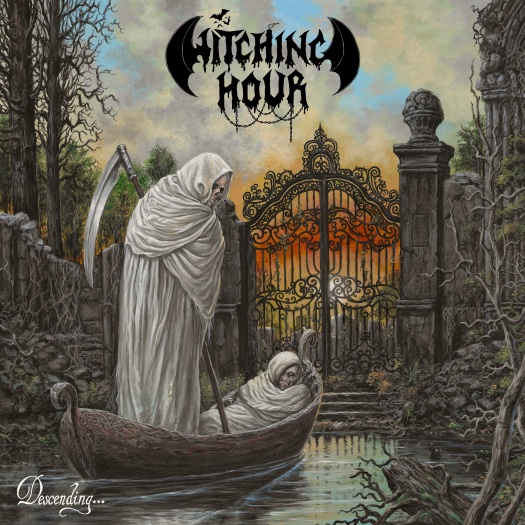
Witching Hour – Descending… Where Time Has Ceased To Exist
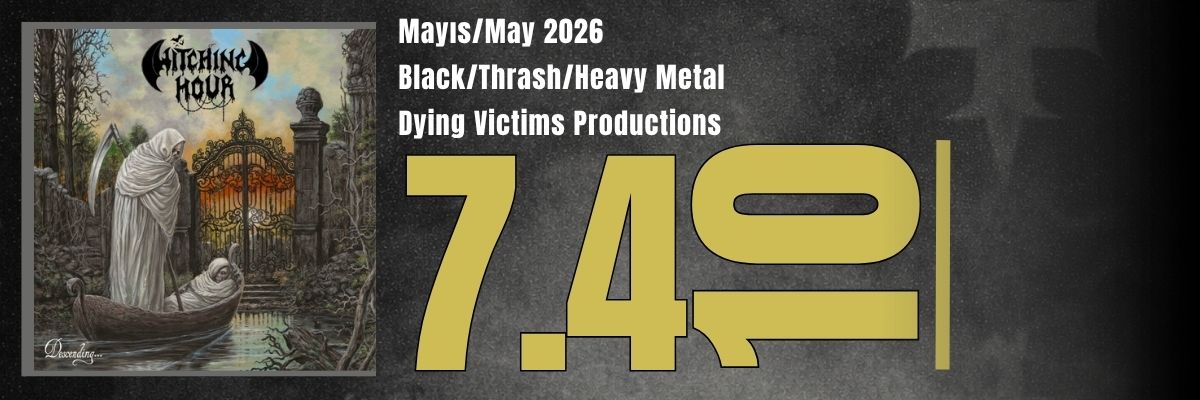
“Descending… Where Time Has Ceased To Exist” immediately positions riff design not as a byproduct of atmosphere-building, but as the structural backbone of the composition itself. The brief piano intro at the opening functions less as a dramatic entry device and more as a void-like contrast layer against the guitar-driven tension of the following sections. The guitars that emerge from this space bring together a tremolo-heavy Black Metal language with the more pronounced lead sensibility of classic Heavy Metal; however, this convergence operates less like a “fusion” and more through a layered riff architecture.
The album’s core identity is shaped by the continuous process of melodic dissolution and reconstruction within the guitars. Rather than locking into a single motif, the riffs expand through short arpeggiated transitions and shifts in tempo. In contrast to many contemporary Black/Thrash examples, this approach relies less on direct speed-driven aggression and more on controlled directional changes. Particularly in mid-tempo passages, the influence of traditional Heavy Metal becomes more apparent; however, these sections function less as moments of epic expansion and more as mechanisms for redistributing rhythmic density.
Within the rhythm section, the drums operate through constant transitions between blast beats and traditional Thrash-driven patterns. These shifts are not arbitrary; they are positioned as pressure-release points within the album’s extended song structures (mostly in the 7–8 minute range). The role of the bass guitar in the mix is notably more pronounced than usual. It does not merely provide harmonic support, but in certain passages acts as a secondary line that carries the directional weight of the riffs from below. Especially in denser sections, the prominence of the bass balances the upper-frequency aggression of the guitars and pulls the composition away from a single-layered speed aesthetic.
The vocal approach is deliberately left “dirty” within the production. The rasping, guttural timbre is not placed at the center of the mix but kept slightly recessed. This choice causes the vocals to function less as a leading narrative force and more as a textural element embedded within the structure. At times, the dispersal of articulation blurs rhythmic clarity more than it intensifies aggression; while this does not operate equally effectively across every track, it establishes a risk space that remains consistent with the album’s broader aesthetic.
One of the most striking aspects of the production is the balance between rawness and separation. The guitars are left deliberately organic in tone, yet the mix remains clean enough to prevent instrumental clutter. This dual approach makes the density of the faster passages legible and readable. However, in the mid-sections of certain extended compositions, recurring riff ideas occasionally create a sense of linear progression due to variations not being sharpened enough. Although this repetition issue—more pronounced on earlier releases—has been reduced here, it has not been entirely eliminated.
The aesthetic framework described as “Ancient Black Metal” functions here less as a stylistic label and more as an attempt to merge Black/Thrash/Speed foundations with historical Heavy Metal references. However, the practical realization of this concept is not always uniformly intense. In some passages, Doom influences or epic Heavy Metal segments genuinely expand the structural scope, while in others these elements remain closer to surface-level coloration. In this sense, the album oscillates between compositional expansion and decorative addition.
Viewed as a whole, “Descending… Where Time Has Ceased To Exist” constructs a framework that relies on the dramatic unfolding of extended-form compositions. Tracks such as “The Graves Yearn For The Dead” represent the album’s most coherent formulation, balancing riff variation and rhythmic rupture with greater control. In contrast, when extended duration is not matched by equivalent density of ideas, internal tension dynamics can flatten into a more linear trajectory.
On the production side, the clarity of the mix signals a deliberate departure from the genre’s typical lo-fi or heavily obscured approaches. This does not indicate a rejection of underground aesthetics, but rather proposes a model in which rawness is defined through performance intensity rather than sonic blur.
Ultimately, the album establishes a listening framework that demands engagement with long-form structures rather than rapid consumption. Its progression relies less on linear climactic buildup and more on recurring but constantly shifting riff blocks. This positions the record both within a recognizable Black/Thrash lineage and within a more legible contemporary production context. However, because the tension between conceptual density and extended duration is not fully resolved in every passage, the album’s strongest attribute—its structural ambition—does not sustain equal force across all compositions.
OZY
https://witchinghourthrash.bandcamp.com/
https://www.facebook.com/WitchingHourThrash/
https://www.instagram.com/witchinghourthrash