Album Review
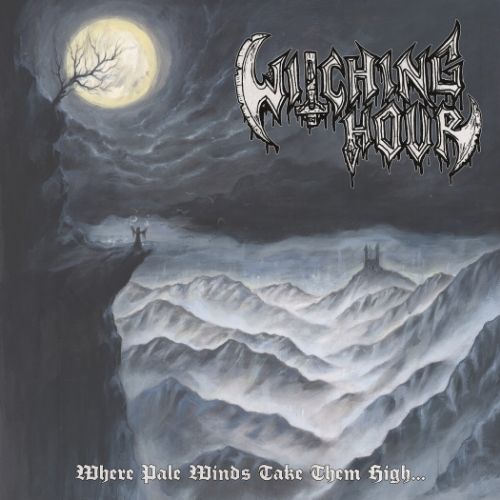
Witching Hour - Where Pale Winds Take Them High…
Released in 2014 and now re-circulated, "Where Pale Winds Take Them High…" represents an early, yet distinctly shaped version of Witching Hour’s language built on the black/thrash axis. Viewed from a 2026 perspective, this record does not merely replicate the frequently encountered “Teutonic speed + black metal aesthetic” hybrid of the German scene; it also clearly exposes where this synthesis remains organic and where it slips into formulaic execution. The album’s backbone is structured around a riff-driven flow: the guitars remain in constant motion, often employing a structure that oscillates between tremolo picking and classic thrash palm-muted propulsion. However, this sense of movement does not always generate a clear dramatic direction; instead, it produces a continuous forward thrust.
The opening track “About A Curse Of A Morbid Century” directly embodies this approach. Within a fast tempo framework, the guitars construct sequences of riffs that support each other yet frequently remain within the same harmonic territory. What stands out here is that the guitars focus more on generating rhythmic momentum than melodic variety. The drums function as more than a simple timekeeping foundation in this context; through tom-heavy accents and a relatively deep recorded character, they operate as a secondary layer thickening the riffs. However, as the tempo intensifies, the micro-dynamic range of the guitars becomes narrower, and certain sections of the track slip into a structurally “block riff repetition,” resulting in a more linear flow.
One of the most defining identity elements of the album is its vocal design. The reverberation and sense of spatial emptiness applied to Jan Hirtz’s vocals reframes the thrash/black vocal tradition through a distinctly “lo-fi atmospheric filter.” This effect creates a constant oscillation between pushing the vocal forward in the mix and pulling it back. Interestingly, during vocal passages, the frequency space of the other instruments narrows, and the guitars appear as if they are being pushed into the background. This creates a grey area regarding whether this is a compositional decision or a mixing balance issue. In either case, the result is a consolidation of rhythmic density around a single focal point during vocal sections, while partially suppressing the contrapuntal potential of the guitars.
The drum performance stands as one of the most consistent structural components of the album. In particular, the snare–tom transitions and kick density deliver a clear articulation even at thrash-level speed. Nevertheless, in high-velocity passages, the increasing density of the guitars pushes the finer nuances of the drums into the background, whereas in more controlled tempos the layering between instruments becomes significantly more pronounced. This contrast becomes especially clear in tracks like “Von Unaussprechlichen Kulten,” which leave more breathing space. The instrumental closer reveals not only the guitars’ speed-oriented function but also their capacity for motif development. Here, the riffs are less compressed and granted more room to breathe, which in turn makes the tonal depth of the drums more legible.
The mid-section of the album forms its most contentious compositional area. In theory, the high tempo and constant riff changes should generate variety, yet in practice they can reinforce a sense of repetition. While some riff transitions are melodically striking, many of these ideas are consumed quickly rather than being developed within the song structure. Particularly in moments where the guitars shift into dual or harmonized passages, the NWOBHM influence becomes more apparent; however, this influence often remains a surface-level coloration rather than a structural transformation. In other words, the idea of harmonic expansion is present, but it never becomes dominant enough to reshape the architecture of the songs.
The production aesthetic deliberately carries a retro character. The guitar tone, reinforced by an analog-like sensibility, creates a full-bodied low-end presence while remaining slightly blurred in the midrange. This blurriness establishes an intermediate zone between black metal atmosphere and thrash clarity, though this zone is not always tightly controlled. In particularly fast riff sections, guitar definition occasionally loses its edges, making technical detail harder to perceive. In contrast, the more “room-like” character of the drums emerges as the most organic element in the mix.
The album’s overall compositional approach clearly reflects early Witching Hour’s exploratory phase: a short-form, riff-oriented structure that nevertheless attempts to establish an atmospheric identity. This attempt works more successfully in the intro and outro arrangements, while in the central song blocks the density of ideas tends to overpower their developmental potential. There are no expansive elements such as saxophone, keyboards, or external instrumentation; as a result, the atmosphere is constructed entirely through guitar harmony, vocal effects, and drum dynamics. This effectively turns the record into a pure “riff architecture test.”
From a contemporary standpoint, "Where Pale Winds Take Them High…" does not represent a radical rupture within the genre, but rather a typical example of the melodic direction within the German black/thrash scene of its period. Its strongest aspect lies in how it demonstrates the rebalancing of instruments across different velocity layers; its weakest aspect is the fact that these ideas do not consistently translate into compositional development. As a result, the record remains a form that operates through the immediate impact of individual tracks rather than sustaining a cohesive dramatic architecture.
Ultimately, this EP/mini-album demands a segmented listening approach focused on detail rather than a linear flow of speed. Micro-level observations—such as how riffs are repeated, how vocals are positioned within the mix, and when drums come to the foreground—become central to the listening experience. Witching Hour does not yet present a fully crystallized signature here; instead, it documents a transitional phase that tests the tension between melodic expansion and rhythmic severity within the black/thrash framework.
OZY
Pre-order:
www.dyingvictims.com
https://dyingvictimsproductions.bandcamp.com/