Interview
BURIAL CLOUDS: Inside Burn Holy | Composition, Tension, and the Sound of Negative Space
An interview with BURIAL CLOUDS revealing their secrets
Here's an intimate interview with BURIAL CLOUDS.. In this conversation centered around Burn Holy, we take a closer look at the band’s compositional approach, their production choices, and their relationship with concepts such as tension and negative space. We thank them for taking the time, and without further delay, let’s move on to the interview.
Pit Stop: Throughout Burn Holy, the sense of tension seems to emerge less from a simple “weight vs. fragility” dichotomy and more from the constantly shifting internal architecture of the songs. When writing this album, did you construct riffs with a specific dramatic trajectory in mind, or did the songs gradually develop their own psychological logic through rehearsal and collective evolution?
Matt: It's a bit of a convoluted process. Mostly the songs develop their own internal logic. It always starts with an interesting part, could be any instrument. Sometimes we'll use a couple chords from one riff in another, maybe in a different time signature or a different order or other chords mixed in. Sometimes it's bringing back a certain rhythmic pattern back in a completely different context or moving it from background to foreground. All kinds of stuff. Eventually things take their own shape, then we listen to what the song tells us it wants to be and adjust accordingly. It's an iterative process from there until it feels as close to "right" as we can manage.
Pit Stop: On the album, particularly in tracks like “Burning The Olive Tree” and “Ashen Altar,” it feels as though atmosphere gives birth to the riffs rather than the other way around. There’s a compositional approach here that feels more void-driven than riff-driven, at least in the traditional doom/sludge sense. How consciously did you work with elements like silence, sustain, and tonal non-resolution when shaping this structure?
Matt: We definitely wanted to play with space and absence on these songs. Sometimes it's the things unsaid, the notes you don't play and all that. Mostly it's an intuitive process, not super conscious. We've had a few conversations about avoiding melodic resolution, but you gotta pick your points. Like if you want something to go a certain way too bad, you might mess it up or talk yourself out of something that works, even if it wasn't what you originally thought it would be.
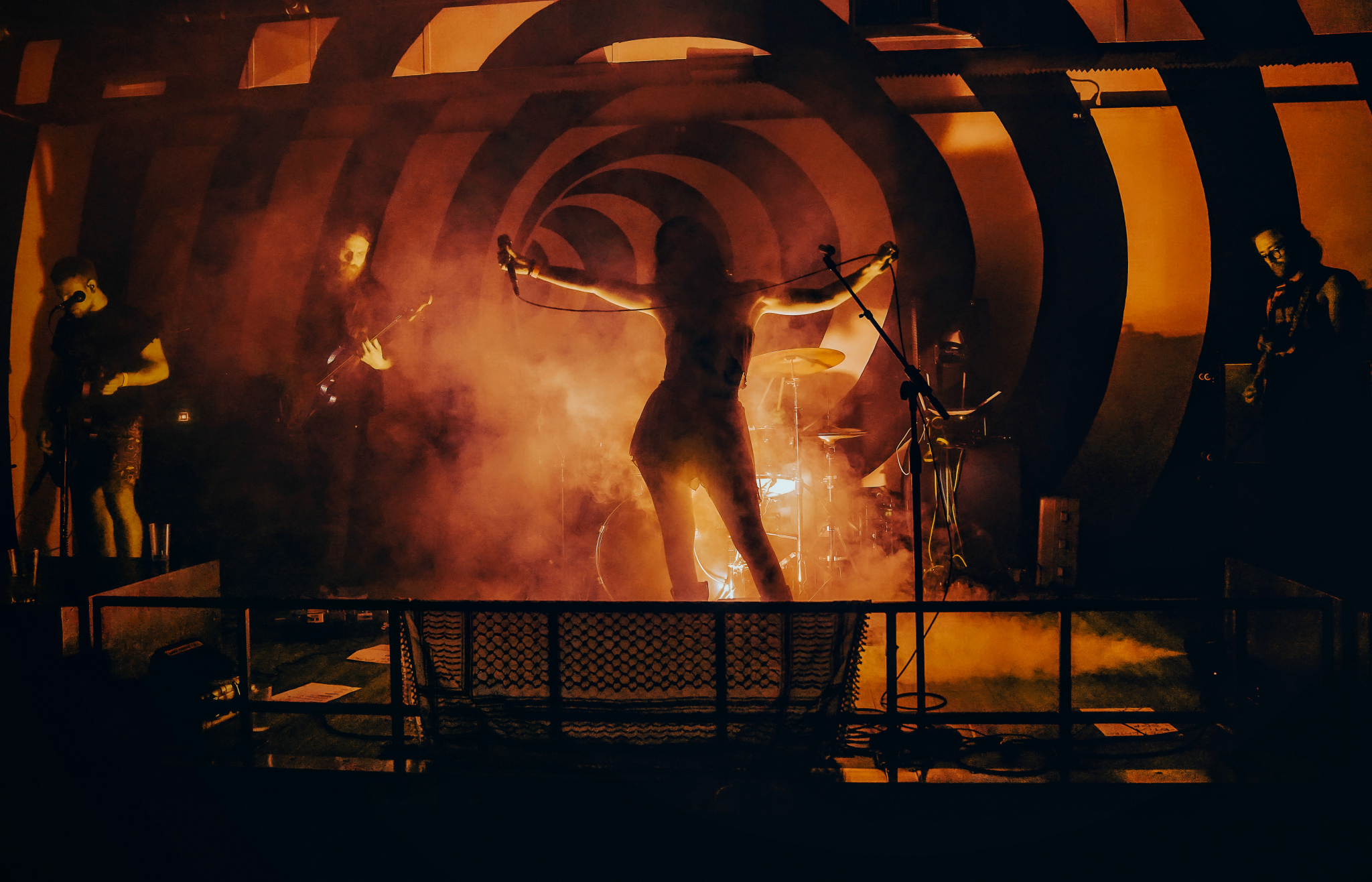
Pit Stop: Marina’s vocal approach doesn’t just add emotional intensity; at times it interrupts the flow of the riffs, disrupts rhythmic balance, and redirects the songs entirely. Did you ever approach the vocals during mixing or arrangement as if they were a rhythmic instrument in their own right?
Marina: Yes, harsh vocals in particular were treated as a rhythmic instrument. Often the pieces first emerge in my mind as morse code, or space that calls to be occupied. Matt, the primary composer, also emphasized the importance of rhythm in vocals. Early in the process I was more hesitant to overpower the music, preferring repetition or droning even, but he encouraged me to fill more space, and to play with more intricate rhythms.
Pit Stop: In the contemporary post-metal landscape, many bands now operate within a shared cinematic vocabulary: massive crescendos, layered guitars, clean/harsh vocal contrasts, and so on. Do you feel Burn Holy meaningfully expands that language into new territory, or is it more of a refined articulation of an already established aesthetic?
Matt: I don't think you can help but mimic things you're inspired by, whether that's a conscious process or not. We all listen to a huge variety of music so those inspirations all find their way in there somehow, just through a heavier filter. I think whether we expand on genre aesthetics is up to other people to decide, but I kinda hope so. If there was anything conscious about that kind of stuff, it's that we wanted to do some of those things but from a different angle and maybe in a little more concise way where possible. Or like with big crescendos for example, they can be absolutely orgasmic but also when you see the drop or whatever coming, it doesn't hit the same. There's a certain element in our writing philosophy of "once the point's been made, move on."
Pit Stop: One of the striking aspects of the production is that the intensity doesn’t come from excessive compression or a sterile sense of “impact,” but rather from a feeling of movement and physical space. How intentional was the decision to preserve the natural room and dynamics of the drums in particular? Modern post-metal productions often lean toward a more digital, weightless kind of heaviness.
Matt: Very intentional. There is very little compression on most individual tracks. We relied on limiting much more. The bass was split into two tracks covering different ends of the frequency spectrum, and there is a ton of compression on the lower end of that, so that's the exception. Personally I feel like limiting can accomplish a similar effect while still allowing dynamics to breathe naturally, and that feeling. The drum sound was very Steve Albini inspired, so yeah, lots of natural room sound. Plenty of the things we did are digital, but there was constant focus on things sounding natural, like getting a convolution reverb obsessively dialed in or whatever. I used to love compression, maybe too much. I just don't think the things that make us sound the way we do can survive it.
Pit Stop: Bryce Ramsey’s second-guitar work often feels less like traditional harmonic layering and more like a destabilizing force against the main riffs. Was the relationship between the two guitars deliberately steered away from conventional harmony/layer logic? Especially in the tremolo sections, there’s a very distinctive sense of controlled fracture.
Bryce: I think the general intent behind most of the layered guitar parts is to not just make the music more three dimensional, but to create tension. I like to think of it like doing a controlled burn, or as Matt once put it, "a glass of ice water in a burning building."
Pit Stop: Across the album there’s a persistent avoidance of melodic resolution. Even clean vocals rarely function as a form of release or catharsis. Was this sustained tension primarily an aesthetic choice, or does it connect more directly to the conceptual core of the record?
Marina: The methods materialized in response to the core meaning, which was ascribed first, as well as variations in the music. The subject matter of this album is intense, dark and grotesque, and it just didn’t seem right to make easy listening music.
The purpose felt like a call to witness, not avoid, not distract, but to truly sit in the despair of human experience. So that’s what I did, I tried to put the feelings of loss, grief, fear and anger into voice.
The modern consumer wants to be quelled, and perhaps the satisfaction of harmony and resolution is withheld, as the systemic injustices have yet to be resolved. We do not live in a harmonious society, and this is a mirror to that chaos. Of course, there is a hope that the discomfort inspires action, that the resolution is achieved in the aftermath.
Pit Stop: The use of religious and ritualistic imagery on Burn Holy is particularly interesting, because rather than evoking spiritual elevation, it instead conveys exhaustion, guilt, and collapse. When writing with these symbols, are you working within a metaphysical framework, or are you more interested in constructing an iconography of social and psychological decay?
Marina: My upbringing as a cradle Catholic certainly lends to the theme (hi/sorry mom). It is a religion rich in ritual, immersed in gothic imagery and language of suffering, death, guilt, repentance, and sacrifice.
There is an underlying tone of skepticism and disgust of how religion is used to justify atrocities. Decay and collapse is directed at oppressive systems of power, and those who adapt spirituality as a weapon of control. Ascension cannot be built on the backs of others.
Within this worldview, "God" lives in the most vulnerable, powerless creatures, giving us constant opportunity to prove our grace. You cannot heal by ignoring the injuries or root cause of disease. To ignore pain and suffering is a form of spiritual bypassing.
Pit Stop: Brad Boatright’s mastering gives the album a significant physical weight, yet the mix never fully collapses into a “wall” of sound. In particular, the decision to keep the bass guitar so present in the midrange is unusual by current standards. Do you think contemporary heavy music production’s tendency toward maximum density actually limits the music’s sense of movement and dynamics?
Matt: Yeah I think that would be my conclusion. There's nothing wrong with that of course, it's just not what works for what we're trying to do. Brad is fantastic at what he does. I won't pretend to understand 10% of what he does, but he's a wizard. A kind wizard who's growing a gargantuan slime mold outside his studio.
Pit Stop: There’s a clear expansion of identity between Last Days Of A Dying World and Burn Holy, but it doesn’t feel like a radical genre shift so much as a process of internal disruption and reconstruction of your own language. Where do you see BURIAL CLOUDS positioned within the post-metal landscape right now? The album both uses the genre’s codes and simultaneously seems to distrust their dramatic function.
Matt: I think with this album we regularly had an aversion to anything that felt like an easy answer or immediately obvious. Sometimes to our detriment, then we'd backtrack and go with the easy answer, but it always had to be tortured out of the process. I have no idea where that places us on the landscape though. We're just doing our thing as well as we're able.
Pit Stop: Thank you for taking the time to answer our questions. Finally, for the readers who will be discovering you through this interview, and for those who already follow your work, we’d like to ask you for a closing message.
Matt: Lean on the ones you love. Consume what keeps your fire lit. Become wealthy in what you find valuable. Pet dogs. Watch Train to Busan, it's a really great movie.