
INTERVIEW
INTO DARKNESS Translates the Silence of the Cosmos into Death Metal
Cosmos and Death Metal.
Greetings to the whole band, and thank you for accepting our invitation and being our guests. If you're ready, let's dive right into the interview.
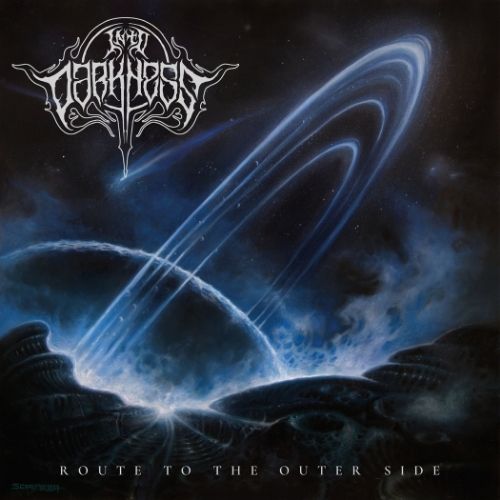
Route to the Outer Side has taken almost fourteen years to become reality. Looking back now, do you feel this album could only have been written by the current version of Into Darkness, or do you sometimes wonder what it might have sounded like had you recorded a full-length much earlier?
I'm sure that if Route to the Outer Side had been written earlier, it would have sounded different. I would have adopted a different approach to songwriting, and it probably wouldn't have been as complex as it eventually became. In the previous EP, Cassini - Huygens - which is a record I’m terribly proud of - even though the Dutch Old School influence is evident, and our songwriting patterns are unmistakably recognisable, we didn’t achieve a complexity and variety in songs’ structure and riff-writing as we did in the album. But it would have sounded great nonetheless.
You repeatedly emphasize that your lyrics deal with astronomy—not science fiction, not Lovecraft, not astrology. Why has it been so important for Into Darkness to draw that distinction? What does real astronomy offer as artistic inspiration that fictional space narratives simply don't?
To define such a sharp line in our lyrics finds its meaning in what I’ve chosen to focus on. I’m more a concept writer, better at expressing myself on one topic, and the topic is: Astronomy. I can’t appreciate people confusing Science Fiction, Lovecraft, abstract cosmic themes with Astronomy because I find it superficial. What can astronomy offer that fiction can't? Speaking for myself, I find it fascinating, immense, and true. But, above all, it’s the aesthetic of the lyric and the vocal performance to make a difference. At least, to me.
Rather than using space as a metaphor for humanity, your lyrics often read almost like poetic scientific observation. Was there ever a conscious decision to let the facts themselves create the emotion instead of forcing human narratives onto them?
Not really. Connecting to the last answer, I’m convinced the aesthetic of a lyric makes a difference. Writing about Astronomy might bring the risk of using the same words to describe events, astral bodies or probes. Not a big issue? To me it is! I particularly care about lyrics writing, I really like writing and I’d be glad if the ones who’ll read the album lyrics would appreciate them the same way I do.
'Jupiter' demonstrates an unusual balance between scientific precision and dramatic storytelling. How much research goes into writing a song like that? At what point does scientific accuracy stop and artistic interpretation begin?
Let’s begin with the fact I always start with songwriting and afterwards I elaborate the lyrics. Speaking of Route to the Outer Side, once I was done with the songwriting, I have specifically chosen the order of the songs, keeping in mind every track was meant to be a good match between music and lyric. Jupiter is the fastest and the more direct track of the album. It’s heavily inspired by masterpieces like Mindloss from GOREFEST, with a Thrash Metal vibe à la INFERNAL MAJESTY and SLAYER: how could that song not be called "Jupiter"? The most turbulent, unstable, the greatest planet of the Solar System. I wouldn’t say we came to a point where scientific accuracy and interpretation stop to match with each other. The Universe is such a mysterious, majestic and violent environment that using earthly words to connect it with Metal music is easier than you think.
The album follows a journey through the outer Solar System, yet you deliberately keep Pluto as a planet despite its official reclassification. Was that simply a narrative choice, or is there a deeper statement hidden behind keeping Pluto on the route?
Nothing more than childhood’s loyalty. My passion for Astronomy started when I was a kid, and back then Pluto was still classified as the ninth and last Planet of the Solar System, declassified in 2009 after Eris’ discovery. I can’t deny that “Pluto” is a pretty tragic, melancholic song. Can’t say if I deliberately matched that lyric with that music piece or it was due to the fact the song itself would have been perfect as the very last song of the album before the closing track (“Route to the Outer Side”).
For years Into Darkness paid tribute to the Dutch school of death metal, but Route to the Outer Side feels less like homage and more like a band finding its own identity. At what point did you realize you were no longer just preserving a tradition, but actually contributing something new to it?
During the songwriting process I guess. It was harder to force myself not to repeat my own patterns and style than to let creativity find its way through the milestones in music that left a mark on me. That was actually the funniest part: to ask myself why that specific album is considered a masterpiece, or the reason why a certain riff is unforgettable, and to shape my own identity with the powerful, outstanding force of the music that inspired me as a musician and Into Darkness as a band.
Italy has produced outstanding extreme metal bands across death, black and doom, yet the country rarely enjoys the same international recognition as Sweden, Finland or the Netherlands. From your own experience, what makes it particularly challenging for an Italian underground band to reach a global audience?
Interesting question. First, in Italy, many forms of art - including music - are extremely underrated and not getting the right consideration. There are no funds from the Country itself, and small venues, pubs or clubs, that would once host a nice stage where bands can perform, are fewer and fewer. Perhaps for an owner it isn't worth giving some space to live music, not profitable enough, or too difficult to manage in terms of finances - think about getting a good backline, lights and stage. Second, Italian people are so much involved into work - I live and work in Milan and I know what I’m talking about - that there’s not so much free time for something as demanding as making music at a semi-professional level. Third, it’s a matter of mentality: we’re not used to consider any form of art as something that serious. Let me explain: an Italian person would never trust someone who’s dedicating a life to a form of art in order to make it a proper job. That Italian would admire that person, perhaps even being envious, but in the end the “cultural shock” would prevail and would bring him/her back to reality. It’s how we’ve been educated. Sad but true. We would never really take such a big risk, none of us would ever be able to.
You have kept the band alive through lineup changes, demos, EPs and years of slow progress instead of chasing momentum. In today's scene, where visibility often seems more important than longevity, has patience become almost a rebellious approach?
Maybe. The amount of people that asked me through the years whether I wanted to become the next SADISTIC INTENT is countless. But I don’t feel like our approach to the songwriting process is driven by anything if not a spontaneous and genuine wish to do whatever we want, whenever we want - or whenever we can! - in order to get the best result for ourselves. No jokes, nothing fake, no bullshits. All the other bands we’re involved and we’ve been involved into, including ex INTO DARKNESS members, are a true example of attitude: THULSA DOOM, DEMONOMANCY, EXTIRPATION, ARAPHEL, FUNEST, KROSSBURST, THACLTHI, MINDFUL OF PRIPYAT … None of those bands - besides DEMONOMANCY perhaps - has such a long discography compared to their years of activity, but we keep on making music, we keep on doing this and to share our passion with those who’re into it, exactly the way we are. We’re not rebels, we’re survivors. And I only mentioned the bands of people I’ve played with, and not the rest of the “small” scene I belong to, but believe me, the list goes on.
Death metal often seeks heaviness through violence, horror or anti-religious themes. Into Darkness finds that same sense of dread by confronting the scale and indifference of the universe. Was that philosophical angle something that emerged naturally, or did you intentionally want to move away from traditional death metal subject matter?
As I previously said, Astronomy has always been a passion of mine since forever. I thought it would have turned out to be a great topic to talk about, and yes, I intentionally moved away from anything that we’ve already read, explored and focused on thousands of times. I can say, with a certain pride, that the Astronomy topic and the Dutch Death Metal influence made Into Darkness a pretty unique band nowadays. We might not be on trend, but definitely unique and authentic.
Many listeners describe old-school death metal as 'earthy' or 'organic,' yet your music explores unimaginably distant places. How did you avoid sounding like stereotypical 'space metal' while still making listeners feel the vastness of the cosmos?
What music inspires and brings to you is a very personal matter. I don’t really know if a listener would feel “the vastness of cosmos” or would relate our music to the topic we connect to. I’d say if you didn’t know anything about the themes and if you weren’t helped by the visuals, you can’t guess Into Darkness lyrics are about Astronomy - and that’s not bad at all! All I want to do, what I like to write and play is Death Metal. But I think Death Metal and Astronomy are a great match.
Imagine you had unlimited resources to accompany Route to the Outer Side with a single visual experience—not necessarily a music video, but any artistic project. What would best represent this album: a planetarium installation, a documentary, a gallery exhibition, something else entirely?
A VR experience with Route to the Outer Side serving almost as its soundtrack. That’s what I would appreciate the most if I were a mere listener. I’d be curious to know what the lyrics speak about, transposed into a visual reality, to embrace the majesty of the complex machine of a Planetarian System where we, as Planet Earth, play a role as a civilized life form.
If an astronomer who had never listened to death metal heard Route to the Outer Side, what do you think would surprise them more: the scientific accuracy of the lyrics or the fact that such brutal music can express genuine wonder instead of simple aggression?
The third option might be less realistic but definitely the best scenario. But yes, maybe an astronomer would enjoy the accuracy of the subject moved into lyrics for a Death Metal band. I’d say that to find a good match between such music and its own working field’s topics, that astronomer must be a Death Metal fan!
Finally, after spending an entire album travelling through the outer Solar System, where does Into Darkness go next? Do you see this as the beginning of a broader exploration of astronomy, or was Route to the Outer Side a self-contained journey that cannot simply be repeated?
I wish Into Darkness to keep on making music and to keep the Old School Death Metal flame alive, that’s my aim and I’ll never stop. I already have the next topic in mind and I’m working on the new stuff. But that’s another chapter that still needs to be written.
Thank you for hosting INTO DARKNESS on Pitstop Metal!