
ALBUM REVIEW
ÆNIGMATUM - Infinitude’s Passage
Technical, dark, melodic, and remarkably compelling.
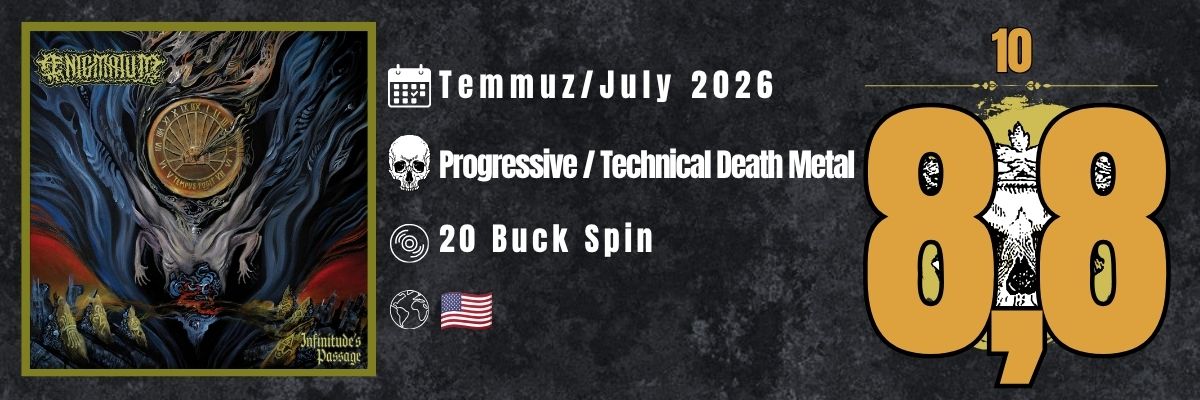
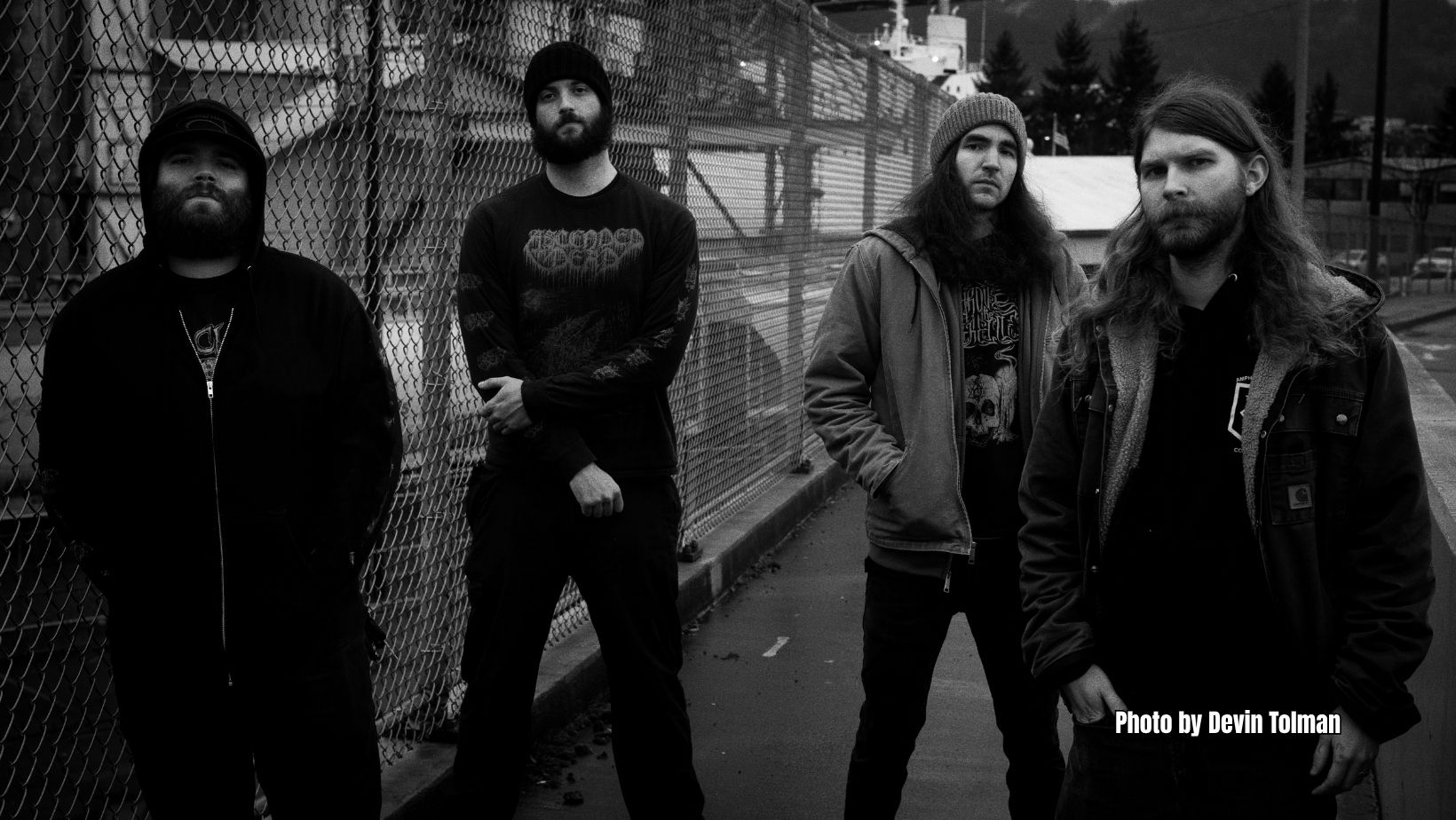
ÆNIGMATUM, formed in Portland, Oregon, in 2017, are a quartet that combines technical proficiency with the more atmospheric and melodic strands of progressive death metal. Following their self-titled debut in 2019 and 2021’s “Deconsecrate”, the band push their balance between dissonance, complex rhythms and dark melodies further on their third album, “Infinitude’s Passage”. Across its 42 minutes, the record provides a strong basis for reconsidering where ÆNIGMATUM’s composition-first approach, rather than technical showmanship, stands within contemporary extreme metal.
To give a brief summary at the outset, the album places technical proficiency at the service of composition rather than putting it ahead of it. What defines the album is neither speed nor constantly shifting time signatures on their own; the real point is that the guitar riffs make their next move difficult to predict without ever losing their internal sense of direction. As a result, the 42-minute, six-track structure avoids the “showing off your skills” trap that technical death metal so often falls into. ÆNIGMATUM play complex music, but they use that complexity not for display, but to facilitate the riffs’ constantly shifting movement.
This approach is particularly evident in the relationship between the guitars and drums. The riffs often have an extremely simple core when considered on their own, while the drums build far more animated, asymmetric and fragmented layers over them. “Pitiless Mechanism” is a direct example. The rising electric whine at the beginning of the track creates a brief preparatory space, after which the main riff that follows develops into a far more complex rhythmic structure than expected through the drums’ intense intervention. Once the vocals enter, the rhythmic foundation fractures again; within a few bars, the riffs shifting their accents allows the track to generate its technical character not merely through note density, but through a constantly changing rhythmic perspective.
This is where ÆNIGMATUM’s use of their “progressive” side becomes important. The band does not lean too heavily into the aspect of progressive metal defined by extended passages, flashy solos or overt displays of virtuosity. Instead, they favour a compositional approach built around connecting short riff cells through unexpected pauses and shifts in direction. As a result, while the album recalls the progressive death metal tradition associated with bands such as Cynic and Atheist as much as it does technical death metal, the sharper and more atmospheric touches drawn from black metal keep the music’s tonal field consistently dark.
Compared with ÆNIGMATUM’s previous album, “Deconsecrate”, the technical density here has developed a more pronounced compositional discipline. Where the riffs’ technical energy occasionally took precedence on “Deconsecrate”, “Infinitude’s Passage” places that energy within a more controlled whole. This makes the band’s position between technical death metal and progressive death metal more clearly defined. They lean neither entirely toward melodic death metal nor toward a sterile tech-death aesthetic. Different strands of The Chasm, Stargazer, Gorguts and early progressive death metal converge here, but the result does not sound like a direct collage of those influences.
“Inseverable” reveals one of the album’s working principles particularly well. The short guitar solo at the beginning functions as part of the composition without falling into the familiar technical death metal mindset of “this is where we show off our virtuosity.” The dissonant riffs and off-kilter accents that follow keep the track in a constantly unstable rhythmic space, while its returns to more regular four-four sections allow the music to regain its footing. This contrast matters because the album’s accessibility does not come from simplified riffs, but from recognisable rhythmic and melodic reference points embedded within its more complex passages.
“Architects of the Fated” takes this method into a broader form. The heavy use of double-kick beneath the slowing guitar movements creates the impression of a lull on the surface, while the rhythm section actually maintains the track’s tension. Brian Rush’s ascending bass lines and the guitars’ harmonically divergent structures become more pronounced during the track’s grandiose, black-metal-inflected middle sections. Here, the black metal influence is not used merely as tremolo or vocal aesthetics; it creates a broader atmospheric space behind the guitars. This is precisely where ÆNIGMATUM succeed in their genre-hopping: elements from different styles are not simply placed side by side, but made functional within the same compositional mechanism.
“A Tarnished Nexus” opens the door to the more spacious structure of the album’s second half. Unlike the band’s constant movement on the preceding tracks, its heavy, repetition-based opening riff remains centred on the same idea for longer. Yet this repetition does not create stagnation; it builds tension. The tempo change marked by the hi-hat accents re-establishes the track’s centre of gravity, after which a brief silence interrupts its flow and a guitar line resembling an echo of the preceding riff returns. These kinds of small structural breaks play an important role throughout the album. Rather than continually filling their songs with new material, the band disrupts existing ideas and reuses them in different contexts.
The role of the bass guitar should not be overlooked here, either. Brian Rush’s lines do not remain merely a supporting layer underneath the guitars; particularly during the more complex transitions, they form an independent axis of rhythmic movement. The same applies to Pierce Williams’ drumming. The drums are not simply a device for increasing speed, but an active compositional tool that changes how the guitars are perceived. Double-kick patterns, intensive hi-hat work, sudden stops and freer accents continually reframe the character of the riffs. Kelly McLaughlin’s vocals, meanwhile, do not become an incomprehensible wall of brutality over this density; instead, they carry a sharper, clearly articulated aggression in a mid-range register. This choice also helps ÆNIGMATUM retain their death metal roots while opening further toward black metal.
The album’s greatest strength, however, is that its technicality never becomes detached from physical impact. In this kind of music, it is common for riffs to lose their weight as complexity increases. ÆNIGMATUM avoid that problem by balancing their constantly moving guitars and rhythmic disruptions with strong accents, allowing the music to retain its headbanging pull. “Nocturne of Ageless Reverie” is the clearest example. Despite running for around five minutes, it functions as one of the album’s most direct tracks. The density of the riffs becomes somewhat more controlled here, giving its aggressive drive a more clearly defined rhythmic backbone. The result is one of the album’s strongest compositions, bringing together the calculated complexity of technical death metal and the physical appeal of classic death metal within the same track.
It is therefore no coincidence that “Nocturne of Ageless Reverie” is one of the album’s most memorable pieces. ÆNIGMATUM’s melodic approach is also more clearly audible here. The band does not use melody as a superficial “pretty section”; melodic lines often emerge from within dissonant harmonies and rhythmic fractures. This makes the album’s melodic character more durable. The music can remain melodic without ever becoming overly polished or melodramatic.
The production supports this compositional approach as well. As on the previous album, “Infinitude’s Passage” was mixed and mastered by Colin Marston. The result differs from the production philosophy of modern extreme metal that attempts to make everything excessively huge at once. The instruments are cleanly separated, but that separation does not diminish the music’s physical force. The layers of guitars, the movement of the bass and the details of the drums can all be heard without masking one another. This is particularly important for such a dense album; a muddier or excessively compressed mix could have rendered a significant portion of the rhythmic detail contained within the compositions invisible.
Another advantage of the production is that it does not make the album’s technicality feel artificially “sterile”. Separating the instruments does not disconnect them from one another. On the contrary, the performances retain the sensation of the band playing together in the same room while allowing the details of each performance to come through. That balance strengthens the organic movement within ÆNIGMATUM’s compositions.
At the same time, the album’s most controversial choice is also one of its most deliberate risks: the saxophone on the title track. Patrick Corona’s performance adds a distinct colour in the track’s final section, opening beyond the texture of death metal. The important question here is not whether the saxophone is “unusual”; the real issue is how well the instrument integrates with the rest of the composition. For most of the track, Gorguts-like dissonance, black metal darkness and progressive guitar work connect with remarkable naturalness, whereas the softer, more fluid saxophone approach in the final section pulls that tension in another direction.
For some listeners, this choice may be the album’s boldest move; however, given the sharp harmonic and rhythmic language of the rest of the music, the saxophone can also be seen as functioning more as an element of contrast than as a structural transformation. Particularly when the clean guitar passage from the beginning of the track reappears later, the final section deliberately moves away from the album’s central aesthetic. So the question is not whether “you can have saxophone on a metal album”. The real question is what this saxophone contributes to the compositional logic of the track. ÆNIGMATUM take a risk here, but the musical payoff of that risk is not as convincing as their other genre-crossing passages.
Even so, the presence of this choice does not overshadow the album’s overall success. In fact, it is significant in showing that the band does not want to confine themselves within a safe technical death metal framework. Kelly McLaughlin’s bass clarinet and Pierce Williams’ synth contributions are further, more understated examples of the same expansion. However, these elements do not come far enough forward to define the album’s core identity; the primary compositional structure formed by the guitar, bass and drums remains at the centre of the music. ÆNIGMATUM’s experimental side therefore expands the boundaries of their musical language rather than replacing it.
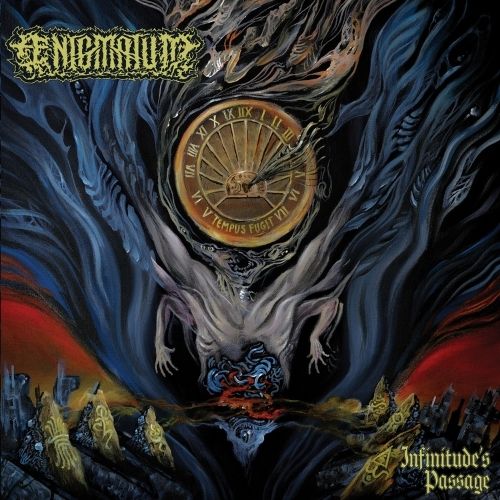
Daniel Hermosilla’s cover artwork complements this approach on the visual level. Its surreal and densely layered imagery fits the music’s non-linear structure. Rather than reducing the album’s complexity to the mechanical symbols of a “technical metal” aesthetic, the artwork establishes a more abstract and alienating visual space. In this respect, there is a direct correspondence between the music and the visual identity: both expect the listener to construct meaning by bringing disparate elements together rather than simply explaining them.
This is where the real strength of “Infinitude’s Passage” lies. ÆNIGMATUM use the complexity of technical death metal not as an end in itself, but as a compositional method. That is why the album’s tracks do not reveal all of their details on a first listen; with repeated plays, however, what emerges is not merely more notes, but more structural connections. The expanding form of “Architects of the Fated”, the controlled repetition of “A Tarnished Nexus” and the more direct aggression of “Nocturne of Ageless Reverie” are different faces of the same songwriting philosophy.
This approach makes ÆNIGMATUM more than simply a technically accomplished band within today’s progressive death metal scene. Unlike the cosmic, forward-looking atmospheric approach of contemporaries such as Blood Incantation and Cryptic Shift, ÆNIGMATUM draw their strength primarily from movement within the riffs themselves. The band are not dramatically tearing down the boundaries of the genre; they are taking death metal’s existing vocabulary and making its syntax more complex. They bring together the atmosphere of black metal, the structural flexibility of progressive death metal and the instrumental density of technical death metal around a single centre, without allowing any one of them to become completely dominant.
For that reason, “Infinitude’s Passage” demands a listener interested not merely in virtuosity, but in following how the riffs speak to one another. The album is challenging not because it is inaccessible, but because it is constantly establishing new connections. ÆNIGMATUM’s third album demonstrates just how flexible a compositional field technical death metal can still be without surrendering the genre’s physical weight. While some of its experimental touches remain open to debate, the central structure is exceptionally solid: complex, melodic, dissonant and constantly in motion, yet underpinned by unmistakable songwriting. That is precisely where ÆNIGMATUM establish their distinction within contemporary extreme metal.

https://www.facebook.com/20buckspin
https://www.instagram.com/20buckspinlabel
https://20buckspin.bandcamp.com