
ALBUM REVIEW
Coffin Hunters - Cosmic Dawn
Classic Heavy Metal Meets Cosmic Prog
California-based Coffin Hunters have carved out a distinctive place among bands that fuse traditional heavy metal roots with progressive rock, psychedelic textures, and science fiction themes. Their third full-length album, Cosmic Dawn, stands out as a work that maintains the band's commitment to classic metal aesthetics while approaching its songwriting from a broader and more atmospheric perspective. At a time when retro influences are commonplace throughout contemporary heavy metal, Coffin Hunters adopt an approach that seeks to add new colors to that legacy rather than simply reproduce it.
Cosmic Dawn is built upon a riff-driven songwriting philosophy. Throughout the album, the expansive compositions occupy a space between progressive rock and traditional heavy metal, striving to preserve memorability rather than treating complexity as an end in itself. This approach becomes particularly evident in the opening sections of the record; the songs establish layered structures, yet instead of exhausting the listener with constant time-signature changes or displays of virtuosity, they keep groove at the center of the experience. As a result, Cosmic Dawn strikes a careful balance between the intricacy of progressive music and the directness of classic heavy metal.
The guitar work serves as the primary vehicle for that balance. Eric Harriman’s riffs at times carry the melodic character associated with the traditions of Thin Lizzy and Uriah Heep, while at other moments they lean toward a harsher, grittier tone that approaches the modern heavy metal sensibilities of bands such as Crypt Sermon. However, Coffin Hunters’ chosen method is not to recreate nostalgic references note for note. While a significant portion of the riffs are built upon familiar harmonic patterns, they are often steered in different directions through unexpected transitions, psychedelic textures, or expanding arrangements. Consequently, the album never feels like a mere exercise in looking backward; instead, it presents itself as an effort to reorganize traditional material within a contemporary context.
At this point, the use of keyboards and synthesizers becomes critical. The album’s cosmic and fantastical aesthetic does not remain confined to the lyrics or cover artwork; it is embedded within the arrangements themselves. Rather than functioning as decorative colors pasted over the guitars, the synth layers frequently define the atmospheric dimension of the material. Particularly during the album’s expanding transitions and melodic ascents, the keyboards lift the music beyond a conventional retro hard rock formula and into more psychedelic and spatial territory. Even so, Coffin Hunters never surrender to the excessively theatrical side of progressive rock; melodic clarity and the riff-centered framework remain intact.
Sean Rivera’s vocals fulfill a similar role. Although his approach initially recalls the traditional vocal styles associated with epic heavy metal and fantasy-themed music, the true strength of his performance stems not from dramatic exaggeration but from its ability to align with the pace and tension of the songs. The vocals regularly create melodic peaks while simultaneously pushing forward the energy established by the guitars. As a result, themes such as death, mythology, and existentialism find expression not only through the lyrics but also within the overall dynamism of the music itself.
The rhythm section, meanwhile, is what sustains the album’s accessible side. The bass and drums support the more intricate arrangements without attempting to dominate them. In particular, the drums’ clear and straightforward approach preserves a sense of rock ’n’ roll-driven momentum despite the songs’ progressive tendencies. This choice is significant to the album’s overall character, because while Coffin Hunters add technical layers, they never abandon the music’s physical energy.
Greg Wilkinson’s production at Earhammer Studios reinforces this approach. Rather than embracing the overly compressed and sterile sound often found in modern heavy metal productions, the album opts for a more organic character. The guitars sound warm and full-bodied, while the rhythm section retains its natural sense of movement. This makes the album’s influences from the 1970s and 1980s apparent not only at the compositional level but also in terms of sonic aesthetics. At the same time, the recording remains sufficiently clean and powerful; it never becomes muddied in the name of nostalgia.
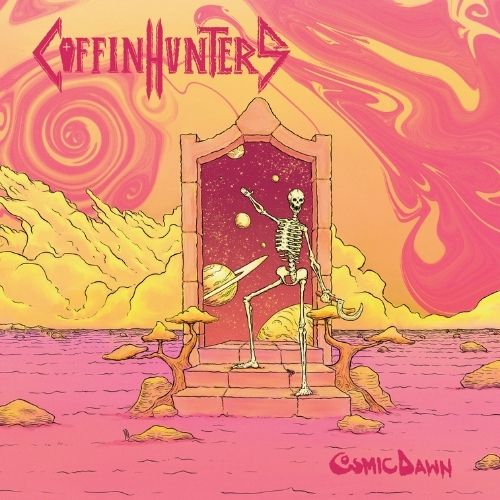
The album’s visual identity is likewise largely aligned with its musical content. The Cosmic Dawn cover artwork clearly reflects the science fiction and cosmic fantasy narrative at the heart of the record. What stands out here is how accurately the visual aesthetic represents the experience offered by the music itself. While many retro-metal releases feature cover art that promises a sense of grandeur the music cannot ultimately support, there is a noticeable consistency between Coffin Hunters’ visual language and their sonic presentation.
That said, the album does not offer a completely flawless structure. Coffin Hunters succeed in establishing a strong identity, but the price of arriving at that identity so early is that the distinction between individual songs occasionally becomes less pronounced. The tracks tend to revisit similar dynamic arcs and comparable dramatic resolutions. While this strengthens the album’s sense of cohesion, it also diminishes the element of surprise in certain passages. The compositions remain consistently enjoyable, but not all of them leave an impression with the same degree of intensity.
Within today’s heavy metal landscape, retro aesthetics can often become a safe space for nostalgia. Cosmic Dawn, however, is one of those albums that does not fully fall into that trap. While preserving the fundamental building blocks of the genre, Coffin Hunters seek to expand their territory through psychedelic textures, progressive arrangements, and a strong melodic sensibility. These efforts do not radically redefine the boundaries of heavy metal, but they do elevate the band’s identity beyond that of a standard retro-heavy metal outfit. Rather than merely reproducing admiration for the past, the album strives to keep that legacy current and alive; and what it ultimately asks of the listener is to follow that very balance between reverence and renewal.
OZAN