ALBUM REVIEW
Destructor – Tales of Glory
US Power/Thrash Metal
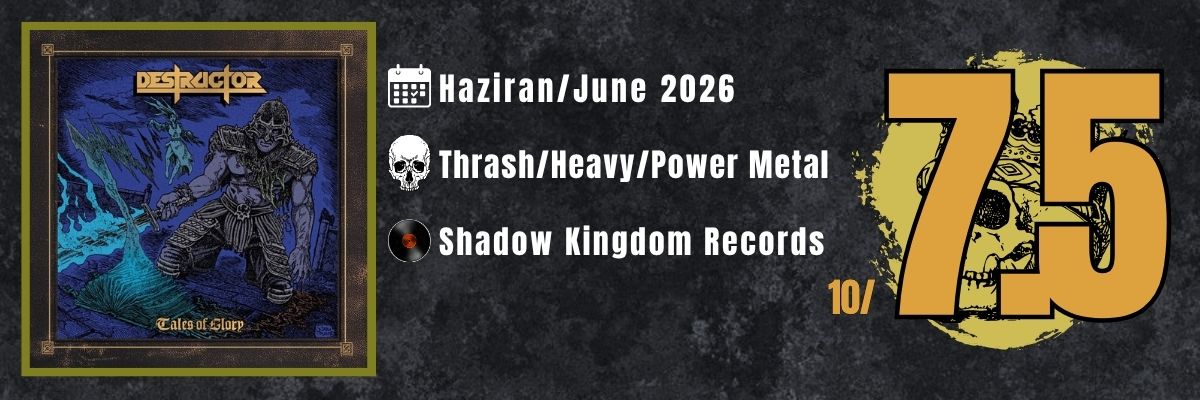
Destructor, as one of the most persistent representatives of the US power/thrash tradition emerging from Cleveland in the mid-1980s, has throughout its career continued without abandoning the raw, riff-driven, and direct aggressive line of the genre. Despite long interruptions, lineup changes, and off-stage tragedies, the band has chosen to preserve its own historical sonic signature rather than pursuing aesthetic modernization. “Tales of Glory,” as a new link in this continuity, functions as a record that repositions Destructor’s inherited riff language within contemporary production conditions.
“Tales of Glory” does not lean on any claim of “redefining” riff writing; on the contrary, it operates through a compositional approach that re-engages the classic US power/thrash vocabulary with almost archival clarity. The guitars predominantly open with fast alternate-picking-based, palm-muted progressions, and the resulting structure relies more on flow and impact than on technical complexity. At this point, the drum parts function not merely as tempo carriers but as an element that expands the rhythmic backbone of the guitars, with accents that continuously sustain a forward-driving sense, especially in double-time transitions. The bass line, rather than adopting the separated counterpoint approach often found in modern productions, is positioned as a support layer embedded within the guitar wall, increasing low-mid density.
The most noticeable shift in the album’s character emerges through an “expanded heavy metal” concept built upon this foundational thrash framework. This expansion is not achieved through orchestral layers or external textures, but entirely through the sentence structure of the riffs and vocal placement. Dave Overkill’s vocal performance here is not only narrative in function, but also serves to “segment” the rhythmic phrases of the riffs. The more open, chorus-oriented melodic lines that appear in the refrains pull the tracks away from pure speed-driven thrash structures and move them closer to a more traditional heavy metal hymn format. However, these transitions do not always create a fully new architectural layer within the compositions; in most cases, they function as a scaling effect achieved through expanded vocal lines over the same riff material.
Production is one of the most decisive factors shaping the album’s aesthetic position. The sound design does not rely on a sterile modern metal mix; guitars are distinctly midrange-heavy and carry a slightly raw distortion character. This choice does not so much intensify aggression as it anchors the riffs within the same perceptual space as 1980s US metal tradition. The placement of the drums in the mix, particularly with snare hits pushed forward, reinforces the sense of live performance. At this point, the production’s clear objective is physicality over technical clarity.
The album’s claim to “epic expansion” should primarily be read through its arrangement density. The expansion emphasized in available information about the record is based less on new instrumental layers and more on internal repetition structures and longer, more extended riff phrases. In other words, this is not a sound expansion but a form expansion. While this enhances dramatic build-up in some tracks, it can also increase a sense of linearity in others due to the extended looping of the same riff ideas. The sense of epic scale exists as an aesthetic direction, but it does not always transform into a structural force within the compositions.
The interaction between vocals and guitars becomes particularly clear in tracks such as “Harbinger of Death” and “Rise to the Call.” While the guitar riffs progress on a fast and tightly gridded rhythmic framework, the vocal lines place more widely spaced phrases on top of this structure. Rather than breaking the mechanical continuity of the riffs, this creates a narrative rhythm that segments them. In tracks like “Never Take Me Alive,” this structure evolves into a more direct hymn form; here, the riffs function as a constant motor in the background while the vocal melody is pushed to the center.
One of the most critical contributions of the drum performance lies in the micro-accents that prevent the speed from remaining entirely flat. The classic speed metal-inspired fills used in transition passages help avoid a one-dimensional flow of velocity. However, unlike the polyrhythmic or fragmented structures of contemporary extreme metal, this variation is resolved entirely within traditional linearity. In other words, this is not rhythmic innovation but rather a refined execution of tradition.
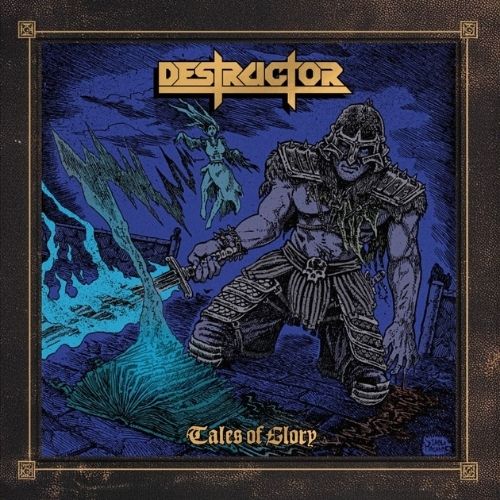
Visually, the aesthetic language of the album is also directly aligned with its sound. The fantasy-heroic iconography of the cover art supports the idea of “storytelling” embedded in the riff structures, but it does so not through the dark abstraction or symbolic density seen in contemporary metal, but through a direct pulp fantasy aesthetic. This visual approach does not decorate the nostalgic references in the music; it frames them explicitly. However, this framing does not expand the album’s musical ambition—it stabilizes it. Tales of Glory builds a cohesive identity that confirms rather than updates its own aesthetic coordinates.
At this point, the album’s position within the contemporary extreme metal landscape becomes clear. Destructor does not move toward modern technicalization or production hyper-detail; instead, it focuses on maintaining a US metal line centered on riffs and direct performance energy. While this choice deliberately excludes certain modern dynamics, it also partially prevents the album from becoming a mere retro exercise, because the intent is not to reproduce the past, but to demonstrate that its language remains functional today.
Ultimately, “Tales of Glory” constructs a framework that expects the listener not to analytically deconstruct the tracks, but to align with their linear energy. The album does not open a new technical vocabulary, but it does rescale the existing US power/thrash grammar through broader vocal formulations and more open song structures. While this scaling does not always produce structural transformation, it reinforces a sense of continuity that reaffirms Destructor’s historical position. For this reason, the album is not aimed at listeners seeking novelty within extreme metal, but rather at those who want to hear how an established riff language continues to function today.
OZAN
facebook.com/destructormetal
shadowkingdomrecords.com
facebook.com/shadowkingdomrecords
shadowkingdomrecords.bandcamp.com