
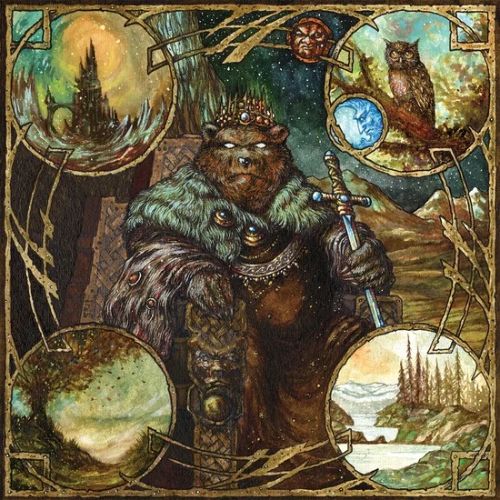
SPLIT ALBUM REVIEW
ELFFOR, HYVER & ERROIAK – Roi des Forêts Albüm
Three distinct visions of folklore.
The folklore of the Basque Country, shaped by the Pyrenees, places the bear at the heart of not only its natural landscape but also its legends, ancient beliefs, and stories passed down through generations. Bringing together ELFFOR, HYVER, and ERROIAK, "Roi des Forêts – Basoen Jauna" transforms this cultural heritage into an eight-track exploration through black metal and dungeon synth. By approaching the same subject through three distinct musical languages, the three solo projects turn what could have been an ordinary split release into a cohesive concept built around contrasting aesthetic visions.
ELFFOR opens the split with a 20-minute composition, by far the longest piece across its eight tracks. Rather than filling the runtime with a succession of disconnected riffs, Eöl uses it to construct an expansive narrative with clearly defined stages of development. Raw black metal foundations are expanded through symphonic touches and melodic tremolo-picked guitars, with a particularly memorable guitar passage emerging around the six-minute mark. The transitions between quieter passages and more forceful sections sustain the composition's dramatic progression, preventing its extended runtime from becoming monotonous. The legend of Urkhal, an immense white bear who protects a human clan, and the enduring traces of his presence in the mountains generations later provide a folkloric framework for the musical narrative. The distant placement of the vocals, buried behind the instrumentation, further reinforces their storytelling function. Rather than taking precedence over the music, they become part of the legend being recounted.
HYVER's four-track contribution approaches the same subject through a more folkloric and symphonic strain of black metal. Its defining characteristic is a compositional approach that gives synthesizer and keyboard melodies considerable room alongside the guitars. 'Culte Ancestral' establishes a more distant and sombre atmosphere than the other tracks, with its restrained musical character complementing a narrative centred on ancient bear cults. 'Cannelle', by contrast, brings a distinctly different energy. Its memorable melody, lively rhythmic drive, and more spirited guitar riffs inject momentum into this section. It is an effective demonstration that HYVER's melodic approach is not limited to creating atmosphere but also plays a direct role in making the compositions memorable.
The second narrative, which explores the continuation of cultural memory through the teddy bears of childhood, establishes an interesting connection between historical folklore and everyday life. The fourth track, 'Le Trône des Bois', opens another door with its slightly mischievous introduction and cheerful riffs. Depicting the mythical gathering place of bears, the composition combines melodies reminiscent of medieval folklore with keyboard arrangements, creating an almost ceremonial atmosphere. The diversity of HYVER's contribution stems not simply from the different stories being told, but from its ability to develop a distinct musical character for each of them. The track dedicated to a bear killed by a hunter in the Pyrenees in 2004 also plays an important role in this narrative framework, taking the release beyond mythology and touching on the conflict between humanity and the natural world.
With ERROIAK's three compositions bringing the split to its conclusion, the musical centre of gravity shifts noticeably. Taking a more introspective and melancholic approach to the relationship between dungeon synth and black metal, the project brings piano and synthesizer melodies to the forefront of its storytelling. Mid-paced, deliberate guitar work and more expansive atmospheric passages offer a different narrative language following the first two contributions. Here, melodies are not merely secondary elements supporting the guitar riffs; they are fundamental components shaping both the emotional character and progression of the compositions. Although ERROIAK's affinity with the Summoning tradition is apparent, its use of piano and individual melodic choices prevent this influence from descending into straightforward imitation.
'Basoen Jauna' opens with a piano-led passage, providing one of the brightest moments in the closing section. With the bear portrayed as the true spirit of the forest and a symbol of its power, the melodies carry an optimistic quality that sets the track apart from the darker narratives elsewhere on the split. 'Harpeko Oihua', meanwhile, offers a more tragic account centred on the spirit of a bear concealed within a cave. Its gradually intensifying structure combines with the sorrowful character of the melodic guitars to create a strong dramatic effect. In particular, the way the melodic lines expand over time establishes a meaningful distance between the composition's initial tranquillity and its eventual intensity. Closing track 'Azken Ehiza' stands out through its mystical narrative, which leaves the relationship between hunter and prey deliberately ambiguous. While the piano and synthesizer arrangements reinforce the track's spiritual dimension, ERROIAK's harsher vocals prevent the atmosphere from becoming overly subdued or one-dimensional. Their distant, almost ceremonial delivery also completes the dramatic character of the finale.
Perhaps the most valuable aspect of this release is that the three projects never compromise one another's musical identity while exploring the same subject. ELFFOR's expansive, epic black metal narrative, HYVER's folkloric, melodic, and symphonic approach, and ERROIAK's melancholic world shaped by piano and dungeon synth form three distinct yet complementary interpretations. This diversity gives the split a conceptual coherence that elevates it beyond a mere collection of tracks from three separate projects. Naturally, the eight-track release does not maintain the same musical intensity throughout, and the transitions between its three different aesthetic approaches may occasionally feel rather abrupt to listeners seeking a more unified sound. Yet the point here is not to establish a single, uniform musical identity, but to explore how the same folkloric world can be reinterpreted through different compositional approaches. Demonstrating that the creative relationship between black metal and dungeon synth still has considerable expressive and aesthetic potential, "Roi des Forêts – Basoen Jauna" establishes a distinct presence at the intersection of atmospheric black metal and fantastical folklore.

antiqrecords.com
facebook.com/antiq.label
antiqofficial.bandcamp.com