ALBUM REVIEW
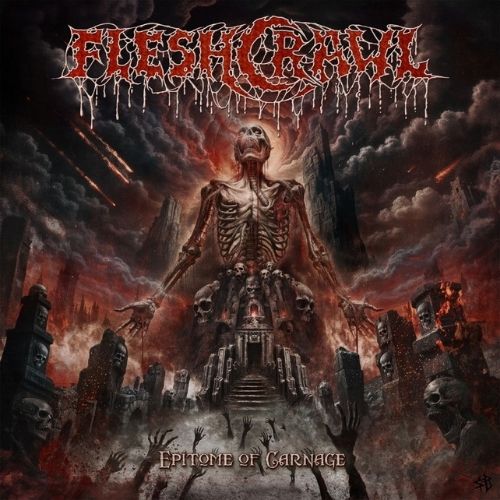
Fleshcrawl - Epitome Of Carnage
HM-2 Death Metal Analysis
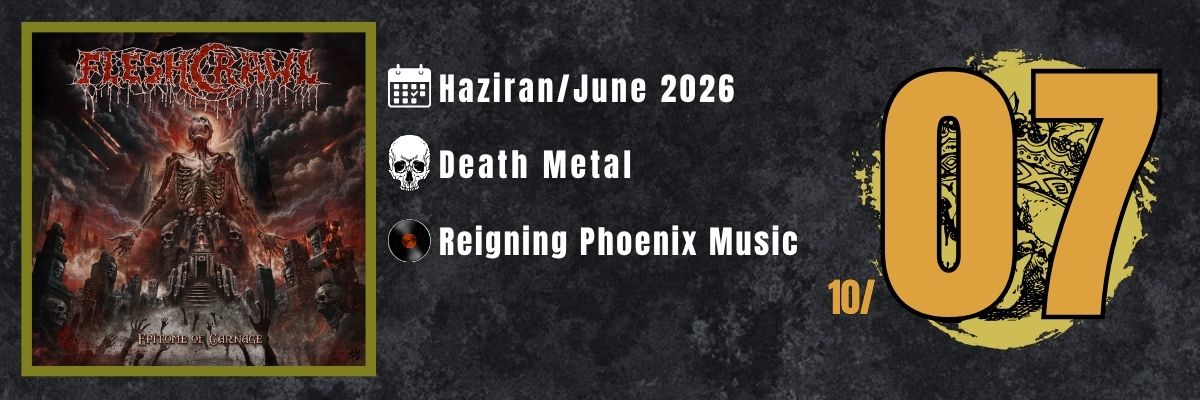
Since the early 1990s, Fleshcrawl have stood as one of the most consistent representatives of the German death metal scene, positioning themselves among the rare bands that continue to carry the Swedish HM-2 aesthetic through their own interpretive lens. “Epitome Of Carnage” reopens the discussion around the band’s balance between continuity and transformation, arriving after a prolonged silence and a significant reshaping of the lineup. The album can be read not only as a return, but also as an attempt to redefine Fleshcrawl’s position within the genre itself.
The album opens with an HM-2-driven death metal approach that does not conceal its compositional intent, but instead presents it with an almost programmatic clarity. On opening tracks such as “Blood Dominion,” the guitar tone directly references the chainsaw midrange distortion of the Swedish death metal tradition, while the riff architecture operates through a motor-like logic that continuously shifts between D-beat and blast beat patterns. The key parameter here is not speed itself, but the constant deconstruction and reassembly of velocity. This establishes the album-wide sensation of forward propulsion without ever relinquishing control.
The lineup changes involving the new guitarists do not radically alter the surface timbre, but they introduce a more pronounced segmentation and transition economy in the riff writing. Particularly on tracks like “Grave Messiah” and “Reign Forever,” the riffs move away from the single-layer drive of classic Swedish death metal and instead unfold as restructured blocks, articulated through short stop-start transitions. This structure indicates that Fleshcrawl have not abandoned their Bolt Thrower-leaning groove-oriented moments, but have instead reframed them through sharper, more fragmented cuts.
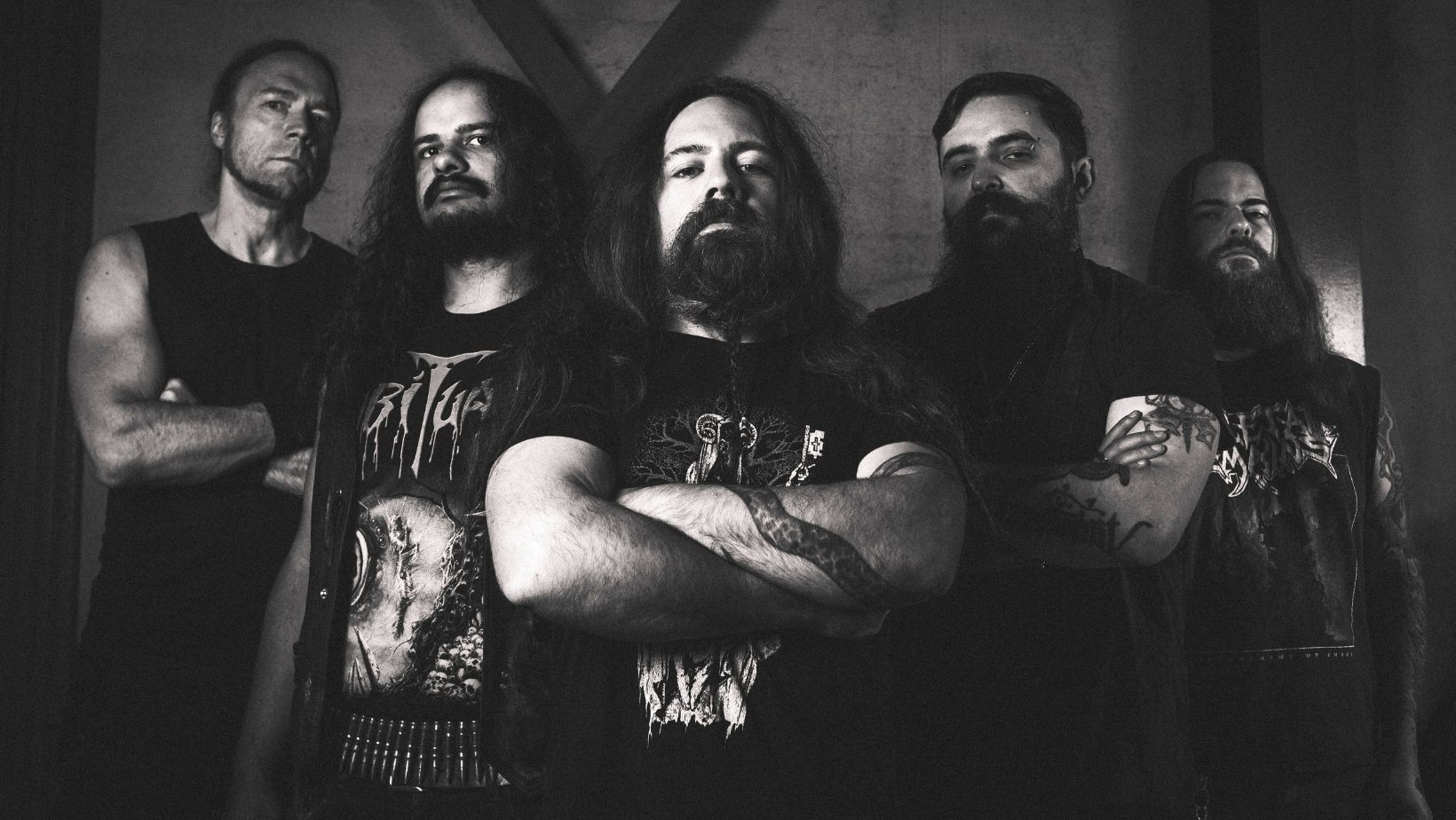
On the vocal side, Borisz Sarafutgyinov’s approach carries a lower-register and less articulated growl compared to the Sven Gross era. This shift results in the voice becoming less of a rhythmic layer in fast riff passages and more of a static noise band. However, rather than intensifying the music’s aggression, this choice distributes it across a more homogeneous surface; the vocals do not contrast the sharpness of the guitars, but instead dissolve into them as a merging texture.
The mid-section track “Chapel Of Guts” more clearly demonstrates how Fleshcrawl construct atmosphere when the tempo is reduced. The doom-leaning weight here is built not on harmonic resolution, but on repetition. Rather than opening melodic direction, the guitars sustain low-tuned chord blocks through cyclical repetition, maintaining intensity without developing melodic release. This approach does not produce a superficial “melodic expansion” that could be mistaken for melodic death metal; instead, it keeps melody in a permanently interrupted state of potential.
On tracks such as “Embers Of Wrath” and “Committed To Suffer,” a more pronounced melodic strand emerges, yet these elements function primarily as short lead passages layered on top of the main riff architecture. Rather than structurally transforming the compositions, they operate as surface-level tension layers. In this sense, Fleshcrawl do not adopt the melodic evolution of Swedish death metal, but selectively incorporate its signifiers in a controlled manner.
Within the rhythm section, the bass guitar is notably more present in the mix. Particularly in groove-oriented passages, it does not simply reinforce the HM-2 guitar wall, but operates as a distinct movement layer that highlights transitions. The drums remain faithful to a classic death metal framework, oscillating between blast beats and mid-tempo D-beat passages. Here as well, the intent is not technical display, but the continuous generation of momentum that pushes the riff structures forward.
The acoustic/instrumental interlude “Chronicles Of Bloodshed” functions less as a breathing space and more as a transitional block that sharpens the contrast of the subsequent aggressive material. Such inserts do not open independent narrative threads within the composition; instead, they operate as structurally placed dynamic breaks within a setlist-like logic.
Approaching the closing section, tracks such as “Rebuilt From Flesh” and “Orphan God” reaffirm Fleshcrawl’s strongest ties to the 1990s Swedish death metal legacy. Neither Bolt Thrower’s epic heaviness nor modern technical density is present; instead, what emerges is a refined riff economy operating within a consistent aesthetic frame. This does not position the album as innovative, but it does anchor it in a stable point of internal genre coherence.
Overall, “Epitome Of Carnage” does not radically rewrite Fleshcrawl’s sonic DNA despite its lineup changes. Guitar tone, rhythmic structure, and compositional logic remain firmly tied to the classic HM-2 blueprint of Swedish death metal, while the modifications introduced remain largely at the level of variation. In this sense, the album is less an expansion of form than a tightening of an already established formula.
As a result, the record demands not discovery-oriented listening, but rather a willingness to remain within a defined aesthetic framework. Rather than pushing the boundaries of the genre, Fleshcrawl test how controlled and precise execution can be achieved within those boundaries. This positions the album as a contemporary but cautious example of German death metal filtered through a steadfast allegiance to the Swedish school.
OZAN
https://www.facebook.com/Fleshcrawl