
ALBUM REVIEW
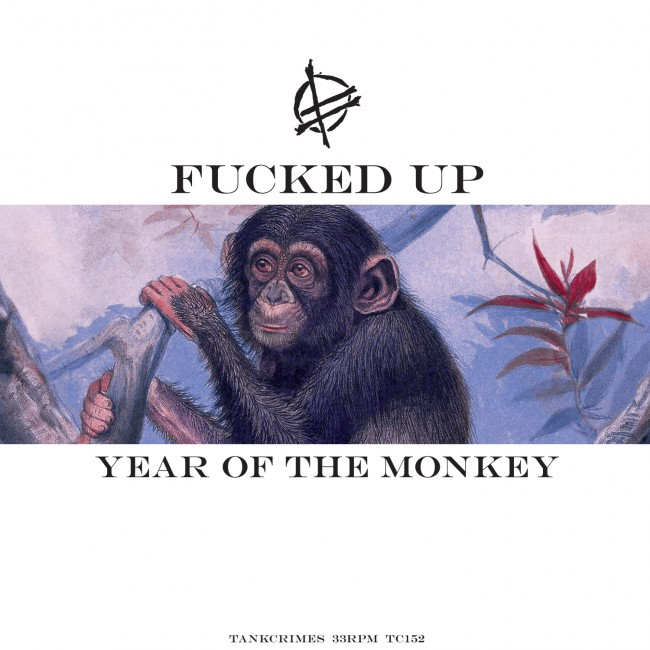
Fucked Up - Year Of The Monkey
A Monumental Progressive Hardcore Epic
Formed in Toronto in the late 1990s, Fucked Up became one of the most distinctive acts in the modern punk landscape by combining their hardcore punk roots with progressive rock, experimental music, and a conceptual album mindset. Throughout their career, the band has consistently pushed against the traditional boundaries of the genre, gradually producing works that have become increasingly ambitious not only musically but also on a narrative level through their long-running Zodiac series. As one of the most comprehensive examples of this approach, Year Of The Monkey serves as a new chapter in which the band's mythological storytelling converges with colossal compositions.
Evaluating Year Of The Monkey means more than simply analyzing a record consisting of four tracks spread across approximately 104 minutes. The album also stands at the intersection of the band's long-running Zodiac series, the Grass Can Move Stones trilogy, and their own career narrative. Yet beneath all of this conceptual weight, the element that truly sustains the album is not the story itself, but Fucked Up's compositional approach, which continually dismantles and reconstructs its hardcore punk foundations.
The album's core dynamic is built less on the riffs themselves than on the relationships those riffs establish with one another. Although “Looking For Heaven And Not Finding It” initially appears to offer a familiar hardcore energy, it soon begins moving between melodic rock, progressive structural ideas, folk textures, electronic transitions, and guitar layers that occasionally edge toward a black metal aesthetic. Despite this, the music never falls apart. Fucked Up's greatest achievement is its ability to hold so many stylistic deviations within a single dramatic flow. The sense of a “collection of ideas” often found in progressive punk or experimental hardcore is replaced here by a narrative that remains in constant motion without ever losing its direction.
Throughout the album, the guitars are not used solely as instruments of aggression. Mike Haliechuk and company frequently treat riffs as tools of dramatic transition. The guitar writing heard throughout “Before Us Tigers Stood” in particular moves away from the linear aggression of classic hardcore and assumes a more cinematic function. At certain points, rigid and compressed rhythmic patterns take center stage, only to give way minutes later to atmospheric passages supported by vast reverberations. These transitions are employed not merely to create variety, but to make the story's turning points musically tangible.
The rhythm section is an equally important component of this approach. While the drums often preserve a punk-derived momentum, the constantly shifting nature of the compositions prevents them from functioning merely as a vehicle for tempo. Particularly within the album's extended-form passages, the drums are used to generate dramatic tension, operating across a broad range that stretches from blast-like eruptions to near-ambient spaces. This prevents the album from becoming static despite its immense runtime.
The vocal approach is among the album's most striking structural choices. While Damian Abraham and Tuka Mohammed embody the story's central characters, the extensive roster of guest performers never feels like a prestige-driven list of names. Each voice assumes a distinct character function and alters the dramatic identity of the material. Dan Bejar's cool, detached vocal delivery, Jacob Bannon's dark intensity, and Walter Schreifels' more measured narration all create atmospheres specific to different sections of the story. At times, the album comes remarkably close to feeling like a hardcore opera. Crucially, however, the theatrical aspect never overwhelms the music itself. The vocals expand the narrative without beginning to dictate the compositions.
One of the album's most intriguing qualities is its ability to create an orchestral effect without relying on traditional symphonic metal tools. Rather than grand orchestrations or elaborate string arrangements, the band employs layers of synths, folk wind instruments, clean guitar passages, and multi-layered vocal arrangements. As a result, the album feels expansive without descending into bombastic excess. Fucked Up largely succeeds in maintaining the delicate line between being epic and being overburdened.
That said, not every idea on the album proves equally effective. Some of the folk and electronic transitions serve the narrative well, while others function more as coloration than as essential structural elements. Certain extended atmospheric passages within the second track, for example, are meaningful in the context of the story but do not always sustain the same level of musical intensity. This ties directly into the album's greatest risk: at times, Fucked Up seems more interested in displaying the sheer volume of its ideas than in refining them. As a result, some passages can feel as though they exist not because they are necessary, but because they are possible.
On the production front, the band strikes an interesting balance. Despite being an exceptionally layered recording, the album avoids the sterile clarity often associated with modern progressive metal releases. The physical weight of the guitars, the organic feel of the drums, and the occasionally deliberate lack of restraint in the vocal performances continually foreground the band's hardcore roots. This choice prevents the scale of the concept from transforming the music into a sterile art project.
The visual and conceptual presentation develops in parallel with the music's approach. Mythological characters, story elements supported by graphic artwork, and the continuity of the Zodiac series elevate the album beyond a mere collection of songs. Yet this aesthetic framework never attempts to compensate for shortcomings in the music. Instead, it provides additional context around an already exceptionally dense body of work. Consequently, the concept does not carry the album; rather, the music carries the concept.
Unlike many contemporary hardcore albums that claim to expand the genre's boundaries, Year Of The Monkey does not merely move between styles. It reorganizes those styles in service of its own narrative logic. Hardcore punk remains at the core, but the album's objective is less about preserving that core than exploring how large a structure can be built around it. This approach keeps the record far removed from easy consumption; it demands attention, patience, and repeated listens from the audience. Yet what Fucked Up accomplishes here is more than simply enlarging an existing formula. The band performs as though it is preparing to push the limits of the aesthetic language it has spent years developing one final time, and for that reason, Year Of The Monkey sounds as much like a culmination as it does a chapter in an ongoing, still unfinished search.
OZAN
https://fuckedup.cc
https://www.instagram.com/fuckedup
https://www.facebook.com/FUglassboys
https://tankcrimes.merchtable.com
https://www.facebook.com/tankcrimes
https://www.instagram.com/tankcrimes