
ALBUM REVIEW
GREY SHORES – Dark Waters of Night
A strong debut turning atmosphere into songwriting.
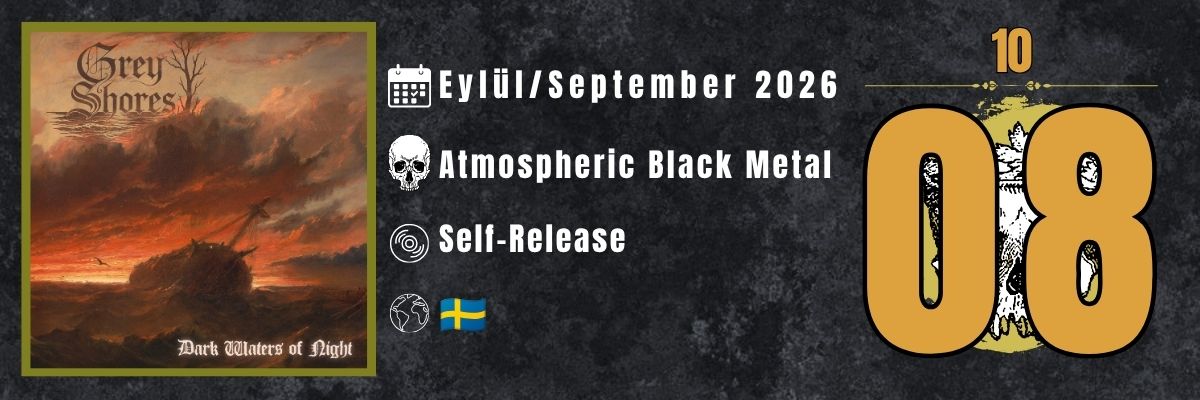
Grey Shores, one of the newer acts to emerge from Sweden's black metal scene, have stepped onto the global stage with their debut album, "Dark Waters of Night." A debut album is the most important step for any band, the first obstacle that has to be overcome. I also believe that bands who embark on this journey with a self-released album deserve just a little more support and encouragement. Especially when that first release is as good and full of surprises as "Dark Waters of Night."
In atmospheric black metal, I think one of the risks new bands have to confront today is allowing atmosphere to take the place of songwriting. GREY SHORES largely avoid that trap throughout "Dark Waters of Night," turning atmosphere into a direct consequence of riffing, rhythmic movement, and arrangement. Tremolo guitars, blast beats, and harsh vocals form the genre's familiar backbone, while acoustic guitars, post-rock layers, E-Bow melodies, ethereal choirs, and fragile clean vocals continually stretch that framework. What becomes apparent across the album is that this duo are not an inexperienced new act simply lining up these elements one after another. Harshness and vulnerability move forward by reinforcing one another within the same compositional motion.
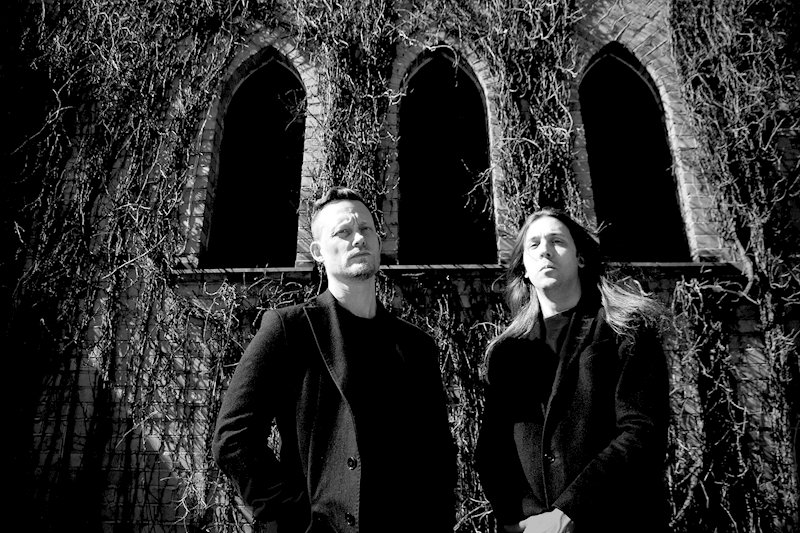
For that reason, the Stockholm-based duo's debut full-length should be viewed less as a conventional black metal album and more as a work that places black metal's expressive tools within a broader melodic and atmospheric framework. The weight carried by Martin Andersson through the vocals and harsher musical layers is balanced by Vilhelm Andersson's approach to guitars and atmosphere. That is where the album's fundamental strength lies after being composed and recorded over three years: the material does not sound like a blueprint built around reconciling different aesthetic directions, but like a cohesive work in which those two approaches meet within the same compositional logic.
The use of guitars is the central element defining the character of "Dark Waters of Night." Tremolo-picked passages and heavy distortion preserve black metal's cold, cutting edge, while more open guitar figures, acoustic sections, and extended melodic lines continually alter the music's frequency spectrum and intensity. These transitions are particularly important because GREY SHORES do not use their heavier sections merely to create contrast. The melodic or harmonic ideas established in quieter passages determine the impact of the intensity that follows.
This approach is especially clear on "The Withering Tree." The song does not use its fragile guitar textures simply as an introduction to the black metal intensity that comes later. The melodic material carried by the acoustic and more open guitars is placed in a different context once the song grows heavier. As a result, the shift into harsher territory never feels like an externally attached section; it functions as a natural continuation of the preceding musical idea. It is one of the most successful examples of the relationship between GREY SHORES' melodic and extreme sides.
"Sights of Woe" applies the same method at a higher level of intensity. Tremolo riffs, harsh vocals, and a rhythm section that constantly pushes forward give the track considerable momentum, while the melodic guitar layers keep that movement from becoming a mere display of speed. The central tension is established between the music's physical forward motion and its continual postponement of harmonic and melodic resolution. The blast beats therefore become more than a rhythmic device fulfilling an extreme-metal requirement; they become a structural element that heightens the track's unease.
Martin Andersson's harsh vocals are also crucial to this balance. The screams are not there simply to generate aggression. Set alongside the clean vocals and choirs, the two vocal approaches make the album's central compositional idea immediately apparent. The harsh vocals laid over fragile vocal layers prevent the music from drifting into the overly polished territory of melodic post-black metal. At the same time, the fact that the extreme vocals are not kept permanently at the forefront gives them a more pronounced function when they do emerge.
Different reference points can be heard in GREY SHORES' music, including DISSECTION, SUMMONING, KATATONIA, ROTTING CHRIST, OPETH, and ALCEST. But the album's real concern is not combining the stylistic traits of these names. Rather, it tests how different compositional approaches drawn from these traditions can function beneath the same atmospheric black metal umbrella.
"In the Pale Light," for example, moves away from black metal's relentlessly propulsive rhythmic framework through its slower pace, allowing the melodic layers more room to breathe. OPETH or ALCEST may come to mind here, but within the context of the full album, this section does not function merely as a genre switch. The reduction in tempo changes how the guitars and atmospheric textures are perceived, thereby expanding the album's overall range of intensity.
Similarly, the use of E-Bow melodies and ethereal choirs might initially be regarded as additional colors within the atmospheric black metal palette. Yet at the album's strongest moments, these elements do not remain superficial decoration. When positioned immediately before or after heavier passages in particular, they affect the dynamic architecture of the songs. That said, it would be difficult to argue that these textures are equally decisive every time they appear. In some sections they deepen the atmosphere, while in others they remain secondary layers that primarily color an existing melodic structure.
That distinction matters. As contemporary atmospheric black metal incorporates an increasing number of elements borrowed from other genres, the boundary between innovation and decoration becomes more important. The strength of "Dark Waters of Night" does not lie in presenting every experimental texture as a radical innovation, but in most cases in placing those elements at the service of the central guitar compositions.
One of the album's most notable characteristics is that it does not use atmosphere as a static surface. "Herald the Dark" is a more dramatic example of this approach. Vocals approaching a choral character, melodic guitars, and increasingly heavy sections give the song a broader scale, yet its structure never becomes unnecessarily prolonged, keeping its dramatic character from turning into bloated epicism.
This is where the impact of GREY SHORES' three-year creative process can be felt. The songs are not simply arranged as different variations on the same genre. They contain sections distinguished through shifts in intensity, tempo, guitar texture, and vocal character. The album's length is also significant in this regard: seven tracks spanning roughly thirty minutes. The length problem that atmospheric black metal can so easily fall into is largely kept under control here.
"Mirror of Cimmerian Stars" is a particularly functional example of this concise approach. On many albums, instrumental passages of a similar length can do little more than fill the space between the main tracks. Here, however, the brief retreat creates a genuine pause within the album's intensity curve. It opens up enough space to alter the way the subsequent material is perceived without disconnecting the music from its central aesthetic thread.
"January Wolves" offers a different solution. Rather than restoring the album's full intensity for the finale, one of its shorter tracks opts for a more controlled conclusion. Its function is less about creating a dramatic climax than reducing the dynamic space after what came before. Instead of simply repeating its atmospheric formula at the last moment, the album demonstrates that its intensity can also recede.
Jari Lindholm's mixing and mastering work is particularly important on an album containing so many different layers. "Dark Waters of Night" has a clean, detailed sound, but it does not surrender to the excessive sterilization often found in modern extreme-metal production. The melodic guitar layers, acoustic details, and vocal layers remain distinguishable without completely sanding away the music's rough edges.
This choice also aligns with the album's aesthetic direction. An overly bright and compressed production might preserve the breadth of its post-rock side, but it could just as easily weaken black metal's harsher texture. Here, the mix creates a reasonable space between the two approaches. The guitars can generate both density and melodic detail; the harsh vocals establish a separate point of attack above the atmospheric layers, while the clean vocals and choirs are allowed to spread into a wider space.
The production, then, is not a spectacle that overshadows the album. It functions as a tool that makes the contrasts required by the compositions visible.
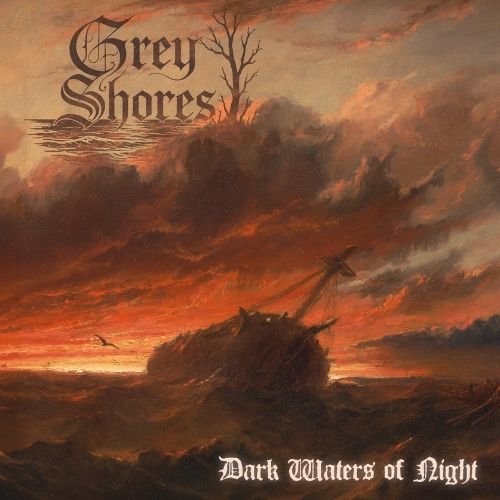
The artwork for "Dark Waters of Night" directly supports the music's aesthetic direction. At its center is a ship listing amid stormy waters beneath a sky shifting toward red and rust tones. Visually, it clearly departs from the familiar cold, ice-blue, forest-centered iconography of atmospheric black metal.
The warm colors are important here. The cover does not define the album's darkness solely through black and grey; it establishes a sense of threat through the red sky. That choice also visually reinforces the fact that the music is not built around coldness alone. "Dark Waters of Night" contains melodic and fragile layers alongside its harsher passages, and the cover reflects that duality through its warmer palette.
The ship metaphor also corresponds with the music's structural character. Constant changes in intensity, guitars that recede, and tremolo passages that rise again create a structure in motion rather than a fixed atmosphere. The cover therefore does more than repeat the genre's dark aesthetic; it provides a visual framework for the album's ideas of movement and loss of control.
What makes "Dark Waters of Night" valuable within contemporary atmospheric black metal is not that GREY SHORES have invented a new genre. Their real strength lies in knowing how to use familiar tools, and in knowing the order, intensity, and contrasts through which those tools should function.
Martin Andersson's harsh vocals and Vilhelm Andersson's melodic and atmospheric guitar approach do not operate as alternatives to one another. They give meaning to each other within the same compositions. The tremolo riff that follows an acoustic guitar passage, the harsh vocal placed over a clean vocal, or the melodic line emerging between dense blast beats therefore constitute more than simple "harsh/soft" contrasts; they form the album's underlying compositional logic.
That said, the album does not establish an entirely unique musical vocabulary. Listeners closely following the genre will have encountered some of these melodic approaches, atmospheric transitions, and production choices in other forms. Particularly at the intersection of post-black metal and melodic atmospheric black metal, many of the tools GREY SHORES employ are already well established. The issue, however, is not whether the materials themselves are appearing for the first time, but how deliberately they are brought together.
"Dark Waters of Night" is convincing precisely at this point. It establishes its claim to experimentation not through the number of tools it uses, but through their function. E-Bow, clean vocals, choirs, and acoustic guitar come to the fore only insofar as they contribute to the central compositional structure. That is also why the album's strongest passages are not necessarily the ones containing the most elements, but the ones in which each element occupies the right place in terms of intensity and structure.
Ultimately, GREY SHORES are less interested in rediscovering atmospheric black metal's melancholic and post-rock side than in exploring how these two aesthetic fields can carry one another. "Dark Waters of Night" asks the listener not merely to follow the genre's familiar markers of heaviness, but to pay attention to how the guitar layers open and close, how rhythmic intensity shifts, and how fragile passages transform the meaning of the heavier sections.
This approach does not place the album at a radical point of departure within the contemporary scene, but it does prevent GREY SHORES from being reduced to the sum of their references. "Dark Waters of Night" establishes itself as a debut that reorganizes the existing language of atmospheric black metal through a more melodic, dynamic, and controlled compositional approach—and makes its concise running time work in its favor.

Bandcamp: https://greyshores.bandcamp.com
Instagram: https://www.instagram.com/greyshoresband