
ALBUM REVIEW
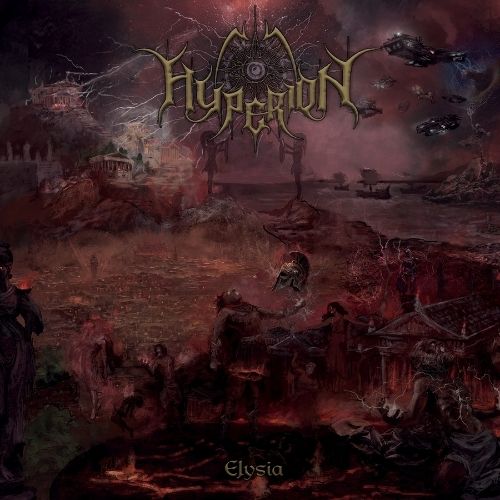
HYPERION - Elysia
Melodic darkness meets symphonic grandeur.
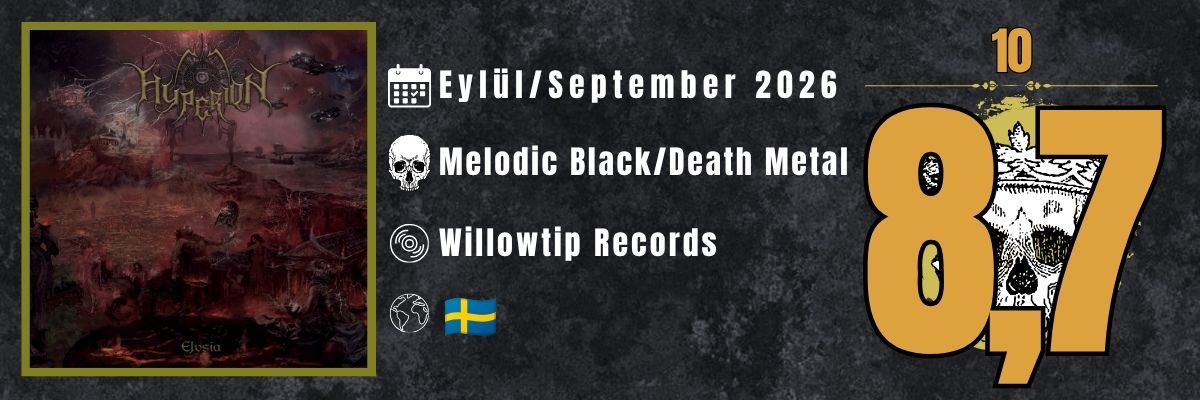
The ten-year gap between HYPERION’s "Seraphical Euphony" and "Elysia" gives the second album more significance than that of a long-delayed follow-up. While the Stockholm-based band’s early work was clearly rooted in Swedish melodic death metal, its gradual incorporation of Swedish and Norwegian black metal has evolved into a much broader compositional approach on the new album. The defining difference of the record lies particularly in the way its guitars and orchestral elements are able to carry each other within the same compositions.
Opening with "Rapturous Overture", the album establishes HYPERION’s scale within its first few minutes. The symphonic arrangements are not used merely to create atmosphere; alongside the melodic guitars, they become an active element that determines the direction of the songs. 'Nefarious Sacrament of the Immortals', meanwhile, reveals the more aggressive side of this approach, with the momentum generated by the fast drums and guitars constantly expanded by the orchestration. When the aggressive structure pulls back midway through the song to make room for synths and atmospheric textures, it also becomes clear that the album is not built solely around speed.
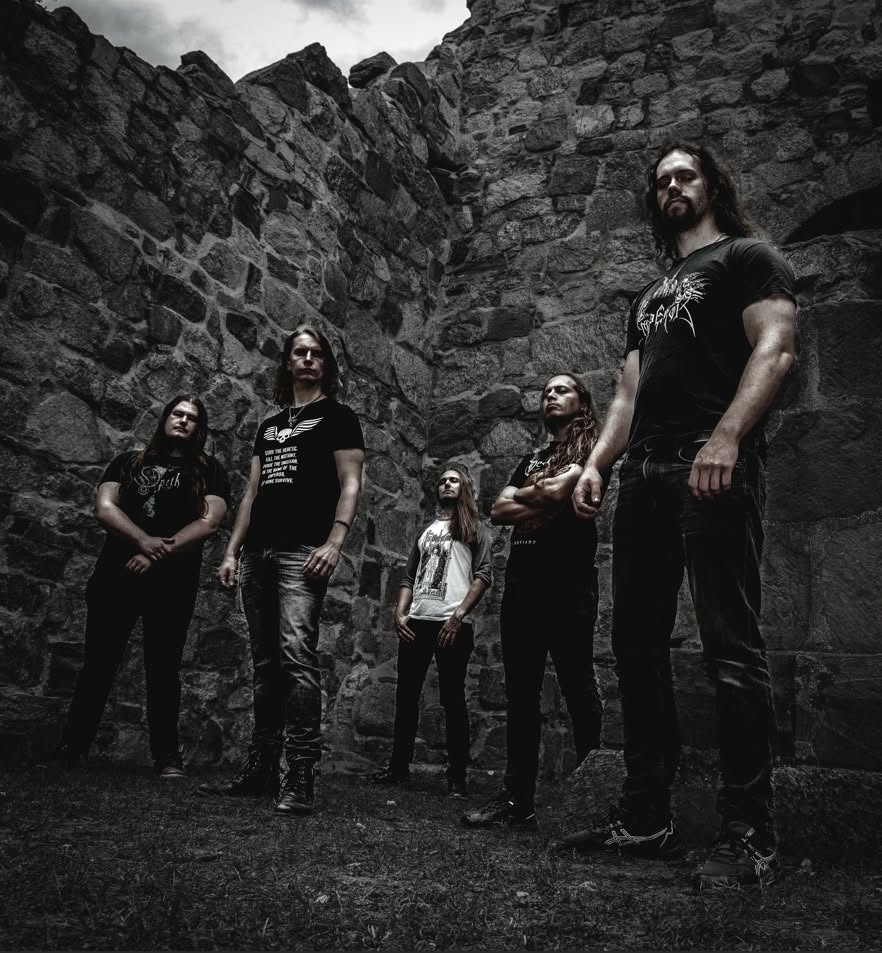
The melodic death metal legacy becomes more pronounced around 'Fides Novem' and particularly 'Iliou Persis'. The emergence of the bass guitar during the more controlled opening of 'Iliou Persis' is significant, because HYPERION’s music is not simply a matter of guitar movement in the upper frequencies. When the guitars, bass, drums and orchestration remain in constant interaction, the melodic side of the compositions also takes on a more distinct character. Additions such as guest vocals and the battle choir further support this large-scale approach.
One of the album’s most ambitious sections is the 12-minute 'Paraphrosynia'. Twin-guitar melodies, constantly shifting tempos and an exceptionally high note density keep the track in perpetual motion. While the complexity occasionally makes the music difficult to follow, the song is important for seeing the limits of HYPERION’s compositional approach. 'Epic of Tribulation' similarly uses its extended form to combine the sense of expansion associated with classical music with the rhythmic severity of extreme metal.
The natural risk of such a dense body of material is that detail can overwhelm melodic memory. "Elysia" approaches that boundary at times. Even so, the album’s orchestral arrangements, the polyphonic nature of its guitars and its rhythmic movement are not there merely for show. The songs that slow down before accelerating again, in particular, shape the album’s dramatic flow. The contrast between the sharp aggression of 'Epoch’s Eventide' and the more spacious finale of 'The Primordial Wellspring' gains meaning as a result of this dynamic approach.
After ten years, what HYPERION offers those who have been waiting for the album is not a new record built around the formulas that defined its debut, but a transformation of those formulas into a more comprehensive compositional approach. "Elysia" is not a flawless exercise in balance; at times, it becomes overwhelmed by its own density. Yet in bringing melodic black/death metal and symphonic writing together on this scale, the band is doing more than multiplying genre labels—it is also sharpening its musical identity. HYPERION’s second album is less a delayed follow-up than a work searching for the musical equivalent of a decade-long absence, building its ambition around the sheer scale of its compositions.
