
ALBUM REVIEW
Maan Looking Man - Maan Looking Man
A Dynamic and Multilingual Post-Hardcore Debut
Berlin-based Man Looking Man’s self-titled debut is a record that seeks not to merely repeat post-hardcore’s familiar mechanisms of tension, but to reshape them through multiple languages, shifting dynamics, and carefully controlled structural ruptures. The album’s primary strength does not stem solely from its level of heaviness, but from the way that heaviness is positioned. The balance between chaotic eruptions and atmospheric transitions becomes the defining element not only of the songs’ emotional intensity, but also of their compositional logic.
Opening track “Symbols of Loss” makes the album’s approach clear from the outset. The tension that begins with spoken-word passages and steadily escalates evolves into the dramatic backbone of the composition rather than functioning as a conventional intro. By keeping the vocals in the background for much of the track, the band allows the guitars and rhythm section to carry the narrative. In particular, the constantly driving character of the high-gain guitar tones, combined with the controlled intensity of the drums, does more than simply make the song sound heavy—it creates a persistent sense of motion. When the vocals finally enter during the closing section, they function less as a chorus or climax and more as a structural decision that elevates an already heightened level of tension to another plane.
One of the album’s most notable qualities is its refusal to fully surrender to the overly atmospheric or post-metal tendencies that have become increasingly common within the genre in recent years, while still preserving its post-hardcore roots. Tracks such as “Zegepraal” and “Samsara” move between aggression and melody, yet these transitions are achieved not through the clean-vocal passages that dominate many contemporary post-hardcore records, but through the reconfiguration of riff density and rhythmic energy. As a result, melodic moments do not function as the opposite of heaviness, but rather as its continuation.
“369” stands as one of the album’s most compelling compositions. Its prominent opening bass line and recurring riff motif lend the track a hypnotic quality, while the placement of the vocals within the mix partially abandons their traditional central role. This choice shifts the song’s center of gravity away from the lyrics and toward the relationship between atmosphere and rhythm. Although there are moments that evoke the dark intensity associated with contemporary Belgian post-metal and sludge acts, the band avoids turning those influences into direct imitation. The use of German vocals in particular alters not only the linguistic character of the piece but also its rhythmic identity, demonstrating that the album’s multilingual framework produces tangible musical consequences.
Man Looking Man’s movement between different languages is a choice that could easily have become a superficial display of identity in theory. Here, however, the situation is different. The primary function of the German, Italian, and English lyrics is not to showcase cultural diversity, but to alter the phonetic character of each composition. Particularly during the harsher vocal passages, differences in syllabic structure have a direct impact on rhythmic flow, bringing an unexpected degree of variety to the album.
The production also deserves special attention. While the decision to record and mix the album entirely by themselves might theoretically have resulted in something amateurish, the opposite is true here, revealing a highly deliberate approach. The recordings do not strive for the sterile perfection of a modern metal production. Instead, the midrange-focused character of the guitars, the mixing choices that occasionally allow the bass to step forward, and the organic feel of the drums transform the album’s DIY origins into an integral part of its identity rather than something to be concealed. This approach also aligns with the album’s themes of social alienation, crisis, and collective solidarity, as there is no obvious contradiction between the way the music is produced and the world it seeks to portray.
Toward the end of the album, “Glide and Turn” and “Poslushayte” present two different sides of the band side by side. The former follows a more expansive and layered developmental arc, while the latter adopts a more compact structure focused on immediate impact. This contrast effectively summarizes the album’s broader philosophy: Man Looking Man do not stretch their ideas merely to demonstrate complexity, nor do they abandon them in the pursuit of directness.
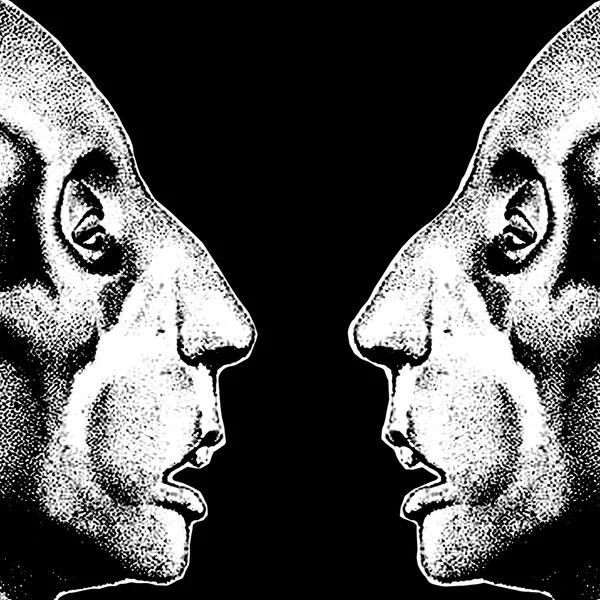
The cover artwork also serves a function that supports the search for identity embedded within the music itself. While it operates within the abstract visual language frequently encountered across the post-hardcore scene, it avoids becoming a decorative element detached from the music by reflecting the album’s themes of tension, alienation, and transformation. The visual and sonic identities operate within the same aesthetic framework.
Man Looking Man are not reinventing the language of contemporary European post-hardcore in any radical sense. Yet that is not where the album’s success lies. By reorganizing the genre’s familiar tools through multilingual expression, strong dynamic control, and impressive compositional discipline, the band carves out a space of its own. This is a record that will resonate less with listeners constantly searching for innovation and more with those willing to engage with the internal architecture of the songs and the intricacies of their arrangements.
OZAN
https://www.instagram.com/manlookingman/
https://www.facebook.com/ArgonautaRecords