
ALBUM REVIEW
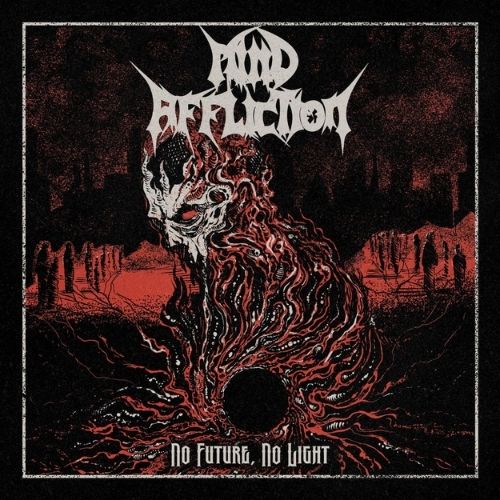
MIND AFFLICTION - No Future, No Light
A darker return after a decade.
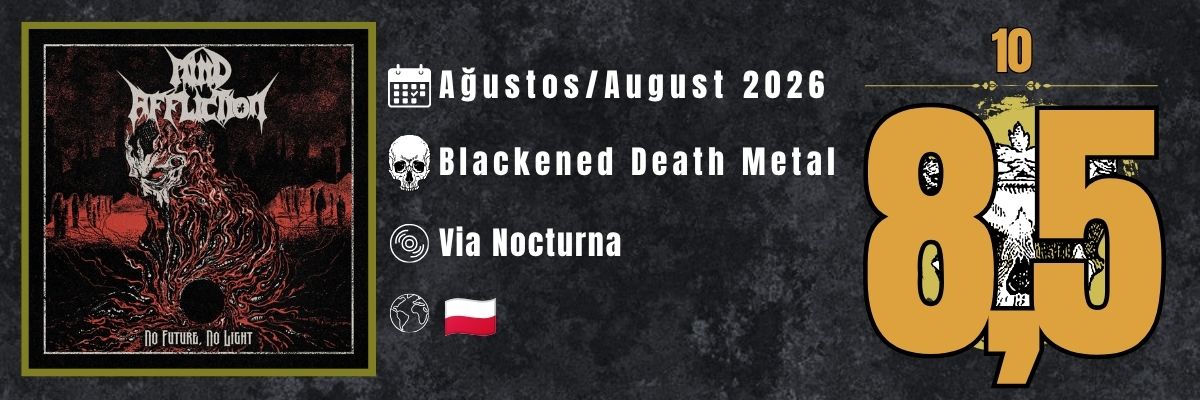
Kraków-based MIND AFFLICTION have a ten-year silence in their discography. Following 2016's "Into the Void", "No Future, No Light" was released on August 21, 2026, via Via Nocturna, marking the band's return with their third studio album after this extended hiatus. What is most striking here, however, is that the comeback is not driven by nostalgia for the past. Instead, the album tightens, intensifies, and suffocates the line MIND AFFLICTION have drawn between death metal and black metal.
The band's musical foundation places the physical weight of death metal alongside the cold atmosphere of black metal. Progressive structures and densely layered arrangements are added to the mix. The impressive thing about "No Future, No Light" is that none of these elements overwhelms the others. Technicality never becomes showmanship, while atmosphere never feels merely decorative. The riffs are often built around direct aggression, with melodic sections and slower transitions providing moments for the songs to breathe. This contrast prevents the album's darkness from being generated solely through speed or sheer distortion.
The guitar writing is one of the album's defining elements in particular. MIND AFFLICTION combine the crushing riffs of death metal with the colder, more threatening guitar character of black metal. The memorability of those riffs is important here as well; this is not an extreme metal record carried by technical precision alone. The aggressive guitar movements that emerge during the faster sections take on a more distinctive character when set against the melodic passages. Blast beat-driven drums keep pushing the music forward, while the pressure does not disappear when the tempo drops during the heavier, more atmospheric sections. Instead, the intensity simply changes form.
This is especially evident on 'Festering Dreams'. Stretching across nine minutes, the track does not rush as it moves between aggressive riffs and atmospheric sections. A natural connection emerges between the song's increasingly dense musical structure and its lyrical exploration of mass psychology, the dissolution of the individual within a crowd, and the transformation of cruelty into a kind of ritual. The track's strength lies not simply in its length or its shifts, but in its ability to sustain tension without confining itself to a single tempo.

The album's lyrical world also offers more than a simple extension of its musical darkness. 'Purified Maggots' focuses on a state of mind in which numbness is accepted as a form of comfort, while 'Eons of Blindness' deals with a cycle of violence and destruction repeating itself in different forms. 'Futureless', meanwhile, looks toward a world in which propaganda and noise erode the bonds holding society together. The limited possibility of hope that appears toward the end of the track is particularly significant; rather than presenting the album's darkness as an absolute aesthetic pose, it leaves the listener to decide whether that possibility is real.
'Niebyt' represents the album's more inward-looking side. Sung in Polish, the track takes an increasingly deepening examination of thought, selfhood, and existence toward the complete dissolution of identity. The issue here is not simply despair, but the gradual disappearance of the ground on which the subject can define itself. The darkness of the song therefore does not arise from an external threat, but from thought folding in upon itself. 'Awakening', meanwhile, offers an apparently opposite but equally unsettling version of this idea: awakening does not feel like salvation, but rather the re-emergence of something older and more threatening.
Toward the latter part of the album, 'Reckoning' and 'Vishe III' continue this psychological and existential thread in different ways. The former addresses punishment and reckoning more directly, while its Polish-language closing section pulls the music toward something colder. 'Vishe III', meanwhile, refuses to establish where the source of the unraveling lies; it remains unclear whether it is the character's world or their mind that is falling apart. That ambiguity fits the album's overall approach. MIND AFFLICTION prefer to leave an unsettling possibility open rather than explain it away.
There is also a measured approach to the use of progressive elements. The multilayered arrangements and technical details never overshadow the music's fundamental aggression. This matters because, within blackened death metal, technicality can easily become a spectacle in its own right. MIND AFFLICTION instead use structural variation to expand the dark atmosphere of their songs. The album therefore does not become complicated for the sake of complexity; its shifts serve to establish musical tension in different ways.
The production supports this density as well. The production, mixing, and mastering handled by Dominik Burzym at Studio 67 allow the instruments to move freely within the album's dense framework. Rather than creating the sensation of uncontrolled noise in which every detail is completely buried, this density produces a cohesive sound that brings out the physical weight of the riffs and drums. The presence of melodic and atmospheric sections becomes important for the same reason, providing contrast against the album's consistently high energy and increasing the impact of its heavier passages.
The most convincing aspect of "No Future, No Light" is the way MIND AFFLICTION merge their various genre components within the same compositional logic rather than presenting them as separate features. The technical and crushing side of death metal, the coldness of black metal, and the progressive approach do not remain isolated characteristics that can simply be pointed out one by one. Riffs, rhythm, atmosphere, and arrangement complement one another. After a decade away, the band are not so much inventing a new identity as compressing the language they had already established into something denser.
For that reason, "No Future, No Light" is not merely a comeback record that can be judged on heaviness or aggression alone. MIND AFFLICTION combine the physical force of brutal death metal with the atmospheric unease of black metal, while carrying the sense of collapse and dissolution present in the album's lyrical world into the music itself. The darkness here is not a surface-level aesthetic; it is a working principle that permeates the entire record, from the weight of the riffs and the tension between tempos to the melodic transitions and vocal approach. That is where the value of this return after a decade of silence lies: MIND AFFLICTION do not simply revive the sound they left behind; they rebuild it in a denser and more oppressive form.
