
ALBUM REVIEW
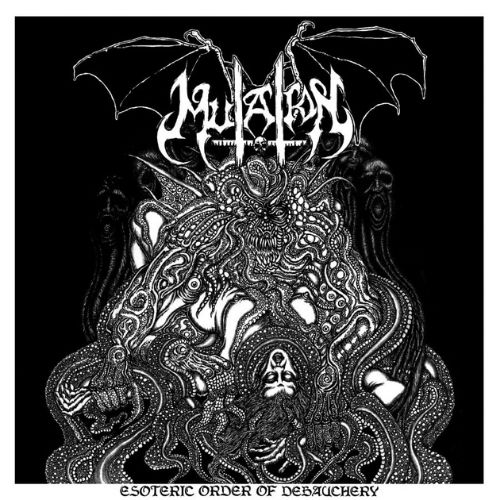
MUTATION - Esoteric Order of Debauchery
Old-school death metal regains its furious momentum.
Mutation’s approach on their “Demo ’23” openly embraced the period when death metal had yet to clearly define its own boundaries. “Esoteric Order of Debauchery” carries that same aesthetic foundation into a more expansive album format. The aim here is not to find a modern equivalent for old death metal, but to reactivate the unruly, aggressive, and not-yet-fully-tamed language of the genre’s formative years, when it was still intertwined with black metal and thrash, and turn it into a pure extreme metal attack.
That is why references to names such as Possessed, early DEATH and MORBID ANGEL, NECROVORE, MERCILESS, SLAYER, DARK ANGEL, MORBID SAINT, and PROTECTOR can be felt throughout virtually every part of the album. MUTATION makes no attempt to conceal these influences. In fact, it is often possible to hear just how directly certain riffs look toward specific bands or periods. But the album’s value does not lie solely in the accuracy of those references. What matters is how effectively this material is kept in motion across an eight-track whole.
The atmospheric introduction sets the album’s aesthetic framework by combining the tension of classic horror cinema with the sharpness of the guitars. ‘Occultation of the Ephemeral Light’ then lays out almost every weapon in MUTATION’s arsenal at once. As the guitars push forward through constantly shifting death/thrash riffs, the drums keep the track perpetually on the verge of losing control with blast beats, hard-hitting patterns, and high-speed transitions. Yet the recording never falls apart. The clearly audible bass guitar is particularly important here; rather than merely filling out the low end beneath the guitars, it functions as an active element that reinforces the sharpness of the rhythmic framework.
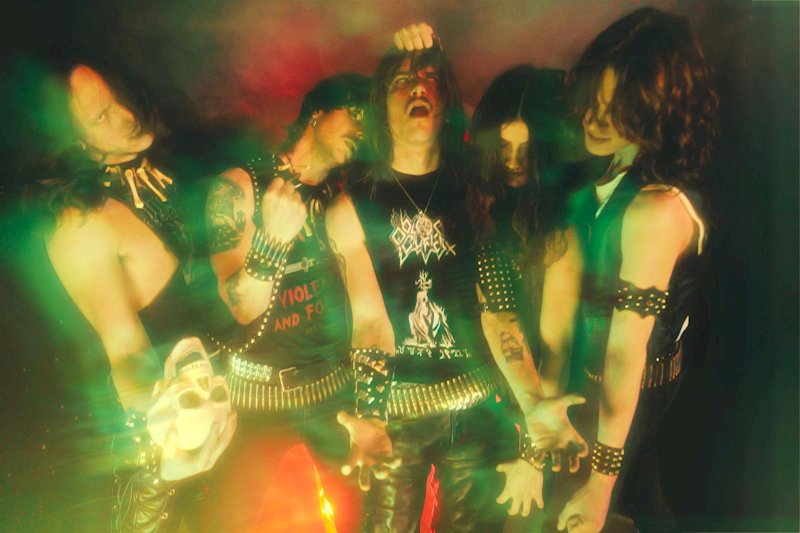
The vocal approach is equally central to the album’s character. N.S’s vocals, hovering around the mid-range while rising into a sharper register and occasionally approaching a scream, have a more aggressive and cutting character than a conventional death metal growl. This choice prevents the black metal influence from remaining confined to the riffs or visual aesthetic. Rather than simply sitting on top of the guitars, the vocals add another edge to the rhythmic turmoil they create. One of the key results of MUTATION rebuilding old-school death metal with a darker vocal character is precisely this.
‘Pestilent Whore’ is one of the clearest examples of the band not relying solely on speed. The use of two solos is particularly striking; one follows a more melodic line, while the other has a more chaotic and abrasive character. As a result, the solo sections cease to be decorative spaces reserved for technical display and instead push the song’s tension in different directions. The same applies to ‘Stygian Spheres’. The high-speed momentum of its riffs would not be nearly as effective without the solid foundation provided by the rhythm section. With the guitars constantly lunging forward, the way the bass and drums keep the track grounded helps explain the sense of control within the album’s faster passages.
One of the most important compositional qualities of “Esoteric Order of Debauchery” is precisely this sense of control. At first glance, the music seems intent on doing everything at once and at the highest possible level of intensity. Yet the songs never turn into a race for speed alone. At certain points, the tempo pulls back, the weight of the riffs comes forward, and then the acceleration resumes. ‘Metamorphosis (Beyond the Flesh)’ is particularly important in this regard. Its movement into slower, AUTOPSY-influenced territory shows that MUTATION can sustain the same aggressive character at different tempos. The slowdown here is not a moment of relief; it is a change in the shape of the tension.
This dynamism balances the album’s old-school character with a contemporary production approach. The recording does not pursue the cleanliness or sterile precision of modern extreme metal; the guitars, drums, and vocals still carry a raw physical impact. At the same time, there is a level of clarity that goes beyond the uncontrolled feel of a demo. The especially audible bass creates a rhythmic layer that does not disappear beneath the interaction between guitars and drums. In this way, “Esoteric Order of Debauchery” does not attempt to reproduce the recording aesthetic of the eighties verbatim, but instead makes the compositional instincts of that era functional under contemporary listening conditions.
MUTATION’s position at the intersection of black/death and death/thrash also becomes important here. The album reclaims the blurred territory of a period when extreme metal’s subgenres had yet to fully separate from one another. The high-pitched, sinister vocal approach drawn from black metal, thrash’s mobile riffing, and death metal’s heavier guitar language complement one another within the same compositions. This makes the music too mobile to be fully explained by the “old-school death metal” label alone, yet the movement between genres is not there simply to appear experimental. MUTATION’s aim is less to expand those boundaries than to recapture the energy of a time when they did not yet exist.
There is a natural cost to this approach as well. The wealth of references that makes the album compelling also inevitably raises questions about originality. Given how openly MUTATION acknowledges the sources they draw from, it would be difficult to regard “Esoteric Order of Debauchery” as a revolutionary work. But originality is not measured solely by the invention of riffs no one has heard before. What matters here is how effectively the band brings together the riffs within the tradition it has chosen and how vividly it keeps the songs alive. The album does not merely put pieces of the past on display; it sets them back in motion through tempo changes, riff variations, solos, and rhythmic shifts.
There is also a conspicuous lack of solemnity in this music, and that is not a drawback. By building death metal’s brutality around the direct physical impact of riffs rather than theatrical heaviness, MUTATION prevents “Esoteric Order of Debauchery” from becoming an overly gloomy exercise in nostalgia. The sinister atmosphere remains intact, but at the center of the music there is still a genuine fascination with riff writing. That is why the album’s strongest moments do not necessarily come where its references to metal history are most obvious, but where those references become functional within well-written songs.
While a significant part of contemporary underground death metal has increasingly gravitated toward slower, heavier, and more suffocating forms in recent years, MUTATION’s mobility gives the album a different kind of energy. Its violence is not built around sheer weight; it remains in constant motion through rhythm, tempo, and riff changes. Even when the band slows down, it does not lose that energy. Quite the opposite: the refusal to rely on speed constantly makes the faster sections hit harder.
“Esoteric Order of Debauchery” ultimately becomes less an attempt to propose a new death metal language than a demonstration of why the old one can still work. MUTATION’s achievement does not lie in how accurately they remember the references of four decades ago, but in how vividly they can keep those references alive within a coherent eight-track album. The riffs stick, the rhythm section keeps the music’s high velocity under control, the vocals sharpen the album’s blackened character, and the production keeps all these elements intelligible without resorting to unnecessary modernization.
In the end, “Esoteric Order of Debauchery” may be rooted in the past, but it does not remain merely an exercise in nostalgia. MUTATION have not yet developed a completely personal language that transcends their references; but for a debut, they accomplish something more important: they demonstrate a genuine understanding of the compositional logic behind the tradition they have chosen. The album’s lasting quality is not that it resurrects the eighties, but that it still knows how to use the elements that made the death metal of that era so mobile, riff-driven, and physical.

hellsheadbangers.com
facebook.com/hellsheadbangers
hellsheadbangers.bandcamp.com
instagram.com/hellsheadbangers
twitter.com/hellshead666
youtube.com/user/hellsheadbangers666