ALBUM REVIEW
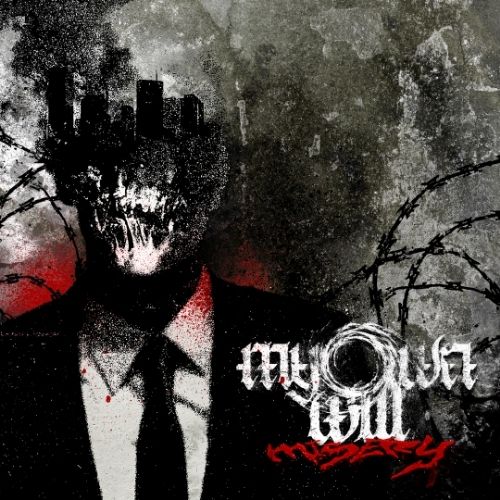
My Own Will - Misery
The Intersection of Deathcore and Metalcore
My Own Will represents one of the more characteristic yet distinctly stamped examples of the rising American underground in recent years, shaped by an aggressive language operating at the intersection of modern deathcore and metalcore. The Misery EP constructs a compositional strategy centered on intensity, groove, and breakdown-driven mechanics within the constraints of a short format, compressing this hybrid aesthetic into a tightly packed expressive field. This review examines not only what the EP delivers, but also how that delivery resonates within the contemporary extreme metal context.
“Misery” builds a structure that pulls the now-standard hybrid writing approach of modern deathcore and metalcore away from the idea of “stylistic stacking” and instead compresses it into a short-form framework. Spanning four tracks and barely exceeding 13 minutes, the EP does not aim for long-form compositional ambition, but instead constructs a “quick-impact” model driven by riff density, tempo shifts, and breakdown engineering.
The opening track “Misery” clearly defines the overall compositional architecture: a cyclical structure that moves from mid-tempo stomp riffs into blast- and double-kick-supported accelerations, before returning to a grounded central weight. The guitars operate with high gain, low-to-mid register palm-muted staccato articulations; the riffs function less as linear melodic development and more as rhythmic blocks. On drums, the use of double kick is not merely a tool for increasing speed, but also for disrupting BPM perception within the same riff cycle. This disruption keeps the track’s sense of “fast or slow?” in constant suspension, although these transitions often reframe existing material rather than transforming the riff writing itself.
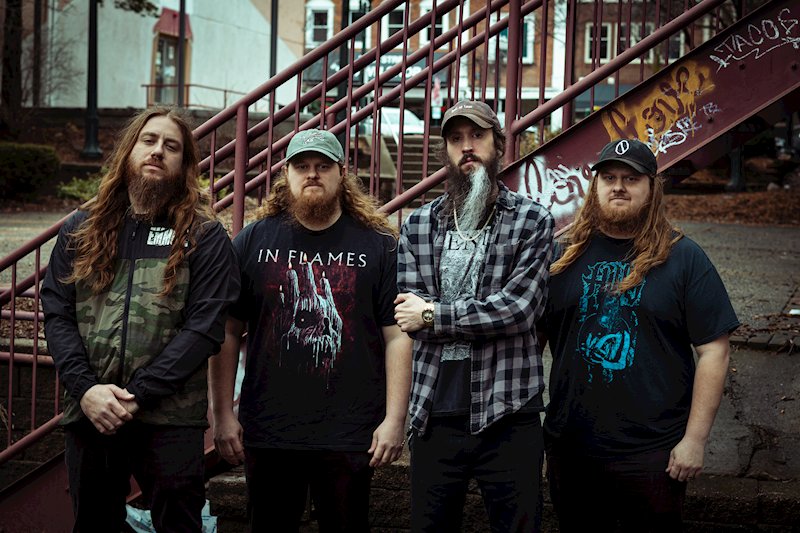
The vocal approach stands as one of the most defining layers of the EP’s identity in this opening track. Dave Keoppen’s performance moves continuously between hardcore-inflected screaming articulation and a semi-growl range that approaches death metal territory. In particular, certain hoarse, semi-sustained low vocal passages aim to weigh down breakdown sections not only rhythmically but also in terms of frequency spectrum density. However, this vocal diversity does not always translate into a corresponding expansion of the compositional framework; more often, different vocal “layers” are simply stacked over the same rhythmic foundation.
“Rorschach” operates through a more pronounced cyclical riff logic. The guitar writing here is built around circular groove motifs rather than linear progression; the riff generates intensity through repetition rather than forward motion. The bass being pushed into a more audible role strengthens the groove presence, particularly in mid-paced sections. However, this sense of groove tends to rely less on new harmonic ideas and more on re-presenting the same riff core at varying dynamic levels. The synchronization between staccato guitar cuts and snare accents creates a physical, hardcore-leaning response mechanism.
“Forsaken” stands out through the introduction of electronic/digital effects. Structurally, these elements function less as devices that redirect the riffs and more as surface-layer intensifiers for transition points. Combined with a djent-adjacent compressed low-end palm-muted guitar tone, they create an atmospheric “pressure field,” though this tension primarily serves as a setup for breakdown sections. In this sense, the electronic textures do not operate as a parameter that reshapes the compositional direction, but rather as an addition that amplifies contrast within the existing dynamics. The critical question therefore emerges: does this sound design expand the EP’s compositional logic, or merely intensify its existing formula? “Forsaken” largely leans toward the latter.
The final track “Phobos” encapsulates the EP’s overall aesthetic intent most clearly. The guitar layers are more crush-oriented, with emphasis placed on weight rather than riff articulation. The drums adopt a more spacious approach; the gaps between fills and transitions create a comparatively open structure when measured against the EP’s earlier constant-intensity strategy. While this openness suggests a more mature handling of dynamics, it functions less as a new compositional idea and more as a closing gesture that allows the EP to “breathe” at its endpoint.
On the production side, the work credited to Max Kushner and Cody Stewart sits firmly within contemporary deathcore/metalcore mixing standards: guitars are concentrated in the low-mid frequencies, drums are pushed forward through kick and snare attack, and vocals remain anchored to the central mix axis. Christian Donaldson’s mastering approach compresses the overall sound wall, narrowing the dynamic range of the EP; this reinforces its sense of continuous assault while simultaneously flattening some of the micro-dynamic movement.
At this point, Misery’s position within the scene becomes clear: the EP operates within a relatively safe zone of modern metalcore and deathcore built around the groove + breakdown + tempo-shift triangle. Hardcore-derived rhythmic aggression merges with death metal tonal weight, yet this fusion more often produces variations of an existing language rather than generating a new compositional vocabulary. Electronic textures and brief atmospheric breaks carry the potential to expand this framework, but in practice they do not rewrite the structural foundation of the tracks.
Ultimately, Misery functions as an EP built on short-term intensity and immediate impact. It offers rapid transitions, frequent breakdown placement, and rhythmic variety rather than long-term structural development. However, this variety largely circulates within the same compositional logic: riffs are not expanded, but rather repackaged. This situates the EP within contemporary extreme metal as an effective yet limited-scope exercise in intensity—defined not by the presence of ideas themselves, but by how far those ideas are actually pushed.
OZAN