
ALBUM REVIEW
SHRINEBURNER - Hymns Of Despair
Expands doom’s darkness with psychedelic depth and melody.
Chicago’s metal scene has been the starting point for SHRINEBURNER, a project Peter Norman and Brent Favata formed in 2023 as an outlet for heavy, repetition-driven music, but it did not take long for them to expand that initial vision. On the "Solitude" EP, the duo shaped the grinding weight of doom and sludge into something approaching a mantra, while "The Burden" began introducing time changes, psychedelic textures, and black metal influences into the framework. "Hymns Of Despair" is not simply a louder continuation of that progression; with the lineup expanding to three members, it is the first full-length expression of a songwriting approach that has clearly branched out.
The most important consequence of this change is that SHRINEBURNER has not abandoned the constant rumble at the center of its earlier material, but it no longer treats that rumble as an end in itself. CJ Johnson’s bass and Edward Hamel’s drums do more than simply add weight beneath Peter Norman’s guitars; they expand the room in which the riffs can move. The low-frequency mass of the guitar and bass remains at the physical center of the music, while the drums continually reshape the tension within that mass through minimal fills and heavy use of crash cymbals. The result is a more dynamic structure that preserves the lumbering momentum of doom/sludge without allowing the songs to fuse into one enormous block.
At this point, the genre references on "Hymns Of Despair" also become more meaningful. Doom and sludge form the backbone, but the compositions occasionally open themselves to the ritualistic weight of doom-death metal, the raw aggression of black metal, and the perception-expanding repetition of psychedelic/cosmic rock. Yet SHRINEBURNER’s real achievement is not in displaying these influences individually. By folding their different characters into the same riffing logic, the band creates a broader dramatic range without sacrificing the music’s hypnotic quality.

The album’s movement from tranquility into tension, beginning with 'Void Of Guilt', is a good example of this approach. "Hymns Of Despair" repeatedly establishes a controlled sense of anticipation before surrendering that restraint to harsher passages. 'Spectral Cataclysm' makes this rupture particularly apparent, while Norman’s vocals function not as something layered onto the guitars afterward, but as another face of the same dark mass. His muffled, expansive, commanding vocal character completes the music’s apocalyptic atmosphere in lines such as 'Cold sun, fall to earth' and 'Burn the wealthy, begin the war'. The lyrics’ focus on organized religion, collapse, war, death, and existential anxiety therefore does not create a narrative detached from the music; it points toward the same world evoked by the guitars’ constant movement toward greater heaviness and intensity.
One of the album’s notable qualities is that this darkness never eliminates melody. 'Bodies Dragged To Sunlight' is the clearest example. Beneath the song’s harsh vocals, thick distortion, and heavy rhythmic foundation lies a riff that is remarkably easy to retain. SHRINEBURNER uses melody here not as atmospheric decoration, but as a structural element that keeps the weight perceptible. That choice prevents the listener from being trapped inside a monotonous mass of frequencies even as the music continues to intensify.
'Slo(w) Death Chant' takes the band’s mantra concept a step further. The repeated lyrical phrases—'Pressure building / Creature dwelling / Churches burning'—merge with the music’s own cyclical character. Here, repetition moves beyond simply repeating a riff and approaches something ritualistic; rather than changing its meaning as the song progresses, the structure intensifies its effect. The subsequent 'We are dying to live' and the passage suggesting that light can emerge from darkness reveal a contrast SHRINEBURNER frequently draws upon musically as well: even within destruction, something melodic or uplifting can still emerge.
This contrast is equally apparent in the album’s lyrical world. While "Hymns Of Despair" circles around death, decay, disbelief, and meaninglessness, it does not produce an entirely nihilistic voice. 'An Ocean Of Broken Hope' is perhaps the best example. Short, fragmented phrases such as 'Dilated', 'Isolated', 'Devastated', and 'Drowning' turn the lyrics into almost rhythmic markers, while the passage 'We sail / On an ocean / Formed of ashes / And broken hope' creates a more expansive, spacious feeling than the aggression of the preceding tracks. This is where the album’s psychedelic and atmospheric tendencies make their contribution most apparent: the weight becomes not merely physical, but a form of mental pressure.
By the time 'Hymn Of Despair' brings the album to its close, that darkness intensifies once again. Fragmented repetitions such as 'Wraith / Melting in / Til you die' reduce the song’s narrative almost to the form of a ritual text, reinforcing the music’s growing sense of heaviness. Rather than attempting to explain the themes established throughout the album, the closing track compresses them. Death, decay, and annihilation become less the conclusion of a story than the final form of the album’s own language.
Production is another important part of this approach. Recorded and mixed by Matt Russell at Altered States and mastered by Edward Hamel at Identity Mastering, the album preserves SHRINEBURNER’s physical weight while also making the separation brought by the new lineup audible. The constantly shifting low frequencies of the guitars and bass form the body of the music, while the drums’ pronounced hits give that body its shape. The intensity does not come simply from the amount of distortion; it emerges from the way the instruments respond to one another within the same heavy space. As a result, the album’s “wall” approach becomes a more developed and flexible version of the mantra concept with which the band began.
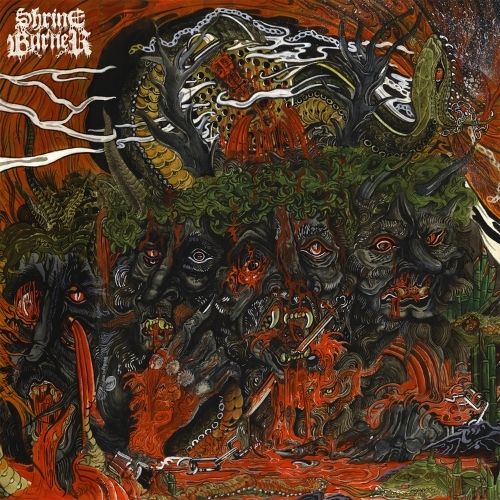
Joshua Hondros’ surreal depiction of hell on the cover also finds a direct visual counterpart in the music. Yet the darkness of the visual aesthetic does not represent the album’s only dimension. What makes "Hymns Of Despair" interesting is that it does not present despair solely as an overwhelming darkness; through melodic lines, psychedelic expansions, and moments that occasionally rise upward, it leaves room for movement within that darkness.
SHRINEBURNER’s first full-length should therefore not be read simply as a bigger, louder, or heavier recording. The repetition-driven doom/sludge core of the "Solitude" era is still alive here, but the contributions of the three-piece lineup allow the riffs to change direction more often, give the individual tracks more distinct personalities, and prevent the atmosphere from becoming locked into a single level of intensity. This is precisely where the album finds its value within the genre: it preserves the physical weight of doom/sludge while restructuring it through psychedelic expansion, blackened aggression, and melodic memory. SHRINEBURNER does not yet sound like a band that has exhausted all of its possibilities; the real excitement of "Hymns Of Despair" lies in showing just how much further this heavy core might still be expanded.

https://linktr.ee/shrineburner
https://shrineburner.bandcamp.com
https://www.instagram.com/shrineburnerband