ALBUM REVIEW
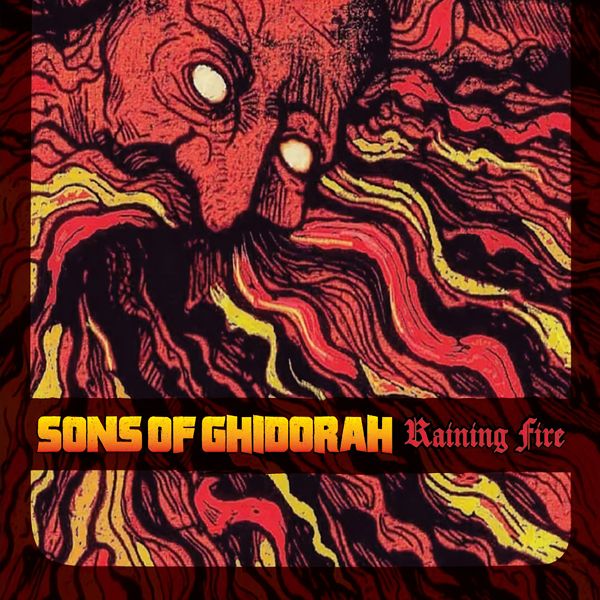
Sons of Ghidorah – Raining Fire
Walk Into Doom/Stoner
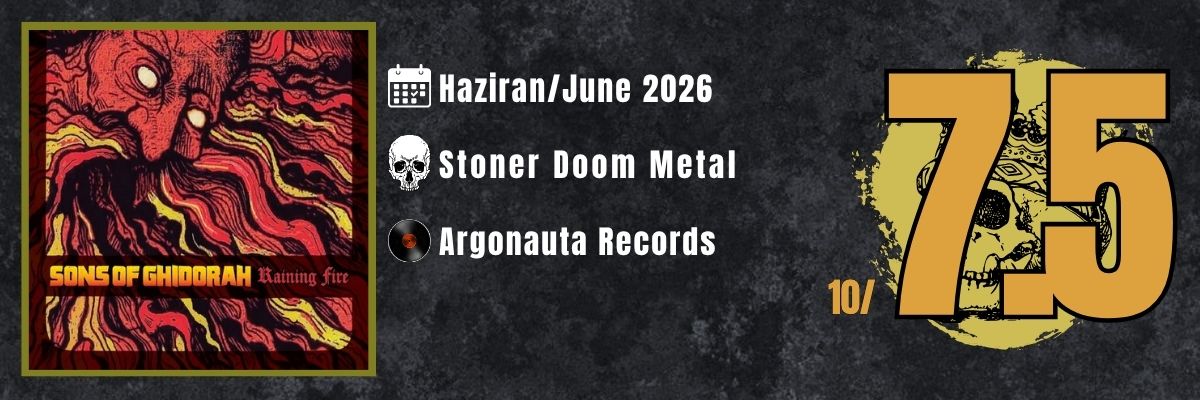
Sons of Ghidorah has been building a multilayered sound operating along the axes of doom, stoner rock and heavy psych since 2014. With Raining Fire, while retaining a classic riff aesthetic, the band moves toward a more flexible compositional approach that foregrounds structural shifts and micro-variations. The album positions itself as a work that remains within the boundaries of the genre while simultaneously testing how those boundaries can be stretched through riff writing.
More generally, the album constructs a framework that operates through continuous micro-shifts rather than a fixed doom/stoner block architecture. While the opening character does not completely abandon the mid-tempo, low-tuned guitar wall of classic stoner metal, the logic of riff repetition is non-linear; instead of a mechanical cycle of the same motif, a structure is preferred in which each return is reshaped through small harmonic or rhythmic deviations. This pushes the sense of “groove” away from a stable hypnosis toward a constantly shifting center of gravity.
In the guitar layers, the most prominent element is the way the main riff and peripheral guitar textures continuously shadow one another. The lead guitar line is often not positioned above the riff in the form of a solo, but instead as independent melodic fragments. These fragments are withdrawn before being fully developed, which indicates that the composition progresses through a flow of transient ideas rather than “completed” ones. This approach creates a deliberate tension with doom metal’s traditional heavy repetition aesthetic: while the weight remains constant, the form is in constant motion.
In the rhythm section, the drum writing leans toward a more fragmented groove logic rather than straight 4/4 doom marches. In particular, kick/snare placement introduces small accents that disrupt the stoner-based flow without allowing groove metal influence to become fully dominant. The role of the bass guitar is not limited to harmonic support; in certain sections it becomes the primary carrier of the riff, filling the gaps left by the guitars with a low-frequency “binding line.” This constitutes an important production decision that balances the hardness of the guitars within the mix.
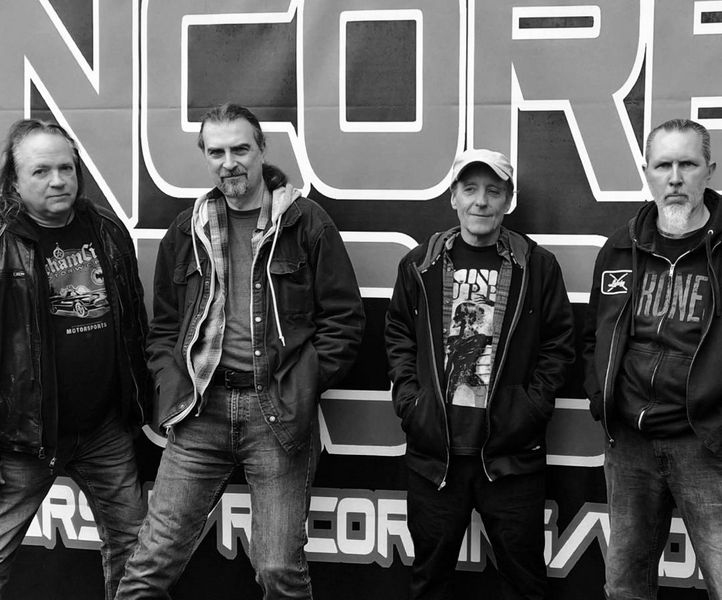
The vocal performance constructs a two-layered structure. Mark Giuliano’s vocals rely on a classic hard rock / early heavy metal articulation, occupying a clear narrative position above the riffs. Here, the vocal carries a more articulated and forward-driving character rather than the semi-monotone weight typical of doom tradition. The secondary vocal line, placed further in the background and performed by Christopher Konys, adds a softer texture rooted in grunge references, attempting to generate contrast rather than heaviness, particularly in chorus transitions. However, this dual-vocal approach does not always produce a fully dramatic opposition; in some passages, the two lines converge within the same frequency range and lose their potential for separation.
One of the most striking aspects of the album is that its heavy psych and proto-metal references are not merely surface-level stylistic markers, but elements that permeate the song structures. In particular, the “appearing and disappearing” nature of guitar melodies can be read as an attempt to re-articulate a 70s proto-metal approach within a modern stoner framework. However, this psychedelic dimension does not always become a force that redirects composition; more often, it remains a set of transient colors layered over an existing riff flow.
The production approach carries a deliberately unsterilized character. Rather than aggressive isolation between instruments, the sense of a collective performance is preserved. This choice particularly emphasizes the physical connection between rhythm guitar and bass. However, this raw aesthetic also limits detail resolution in certain sections; especially when guitar layers overlap, melodic micro-details are sometimes lost within the mix.
The album’s progressive tendencies are felt more through directional shifts between sections than through long-form structural development. Instead of progressing through linear build-ups, the tracks make brief detours into different characters around central riff cores. Some of these detours genuinely alter the direction of the composition, while others function merely as atmospheric transitions without producing structural weight.
Overall, Raining Fire constructs a framework that does not fully abandon the classic riff-repetition aesthetic of doom/stoner metal, but fractures it through small deviations and fragmentary melodic interventions. While some of these interventions genuinely redefine the direction of the tracks, a significant portion remains decorative layering that enriches but does not transform the existing groove flow. This creates the album’s most characteristic tension: a writing language that touches a wide stylistic spectrum, yet whose points of contact do not always develop into a central force capable of reorganizing the composition.
Raining Fire demands not passive background listening, but an active attention based on following riff transitions. However, rather than offering continuous structural reconfiguration in return for that attention, it often prefers to generate micro-variations around the same core riff logic. This positions the album within a “expanded stoner/doom vocabulary” of the scene—one that extends the lexicon, but does not rewrite it.
OZAN
https://www.facebook.com/SonsofGhidorah
https://www.facebook.com/ArgonautaRecords