ALBUM REVIEW
TRENCH WARFARE - Achtung! Destroy The Weak
Old-school death metal meets raw war metal.
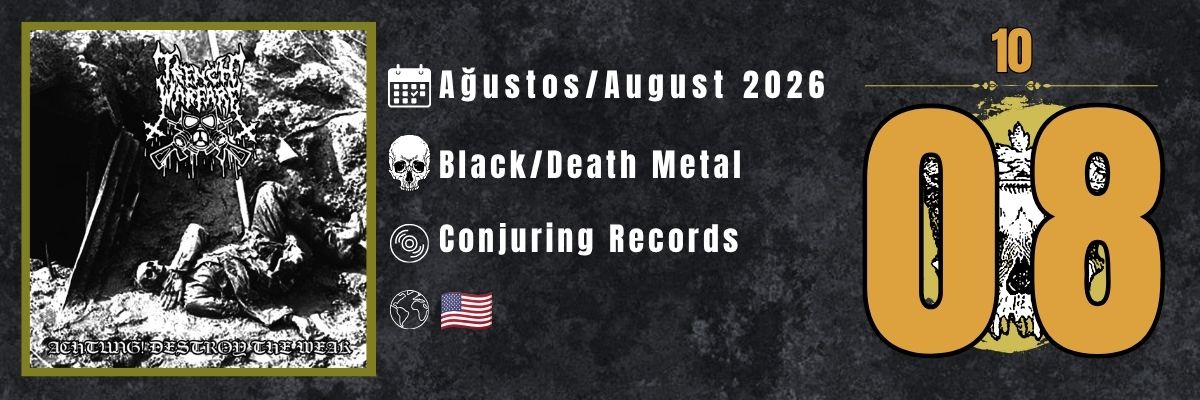
“Achtung! Destroy The Weak” draws its strength from the forceful style it creates by blurring the boundaries between the sledgehammer weight of death metal riffs and the aggressive rhythmic language of war metal. The guitars largely establish a thick, low-register body, while tremolo picking, blast beats, and accelerating passages continually drive that weight forward. The result is not simply a record that becomes aggressive because it is fast; it is a dense construction positioned somewhere between old-school death metal and war metal, where the mass of the rhythm guitars and the high-tempo drive of the drums work simultaneously.
The influence of classic death metal references such as MORBID ANGEL and DISMEMBER can be felt in the album’s guitar character, but TRENCH WARFARE pulls this material toward a more primitive and razor-sharp war metal aesthetic. Particularly in the faster sections, the combination of tremolo riffs and blast beats distances the compositions from the cleaner, more controlled approach of contemporary death metal. At the same time, the riffs do not settle for generating raw noise alone; there are also distinct melodic movements and guitar passages rooted in classic heavy/thrash. This detail matters because it prevents the album from building its aggression solely around distortion density or tempo.
Tony Goyang Jr. and Dustin Putz’s guitars make this traditional/chaotic contrast more apparent, particularly in the solo and lead sections. Although the solos remain rooted in old-school death metal, their more irregular and cutting character, rather than controlled melodic development, reinforces the overall instability of the songs. TRENCH WARFARE’s approach here is not to put guitar virtuosity at the forefront, but to absorb it into the martial atmosphere created by the riffs. As a result, the lead guitars never take over the center of the songs; they briefly disrupt the pressure generated by the main riffs before returning to the same structure.
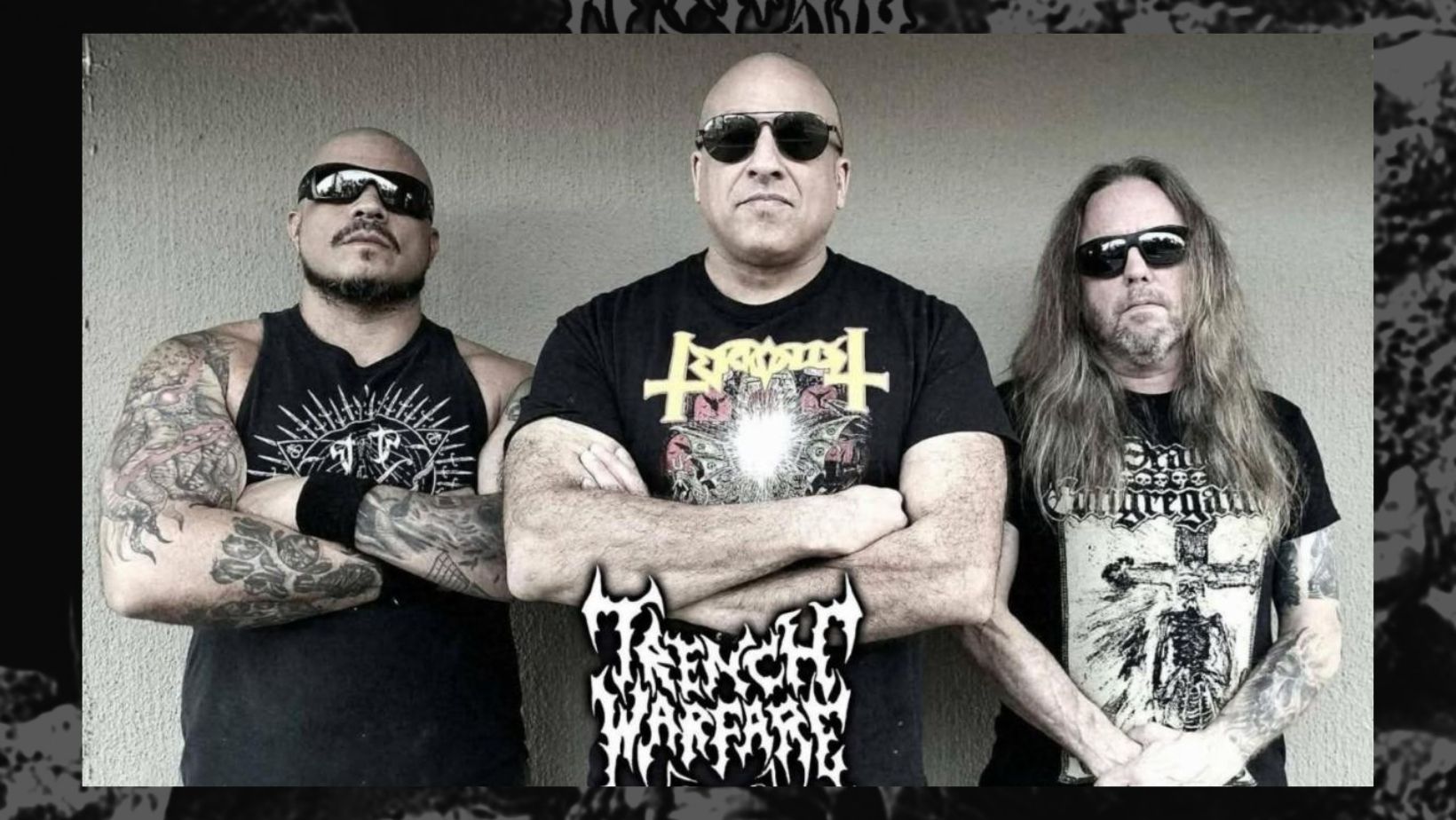
Jake Holmes’ bass performance and Ronnie Parmer’s drumming do not merely provide a backdrop for this guitar-heavy sound. Parmer’s use of blast beats and high-tempo drumming, in particular, sharpens the tremolo-driven passages while also emphasizing the rhythmic weight rooted in death metal. In the album’s faster sections, the interaction between drums and guitars creates an almost mechanical forward thrust, while the guitars’ mass comes to the forefront in the heavier passages. The compositions therefore build tension by moving between speed and weight rather than relying on a single tempo.
Jay H. Gorania’s vocals are directly tied to this musical approach as well. His mid-range, raw vocal style, rooted in old-school death/thrash, differs from the extremely deep, low growl aesthetic commonly found in modern death metal. This vocal approach, reminiscent of Martin Van Drunen’s early work, takes the aggression of the songs in a different direction when combined with the more bestial side of war metal. Because Gorania’s voice has not been sterilized within the production, it remains on the same aesthetic plane as the raw character of the guitars.
“Achtung! Destroy The Weak” follows a similar philosophy in its production. Recorded by John Petri and Justin McClenny and mixed by Jarrett Pritchard, the album carries a powerful, heavy sound without pursuing the immaculate separation favored by contemporary extreme metal production. A balance has been struck between giving the instruments sufficient weight and preserving their raw character. The recording therefore does not sacrifice detail in the name of sounding dirty; instead, the weight of the guitars, the physical impact of the drums, and the harshness of the vocals remain clearly defined within the same mix. This production choice is also central to TRENCH WARFARE’s ability to retain its war metal roots while moving toward the larger, fuller sonic world of death metal.
The most notable aspect of the song structures is that rather than presenting the transitions between genres as separate sections, the band dissolves them into the same riff language. “Follow the Circling Vultures” is a good example of this approach. The song’s battlefield and hunting metaphors do not remain confined to the lyrics; the combination of tremolo guitars, high-tempo drums, and raw vocals translates the physical movement of the narrative into the music. It is also significant that Gorania’s explanation of the song connects family, threat, and the pursuit of an enemy; war metal aesthetics are not being used merely as genre decoration here, but intertwined with personal and metaphorical layers. At the same time, the band’s lyrical world, with its direct use of images of war and power, risks approaching the clichés of the war metal scene. TRENCH WARFARE’s distinction lies in its attempt to connect these themes to personal references rather than simply listing the symbols expected from the genre.
The language extending from the album title to song titles such as “Might is Right,” “Fight and Die for the Bloodline,” and “You Will Bow to the King” is also part of this aesthetic coherence. The directness here does not conflict with the structure of the music; instead, it follows the same line as the unadorned, aggressive character of the riffs. Yet this is also where the limitations of the approach become apparent: TRENCH WARFARE’s identity is largely built from the already strongly defined symbols of war metal, old-school death metal, and black metal. The band rearranges this language and increases the death metal emphasis, but does not transform it into an entirely different compositional logic.
For precisely this reason, it would be incomplete to regard “Achtung! Destroy The Weak” solely as a war metal album. Although the aesthetic legacy of bands such as DEIPHAGO, DIOCLETIAN, GENOCIDE SHRINES, and TETRAGRAMMACIDE is clearly present, classic death metal remains TRENCH WARFARE’s true center of gravity. The influence of MORBID ANGEL and DISMEMBER embedded in the body of the riffs pulls the album toward a heavier, fuller, and more traditional death metal axis. Thrash metal, meanwhile, remains a complementary element, particularly in the vocal character, certain guitar movements, and rhythmic aggression. The genres therefore do not function as four equally weighted components; instead, they form a death metal-centered structure hardened by war, black, and thrash elements.
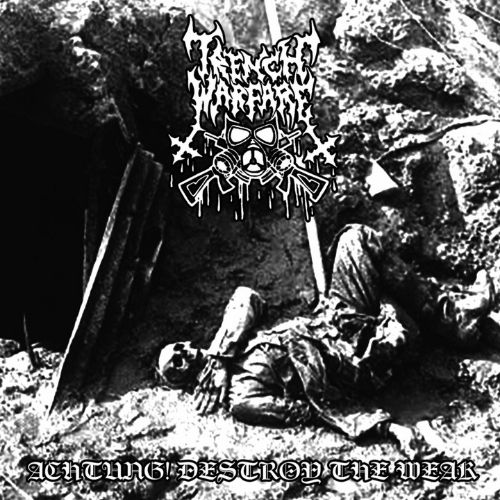
The album’s visual and lyrical framework is also consistent with these musical choices. The title “Achtung! Destroy The Weak,” the lyrics built around bloodline, war, power, and hostility, and the raw death/war metal character of the compositions all speak the same aesthetic language. The visual and thematic elements do not step in front of the music to create a separate concept; rather, they support the existing riff and production philosophy. This strengthens the album’s cohesion while also showing that TRENCH WARFARE consciously remains within the boundaries of a traditional extreme metal aesthetic.
“Achtung! Destroy The Weak” is therefore not a record attempting to break down genre boundaries. More interesting is the way the band re-centers war metal’s raw, primitive energy around the riff weight of classic death metal. The melodic movements of the guitars, the constant pressure of the blast beats, Ronnie Parmer’s physical drumming, Jake Holmes’ contribution to the rhythmic backbone, and Jay H. Gorania’s old-school vocals all serve the same purpose: to build a heavy, fast, and sharp extreme metal sound without embellishment.
This is an album that asks its listener not to look for experimental structural ruptures, but to follow the layers within the riffs and the constant tension between death metal and war metal. TRENCH WARFARE’s real achievement lies there: binding different traditions together within the same riff architecture without altering the genre’s fundamental rules. “Achtung! Destroy The Weak” uses its old-school approach not merely as a nostalgic preference in opposition to the more polished and technical tendencies of contemporary extreme metal, but as a direct compositional principle, reinforcing the boundaries it has chosen rather than expanding them.

https://trenchwarfaretx.bandcamp.com/